

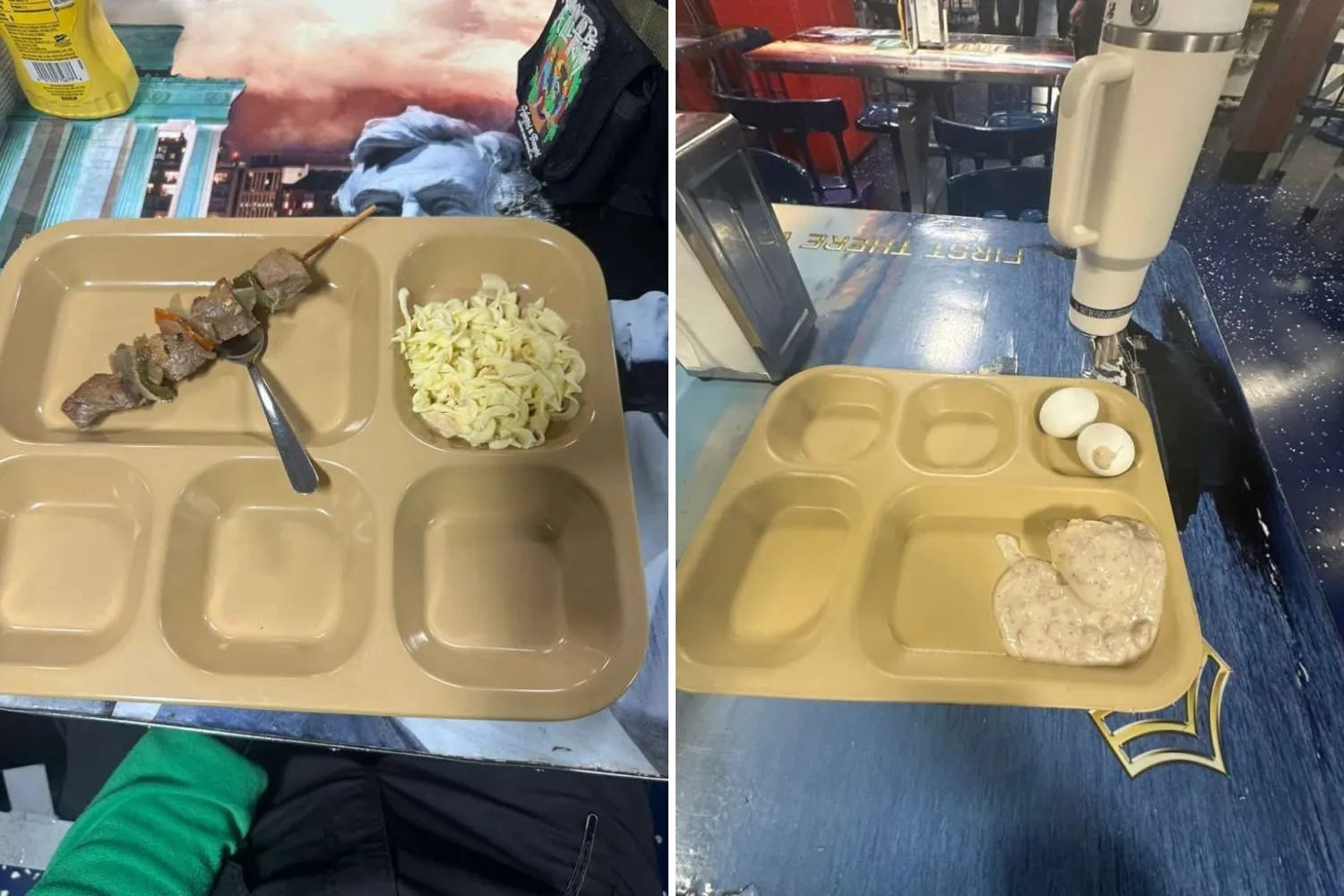
There’s a big food story from the Trump administration this week. It goes right back to the Eating on Board story from a few weeks ago here on Eating In America. I did a podcast and post in conjunction with the Tall Ships that sailed the East Coast in honor of America’s 250th birthday. We talked then about the role of food in keeping up the morale of sailors, and that very topic has exploded with the retreat of the USS Lincoln from the Iran War theater due to the political cost of further deployment while the ship is struggling to feed its troops.
Today, the exposure of our sailors and Marines at sea in the Middle East to inadequate food and deteriorating morale is risky for them and the forces they support in an ill-conceived, unauthorized, unpopular war that is bleeding our resources and endangering our troops, nation, the world, and innocent civilians in many countries without a clear, believable goal.
Trump’s war in the Middle East is a disaster. There are tens of thousands of sailors and Marines at sea who are, or could be, in harm’s way. Several sailors on the Lincoln have attempted suicide. The Navy knows how to feed them in the best possible manner for deployment at sea, but the system is failing these troops.
Weight-loss is not meant as an enticement to enlist
Diet profiteers are everywhere in our society, but weight-loss is not meant to be a benefit of enlistment. It’s a cruel joke, but I wouldn’t put it past Trump to say it in public, given his complete public dismissal of the problems brought to light on the USS Abraham Lincoln and the USS Tripoli. There are multiple reports of severe weight loss and consequent reduction of physical and mental fitness among sailors and Marines aboard vessels deployed to the Middle East. These troops are not being served enough food, and the food they are being served is often not appetizing, but they are expected to do their jobs and be ready for attack in an ongoing war.
Seven tons of food a day
I visited the USS Intrepid, a huge floating museum, in New York City two weeks ago. The aircraft carrier, which saw action in World War II and the Vietnam War, was crewed by up to 3,400 troops. The men on the Intrepid required seven tons of food each day. That’s 14,000 pounds of food.
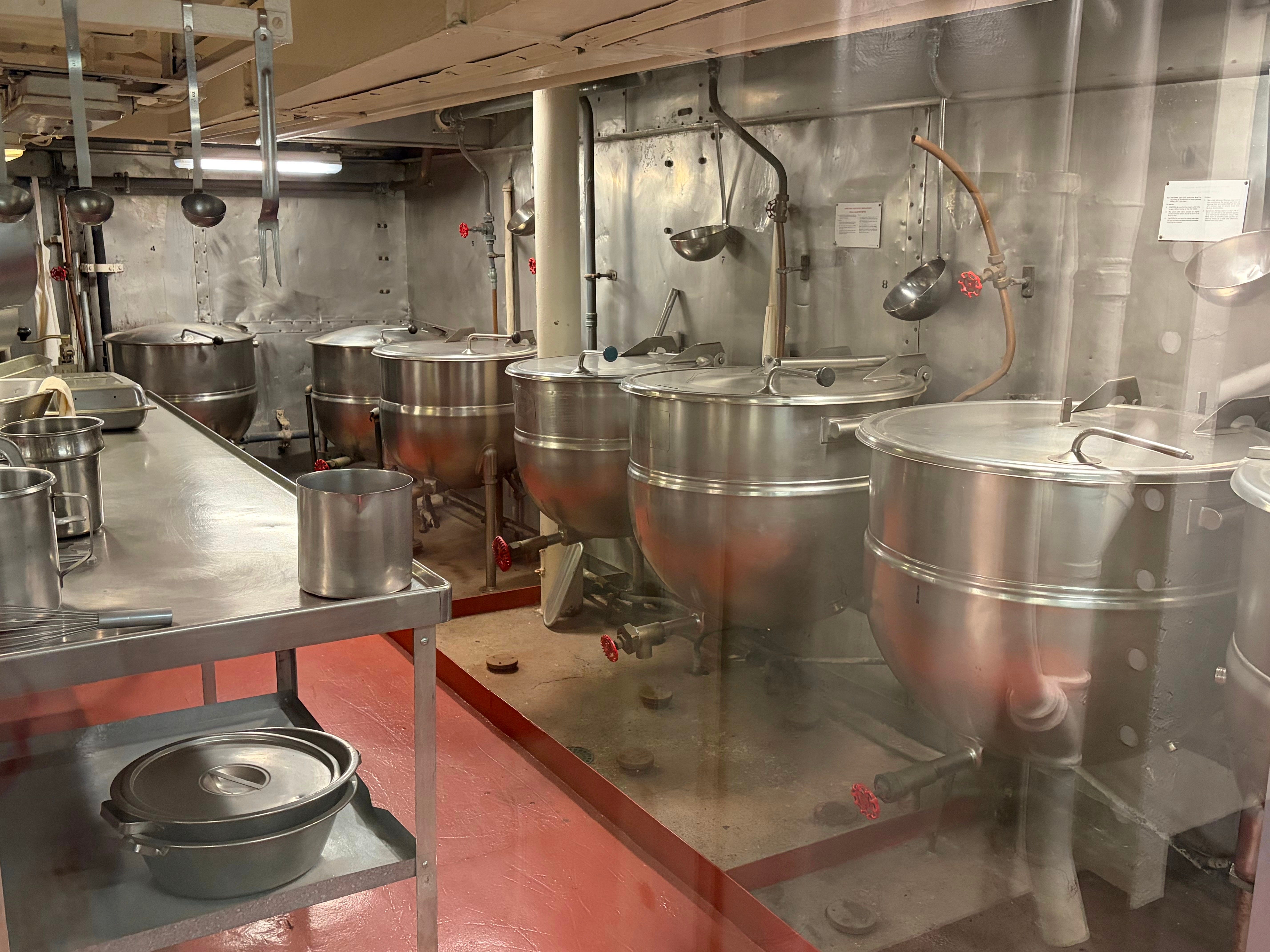
Navies have known for millennia the importance of food for morale and to keep up health, both physical and mental. Food planning has always been fundamental. Even on voyages of Greek mythology, food shortages were deadly, as we’re reminded in several scenes of the new movie re-telling of the Odyssey.
Napoleon Bonaparte invented the processing of canning fruits and vegetables for his sailors. Similarly, his nephew, Napoleon III invented margarine to replace butter, which could only last one week at sea.
The armed services know exactly what they are doing with food
The U.S. military devotes significant resources to optimizing the food and nutrition provided to its troops. The Food Utilization and Energy Laboratory (FUEL) provides the Navy with hard science on warfighter nutrition for high-stress environments, energy utilization, and performance optimization. During World War II the Natick Soldier Systems Center outside Boston developed many ultra-processed foods with the goal of keeping troops fed in heat, cold, and stressful conditions.
I visited the Natick Soldier Systems Center a few years back to investigate research being done there to optimize the gut microbiome for combat performance. It is a little ironic that the very lab that invented foods that could disrupt the gut microbiome was now inventing foods to optimize that biome. But it was all being done with the goal of helping our fighting forces survive combat
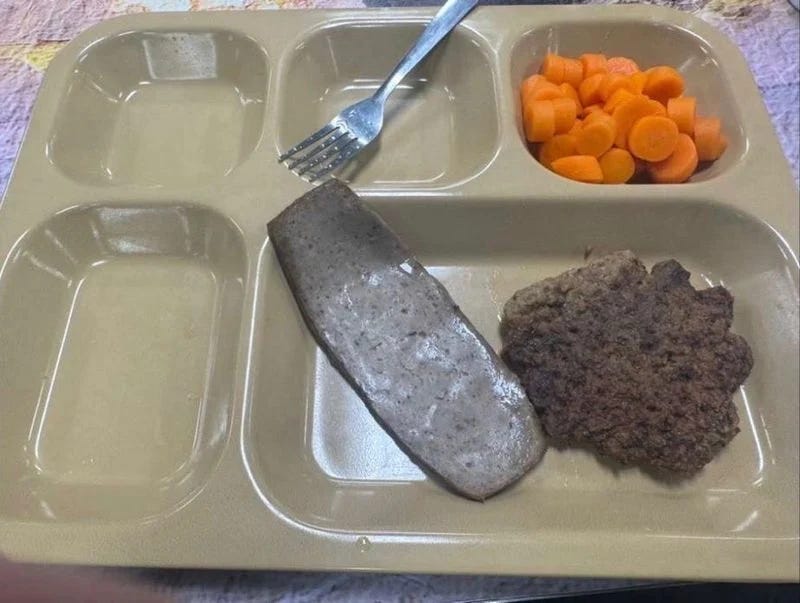
.So the Navy knows exactly what and how much food stuffs to put on board every vessel from an aircraft carrier to a submarine and how that food can best be prepared for purposes of morale, physical health, strength, and energy. They know how much fresh food they can leave port with and how much must be canned, frozen, dehydrated, or dry. What a military food scientist cannot know is the exact nature of the bad conditions that will occur in a war, and conditions have gotten bad in the war on Iran.
Persian Gulf Navy supply hub was a predictable Iranian target
The Iranians destroyed the functionality of the U.S. supply hub on the island of Bahrain in the Persian Gulf, directly across from Iran. Trump should have taken into account, and maybe he did, that this was a vulnerable and likely target for Iran’s missiles. After the depot’s destruction early in the war, the logistics and supply hub had to be moved 2,200 miles away to Diego Garcia in the Pacific. Replenishment of food, weapons, and other supplies became a massive problem, which likely played a large part in the morale crises on board the Lincoln and the Tripoli.
Morale on board reflective of events and attitudes at home?
Also, I suspect – there is little hard data, although some investigators like NPR have made a good case – that decisions in the White House and Pentagon, an upheaval of culture in the military with a downgrading of minorities and women in promotions, political firings, dissatisfaction of the American public, uncertainty about the Iranian war goals, and constant shifting in strategy have been factors in the downward direction of morale. Remember, the Commander in Chief of our armed forces has called troops who gave their lives fighting for America in World War II “suckers” and “losers.”
What is certain is that the chef in charge on a navy vessel is likely to be highly experienced, extremely well-organized, very creative, and absolutely dedicated to his or her role in boosting the morale of the troops eating his or her food.
A sailor testifies to the importance of food on board ship
Here is a former enlisted seaman, who said his name is “Joe,” describing the role of a sailor’s meals at sea. I recorded him as he was about to board the USS Intrepid aircraft carrier:
Your morale is directly tied to food. I was on a small ship, a destroyer, DDG-64 [the USS Carney], so we had usually a bit of a better quality of life for food ‘cause our cooks weren’t making meals for 5,000 people. They had to do 300. So our food was a little bit better quality. We knew our cooks. We talked to them every day, gave them hell when they messed something up. When the food was good, it was great. It made us a lot happier. It was also a great way of telling what day of the week it was. Tuesday is tacos, burger Wednesdays, pizza Fridays, Sunday was brunch. And if you forget everything else out there, as soon as you get burgers for lunch, you know, okay it’s Wednesday. That’s what’s going on now.

Last week Retired Chief Petty Officer Thomas Nutzmann described being at sea in the Navy Times: “There’s no Monday, Tuesday, Wednesday, it’s just a day…You can only do so much to keep morale up before you hit a stalemate … and that’s where the deterioration is.”
Four million meals in nine months at sea
Since the USS Abraham Lincoln was deployed in November, the seven galleys on board have served about 4 million meals. That’s a small miracle in itself, but with troops going so hungry they are losing 20 to 30 pounds on a deployment that is not yet over, that’s a major system failure.
Let them eat steak and lobsters, like they deserve
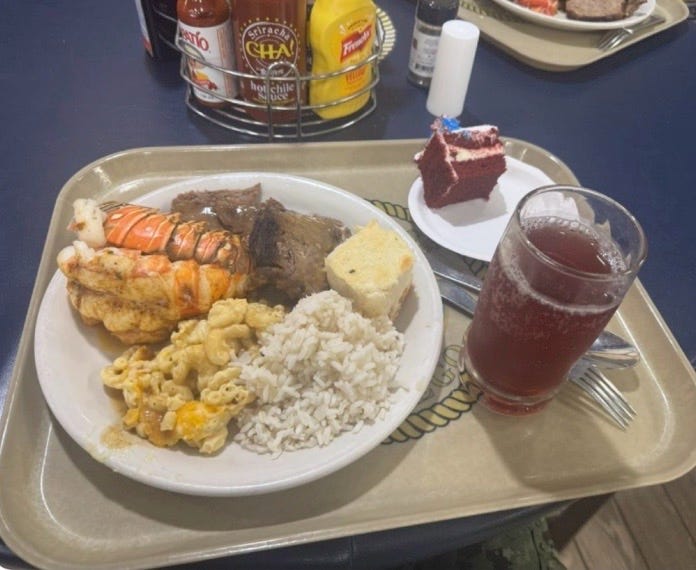
It seems unprecedented and an indicator of how arbitrary and unpopular the Iran War is, but the Lincoln is now sailing home from the Middle East, on the strong winds of public outrage and media attention. I hope at some point before they get to port, the Lincoln will be able to get a few thousand ribeyes on board and just as many lobsters to give the sailors and Marines the Navy’s traditional steak and lobster dinner to thank them for their extended service.
Thank you for reading. Sharing this post with your friends and subscribing or upgrading your subscription will help Eating in America continue to grow and is appreciated.


