
A bright ray of hope shone on the breakfast table while visiting friends this morning.
Two weeks ago I reviewed Sugar Coated, Unboxing the Hidden Forces Shaping America’s Favorite Breakfast Food, Marion Nestle and Lisa Sutherland’s new telling of the transformation of a 19th century health food, un-sugared granola, into a keystone of the American ultraprocessed food diet. The Kellogg brothers’ of the 1870s, launched as disciples into the American food environment by the fervently health-preaching Seventh-day Adventist church, started a lineage that one-hundred years later resulted in the bastardized, unholy, unhealthy Kellogg’s Froot Loops of 1963 with its 12 grams of added sugar, bright artificial colors, refined flours, and child-targeting Toucan Sam mascot.
Today’s food environment: gone to hell in a shopping cart
Since 1963 it’s been sixty years of the American food environment generally going to hell in a shopping cart, but, praise be to Nestle and Sutherland, the first a deity in matters of nutrition policy, the descent into ultraprocessed Hades turns out to be a two-way path!
Uncommonly intutive pre-schoolers
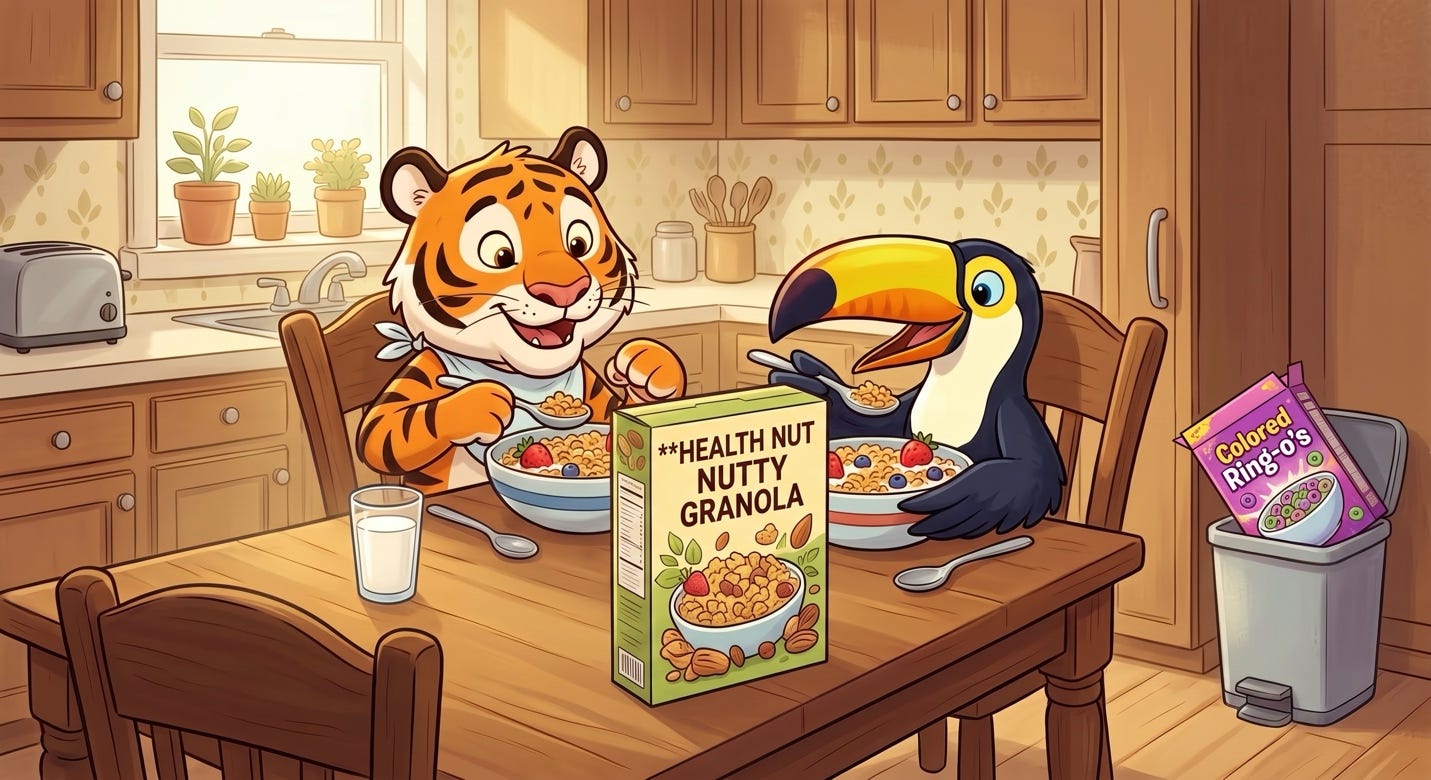
My friends, let’s call them Pop and Mima just as their three- and five-year-old grandchildren do, made a point of eating healthy breakfasts every day. But Pop and Mima first and foremost, love their grandkids and understand the license that grandparents have in making sure the adoring love of the little ones pours back in return. So Froot Loops were acquired for the first morning of a four-day stay of the preschoolers with Pop and Mima. On the morning of the first day, Pop poured himself a bowl of granola, while Mima got ready to pour two bowls of Froot Loops for the little ones. Lo and behold, at Pop’s first bite, adoring Child 1 said “I want what Pop is having” and adoring Child 2 said “Me, too!” And granola, with yogurt, fruit, and a little drizzle of maple syrup to seal the deal, is all the four of them ate every day for breakfast. Pop and Mima, your medal is in the mail.
Pop and Mima deserve a medal
In my experience as a parent there is little precedent for Pop and Mima’s granola magic. It was a breakfast miracle. There is hope.
The coffee pot
Today it’s Breakfast in America on Eating in America, or at least, perhaps, Part One, since, as you will see, I don’t get far on the breakfast menu. We’re going to start where many of us start our day: at the coffee pot.
And a lot of Americans drink coffee: ¾ of us. Half of us drink it every day. 1 And mostly in the morning. For some people, breakfast is only coffee.
It is not my fault or your fault
These days as the writer of Eating In America, I feel like I’m the bearer of bad news far too much. It’s not really my fault: I am not a wellness influencer peddling hope in exchange for clicks, and neither you nor I are responsible for screwing up the food environment. We’re both just figuring out how to do the best for ourselves and our families with the food we are dealt. And, when I write about the politics and the commercial side of our food environment, it’s about who we can blame, boycott, or vote against, all of which feels better and is far more accurate than blaming ourselves.
Coffee: the dependable feel good nutrition story
But when I write about coffee and tea, it’s a happy, feel good story, with the science continuing to tell us that these beverages that most of us enjoy and that make us feel good, are, in fact, good for us.
And the science keeps coming.


