


The biology of cholesterol and other harmful lipids is complicated, but the basic recommendations about control of your lipids are not. First, eat and behave healthy. I’ll go over what that means.
Second, diagnose and treat out-of-balance lipids early, very early, and with rigor, particularly LDL, or low-density lipoprotein, the “bad” cholesterol.
Beyond those few words there is a lot of detail and nuance, depending on you. The Cholesterol Guidelines were updated in March in important ways, so I will get into some of what this means.
Introducing the Dyslipidemia Guidelines
First, we can no longer talk about cholesterol guidelines. Cholesterol, both “bad” and HDL, the high-density lipoprotein, is now seen as part of a bigger lipid picture that describes your risk of cardiovascular disease, that is heart disease and stroke, caused by plaque buildup in your arteries.
Because of the new Guidelines, we need to upgrade to the big, fancy word, dyslipidemia, a six-syllable word that just rolls off the tongue, to describe what we want to avoid to preserve our heart health. Dyslipidemia means dysfunctioning in the body’s control of the lipids in our blood.
Cholesterol is essential to us
By lipids we mean cholesterol, a waxy, fat-like substance, and fats like triglycerides. Cholesterol is essential for making our cell membranes, building hormones and vitamin D, and producing bile to help us breakdown food. Our liver can make all the cholesterol we need, but for those who aren’t vegans, up to 20% of cholesterol in the blood might come directly from animal-sourced food in the diet.
Tryglycerides are also essential
Tryglycerides are the fat particles circulating in our blood. Tryglycerides are stored as energy in fatty tissue and are what is used for energy in our muscles when we are at rest, fasting, or doing low intensity activity for long periods.
Normally, the body is able to get rid of extra, unneeded cholesterol, but some folks’ genetics or age can result in production of more cholesterol than can be expelled. The factors we do have the ability to modify to control cholesterol and dyslipidemia include avoiding saturated fats and refined carbohydrates like sugar and white grains.
We have some control over most of the factors in the #1 cause of death
Others are controlling our weight, getting plenty of exercise and sleep, and not smoking. Of course, all these factors help reduce risk for cardiovascular disease in ways apart from reducing dyslipidemia. In fact, 80% to 90% of heart disease and stroke is due, at least partly, from modifiable risk factors.
While we are doing stats, would you guess that one out of four American adults has too much LDL, the “bad”, cholesterol?
Omega-3 supplements don’t work
To treat cholesterol, let’s start with the popular supplement omega-3s, representing a $1.4 billion market in the U.S. The new Guidelines for dyslipidemia are specific: save your money. The evidence is clear. Omega-3 fatty acid supplements have no significant effect on cholesterol, and, because supplements are unregulated, these capsules may have contaminants, including saturated fats, which would tend to raise cholesterol levels.
What does work is a diet which features lean and plant-based proteins; healthy omega-3 fatty acids from fish, seeds, and nuts; and minimal saturated fat. Add to this lots of vegetables and fruits and whole grains, and minimal added sugar.
Dietary sources of cholesterol
In America, most of the cholesterol we get in our diets comes from meat, about 42%, but eggs contribute about 25%.
We might avoid or minimize meats, especially red meat, and still want to enjoy eggs. Unfortunately, it has been one of those “they’re bad, they’re good, no wait, they’re bad” nutrition stories. The yolks of eggs are a source of concentrated cholesterol. The whites have no cholesterol or fat, just protein. There have been decades of debate about whether avoiding egg yolks reduces your cholesterol level. The egg industry has funded a lot of published research which says eggs don’t increase cholesterol.
Classic industry-funded research results
In fact, I did a search for recent papers about eggs and cholesterol levels and randomly examined one published last year in the American Journal of Clinical Nutrition. I checked for conflicts of interest first, as I always do. Three of the five authors took money from the American Egg Board. Not shockingly, the paper concluded that eating eggs does not raise cholesterol, but, shockingly, the randomized controlled study was designed so the only possible outcome was that eggs were found innocent of raising cholesterol. This paper should never have gotten past the editor and reviewers of that journal.
More credibly, Frank Hu, a highly respected nutrition expert at the Harvard Chan School of Public Health who published a much-cited study on the subject in 1999, says moderate consumption of eggs does not affect the risk of heart disease or stroke.
Who to believe about eggs and cholesterol?
But, whoops, an equally credible 2019 study says each half egg per day is associated with a 6% increase in risk of cardiovascular disease. A full egg per day, a moderate amount of egg consumption, is linked to an increased cardiovascular disease risk of 12%.
Further, eating a half egg daily is associated with an 8% increased risk of death from any cause. Doubling the amount of egg consumed daily doubles the associated increase in risk of all-cause mortality to 16%. Within the category of cardiovascular disease, and this to me is scary, the risk of stroke is more strongly associated with increased dietary cholesterol from eggs and other sources than is the risk of heart disease.
So to eat eggs or not to eat eggs? If you are healthy and your cholesterol is under control, some egg is fine. But 30% of people are hyper-responders to cholesterol in their diet. They eat cholesterol, and it shows up in their cholesterol levels. Personally, since I have elevated LDL cholesterol, I choose cholesterol-free egg whites over full eggs, whenever I can, especially not knowing whether I happen to be a hyper-responder or not.
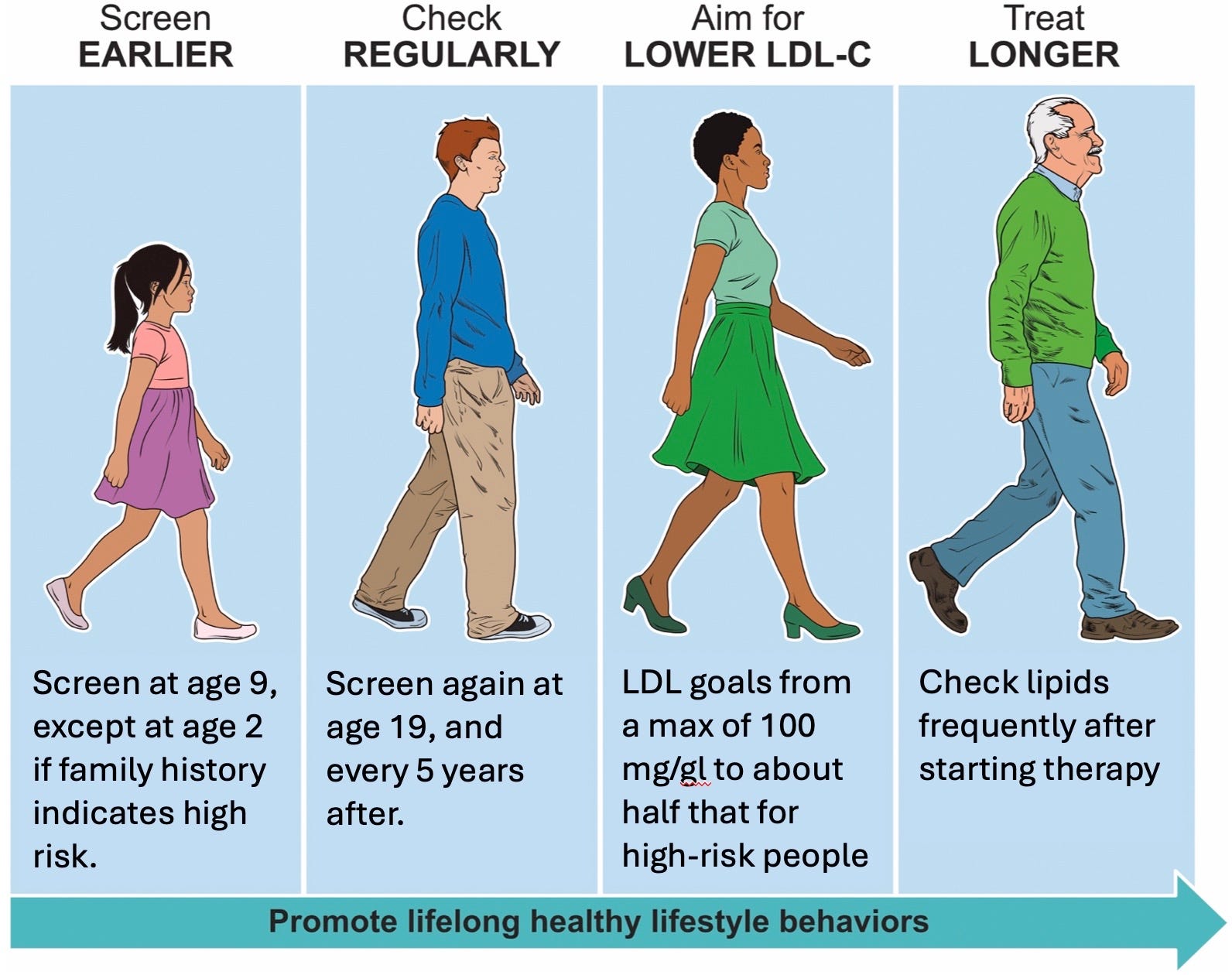
A new recommendation for lipid testing at the age of two
Some people have a genetic disposition to high cholesterol levels. The new Guidelines recommend testing with a lipid panel around the age of 9. If a child has a biological parent with very high cholesterol, the recommendation is to test at age two.
The new Guidelines also recommend a one-time testing for lipoprotein(a) in adulthood. High levels of Lp(a) add to cardiovascular risk. Since Lp(a) is genetically determined and levels stay the same over time, one test is all that is needed.
Personalized nutrition and tryglycerides control
Another big recommendation in the new Guidelines is the personalization of lipid control recommendations and individualized treatment based on the analysis of a much wider array of factors. Additionally, the Guidelines recommend referral to an expert nutritionist, typically a Registered Dietician, when triglycerides are high.
I am happy about these recommendations, since my last post and podcast called for personalization of nutrition recommendations in general and full integration of nutritional expertise into the medical system. The Guideline authors acknowledge that medical insurers are lagging with regard to providing coverage for nutritional counseling and supervision, but are hopeful the new Guidelines will help push the insurance system in that direction.
The fundamentals are easy, but the details are complicated. Get expert medical supervision.
There are many other important aspects to the new Guidelines depending on your situation. Help your medical providers help you be aggressive about staying on top of your lipid health.
Thanks for reading. Next time we’ll check out the other new-ish guidelines, the update on the American Heart Association’s Hypertension Guidelines.
Your support for Eating In America is important. Please help by being a paid or free subscriber, sharing this post with a friend, or leaving a comment.
REFERENCES
Abbasi J. What to Know About the New Lipid Guidelines. JAMA. 2026;335(15):1285–1287. https://doi.org/10.1001/jama.2026.3968
Wiggins BS, Barac A, Benziger CP, et al. 2026 Dyslipidemia Guideline-at-a-Glance. JACC. 2026;87(19):2617–2623. https://doi.org/10.1016/j.jacc.2026.02.4872
Johns Hopkins Medicine. The New Cholesterol Guideline: What to Know. March 27, 2026. https://www.hopkinsmedicine.org/news/newsroom/news-releases/2026/03/the-new-cholesterol-guideline-what-to-know
Vrins CL. From blood to gut: direct secretion of cholesterol via transintestinal cholesterol efflux. World J Gastroenterol. Dec 21 2010;16(47):5953–7. https://doi.org/10.3748/wjg.v16.i47.5953
Klemm S. What is Cholesterol? August 28, 2025. https://www.eatright.org/health/essential-nutrients/fats/what-is-cholesterol
MarketsandMarkets. US Omega-3 Market (2025-2030). July, 2026. https://www.marketsandmarkets.com/Market-Reports/geography/omega-3-omega-6/us
Pappan, N., et al. Dyslipidemia. March 4, 2024. https://www.ncbi.nlm.nih.gov/books/NBK560891
Carter S, Hill AM, Yandell C, Wood L, Coates AM, Buckley JD. Impact of dietary cholesterol from eggs and saturated fat on LDL cholesterol levels: a randomized cross-over study. Am J Clin Nutr. Jul 2025;122(1):83–91. https://doi.org/10.1016/j.ajcnut.2025.05.001
Barnard ND, Long MB, Ferguson JM, Flores R, Kahleova H. Industry Funding and Cholesterol Research: A Systematic Review. Am J Lifestyle Med. Mar–Apr 2021;15(2):165–172. https://doi.org/10.1177/1559827619892198
Aubrey A. Cholesterol Redux: As Eggs Make A Comeback, New Questions About Health Risks. The Salt, NPR. March 16, 2019. https://www.npr.org/sections/thesalt/2019/03/16/703804493/egg-lovers-new-study-finds-eating-too-many-can-increase-risk-of-heart-disease
The Nutrition Source. Eggs and cholesterol back in the spotlight in new JAMA study. The Nutrition Source. March 18, 2019. https://nutritionsource.hsph.harvard.edu/2019/03/18/eggs-and-cholesterol-back-in-the-spotlight-in-new-jama-study/
Zhong VW, Van Horn L, Cornelis MC, et al. Associations of Dietary Cholesterol or Egg Consumption With Incident Cardiovascular Disease and Mortality. JAMA. 2019;321(11):1081–1095. https://doi.org/10.1001/jama.2019.1572
Beynen AC, Katan MB, Van Zutphen LFM, Beynen AC, Katan MB, Van Zutphen LFM. Hypo- and Hyperresponders: Individual Differences in the Response of Serum Cholesterol Concentration to Changes in Diet. Advances in Lipid Research. 1987/01/01/ 1987;22:115–171. https://doi.org/10.1016/B978-0-12-024922-0.50008-4


