
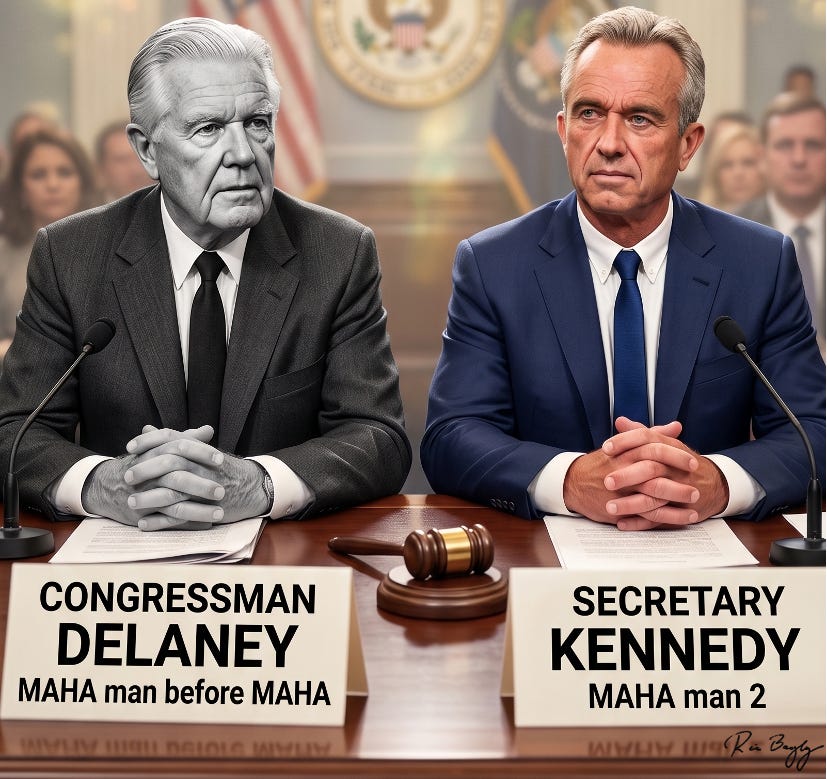
Turns out RFK, Jr. could be called today’s James Delaney, the congressman who gave us the Generally Recognized As Safe, or GRAS, system. Kennedy has been voicing many of the exact same nutritional concerns that Delaney expressed – two years before Kennedy was born. And, in the same way that Delaney struggled with the power of what was to become known as the ultraprocessed food industry, Kennedy is struggling today. Because of the influence of Big Food and the lack of will in Congress to properly fund the FDA, the Delaney Act and its GRAS system in 1958 failed to effectively regulate the addition of chemicals to our food. Given the enormous size and power of the ultraprocessed food industry today, Kennedy has a challenge on his hands in reforming it, as he would like to do, for the benefit of the public’s health.
So what’s going on with the FRESH Act collision in the House? First, I noticed, as did the nutrition watchdogs Center for Science in the Public Interest and the Environmental Working Group, the appearance of Florida Republican Kat Cammack’s FRESH and Affordable Foods Act. Both CSPI and EWG termed the Act not fresh but rotten.
Cammack’s FRESH Act is, in full, the FDA Review and Evaluation for Safe, Healthy and Affordable Foods Act. Cammack and her food industry friends would use it to further eviscerate an already weak food additive safety system. The Environmental Working Group’s Melanie Benesh said, “I did not think it was possible to make our food system even weaker, but this proposal does it.”
Cammack’s draft bill was discussed this past week in subcommittee. There is a large amount of doubt about whether it, or any of the several congressional proposals currently in committee that are intended to reform GRAS in a positive, public health direction, will succeed in this session.
Cammack’s FRESH act was introduced on April 22nd in draft version. Another Republican, Julia Letlow from Louisiana, an avowed MAHA mom, introduced her own FRESH Act on April 29th. Representative Letlow’s bill, H.R. 8578, the Food Reform for Effective and Sustainable Health Act of 2026 does just two things. This FRESH Act makes the new inverted pyramid Dietary Guidelines into law, and it requires each new Dietary Guidelines to be approved by a new law in Congress. Letlow’s proposal is not as horrible as Cammack’s law, but it isn’t good. It inserts Congress into a supposedly scientific process that is already thoroughly corrupted by politics.
Cammack’s aberration is the story, but I mention Letlow’s bad idea because it seemed to me far too unlikely to have two Republican nutrition proposals named the FRESH Act coincidentally introduced in the House seven days apart. Perhaps it is just an attractive name for a bill. There was yet a different nutrition-oriented FRESH Act introduced last year.
Maybe I’m just overly suspicious of what goes on in Congress these days, but it seems plausible that the name of Letlow’s bill is meant to be confused and amplified by the anti-MAHA FRESH Act introduced by fellow House Republican Cammack. Letlow is strongly aligned with MAHA and RFK, Jr. and is the deep underdog in a fight for the Senate seat of Louisiana’s incumbent Senator Bill Cassidy. Cassidy, a pro-vaccine physician, is seen as a traitor by Trump and MAHA for torpedoing Trump’s nominee for Surgeon General, MAHA darling Casey Means. With her FRESH Act, Letlow could be undercutting Cammack’s bill and gathering MAHA energy and attention in her Senate fight. Neither FRESH Act is good for public health and science, so another crack in the anti-science, anti-public-health Republican Party is okay from my perspective as a public health scientist.
Meanwhile, a year ago RFK, Jr. directed the Health and Human Services Department to begin a rule-making process to close the GRAS loophole through which the ultraprocessed food industry has self-certified as safe thousands of chemicals – without providing the FDA or the public any information. However, experts have doubts that Kennedy’s rule-making will be able to circumvent congressional involvement and, in the end, changing GRAS will require a law.
At least RFK, Jr. is acting and some members of Congress have moved to address the GRAS mess. It is an uphill battle against the ultraprocessed food lobby, the biggest in Washington.
The ultimate problem with any proposed solution is that the FDA is and always has been underfunded, and the already inadequate staffing has been slashed by Trump. These cuts are badly affecting food safety in all areas, not just additives. One estimate of the cost of establishing the safety of a food additive is 2.5 to 5 million dollars and thousands of substances have already been introduced which have no published safety evidence.
An obvious solution is to put the cost of this proof on the manufacturers who would profit. If this means we have a much reduced number of food additives, we should consider the effects of that on an individual basis. We humans coped without these added chemicals in our food for thousands of years. We now have the science to create these complex substances, but we should also use our science to truly understand the health effects of these additives and newly imagined foodstuffs before we sell them.
Your support of Eating in America is appreciated. Please share this post, like and comment if you’ve a mind to, and subscribe if you haven’t. Thank you.


