
Yes, I know it is Eating in America, not “Smoking in America”, but today’s news is important, and I had to cover it, given the conclusion this week of EiA’s four-part series on cannabis. Think of this as a little bonus, since I already wrote this post for the Notes social media-ish stream of Substack. (If you are not familiar with Notes, you can find EiA’s Notes collection on the website EatingInAmerica.co. Many of my Notes extend or synopsize EiA posts and podcasts and there are thousands of worthwhile Notes from other authors.)
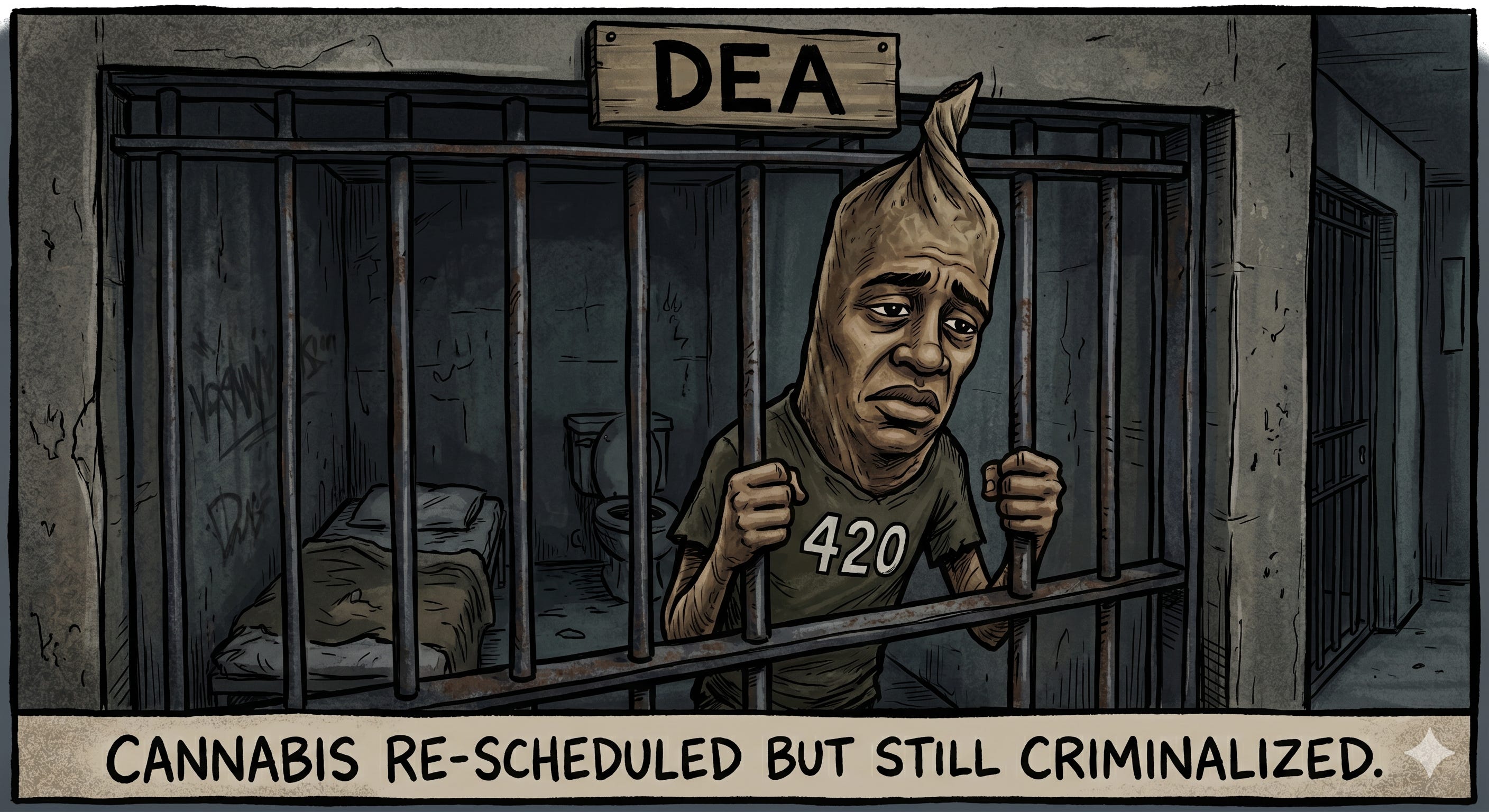
Cannabis has been reclassified today to a Schedule III drug for medical purposes. The Drug Enforcement Administration within the Department of Justice made the change, presumably on the basis of a scientific finding from RFK, Jr.’s Department of Health and Human Services. All of this avoids the further exasperation of Donald Trump, who expressed frustration a few days ago that the rescheduling had not yet occurred after he had ordered it in December.
From the public health perspective, the two major benefits of reclassification are the greater ease of doing medical research on a Schedule III substance and the potential for the FDA to regulate cannabis products. The direct health benefits of national regulation could be huge.
Today’s ultra-high potency products are linked to increased health risks including cannabis use disorder, cannabis hyperemesis syndrome, and psychosis. Any national regulation at this moment would apply only to medical uses, since recreational cannabis will remain fully illegal in federal law. However, according to Reuters, the Department of Justice has scheduled hearings to begin June 29 with the aim of reclassifying cannabis for all purposes.
Too bad Trump rescheduled cannabis for medical purposes without first putting together a coordinated program of research and FDA regulation, but as usual he appears to be acting in response to personal appeals and the widespread opinion of potential voters, and not from a public benefit (health and safety, in this case) perspective. If, following the hearing process beginning in June, recreational cannabis is reclassified, that is another moment the administration could embrace setting up national regulation of cannabis and pumping up the research.
However, stocks for cannabis-related companies rose sharply yesterday with leaked word of the rescheduling. A windfall of tax savings will occur as medical dispensaries will, for the first time, be able to take tax deductions for their expenses, including rent and payroll. The cannabis business is likely to be suddenly much more profitable.
A portion of those profits are certain to appear in increased lobbying power in Washington, D.C., almost certainly fighting against needed national regulations, like potency caps, that could help reduce the risk of harms such as cannabis use disorder. Following the tobacco, opioid, and ultraprocessed food playbooks, Big Cannabis is likely to fight hard and with lots of cash lubrication against regulatory control of qualities of its product, like high potency, which are linked to the tendency of frequent users to use even more frequently than they might want.
Rescheduling and any other step to federal legalization offers an opportunity to provide a carefully designed, scientifically-based policy framework for cannabis’s place in our society, including limits on product potency along with testing, labeling, and safety requirements. A smart strategy, one that has been tested country-wide in Uruguay, is to allow a reduced-risk level of cannabis potency that is still satisfying to recreational users, with the goal of displacing cannabis sourced from criminal enterprises in favor of standardized and more trustworthy products from legal dispensaries and pharmacies.
From my public health point of view, national cannabis legalization for both recreational and medical use is a step I hope will happen, but only in coordination with ample support of rigorous research and a well-designed and closely monitored program of regulation based on that research.
Thanks for reading. I would love to read your thoughts, opinions, and experiences, if you care to share.
There’s more on the interesting and unfolding story of cannabis in America with my new four-part series on the subject on Eating In America.


