
Guess who said:
…the survival of the country, as well as its democracy, depends on the health of its citizens. The shocking number of our young men who cannot meet the … physical requirements of our armed services must make each of us ask the reasons for this reservoir of ill health in the midst of such a varied and abundant food supply.
It wasn’t Abe Lincoln with regard to the Union forces or Franklin Roosevelt at the outset of World War II, although it very much applied then. Nor was it Robert F. Kennedy, Jr. in his run for the presidency.
The quote above is from U.S. Representative James Delaney in 1951, the year following the start of Delaney’s House Select Committee’s years long investigation into the glaring lack of safety in food additives.
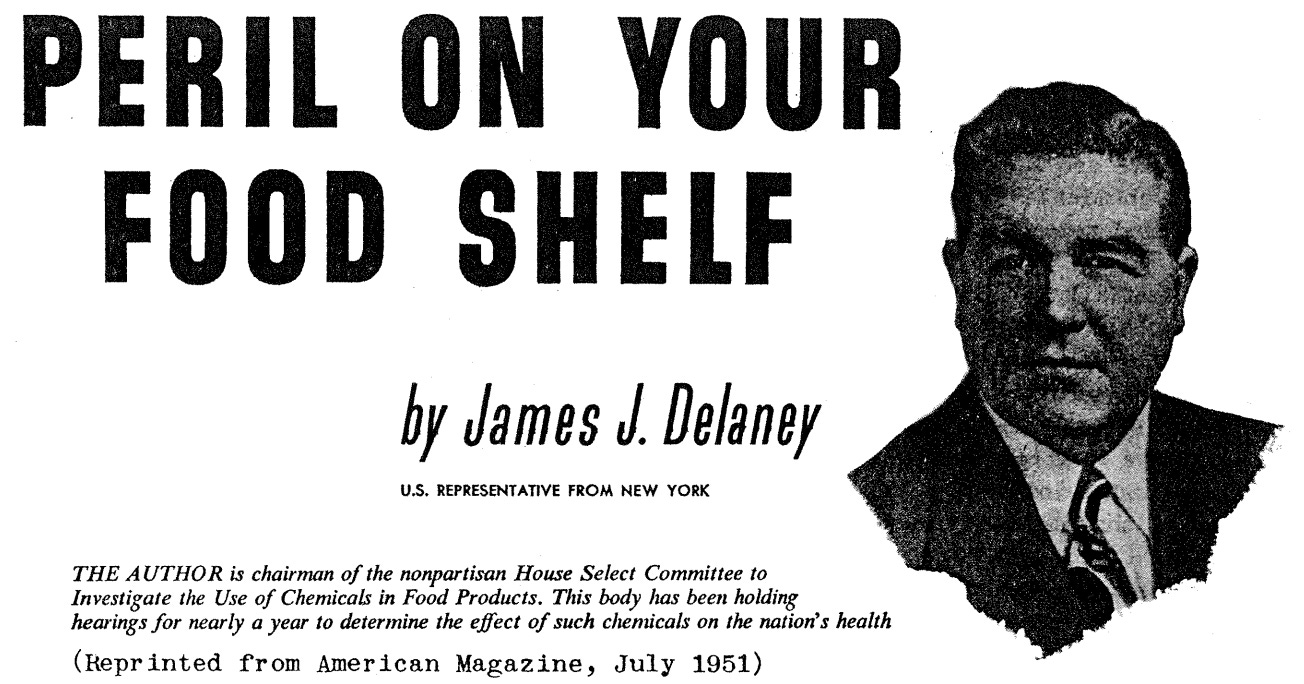
Delaney is known today for giving us the Generally Recognized As Safe, or GRAS, system of food additive safety assurance or, most would say, lack of assurance. But Delaney’s words sound as though they came from the lips of RFK, Jr. And what Delaney told us was bad in 1951 is still bad, 75 years later.
The congressman, increasingly alarmed about what his Committee was finding, wanted to spread the word to the public and build support for a battle with the increasingly powerful food industry. He wrote an article for American Magazine with scary, but not exaggerated, examples of the public at risk from toxic food additives and unregulated pesticides and of the food industry’s eagerness to capitalize on preferences of the human palate while ignoring nutritional needs. The congressman’s condemnation of the food additive practices of the industry, the lack of regulatory oversight, and the sad nature of the food environment as a whole, could have been written today.
The date I give for the start of the ultraprocessed food era is 1953. Somewhat arbitrary, but it marks the introduction of Swanson TV dinners, Kraft Cheez Whiz, frozen French fries, Tony the Tiger and Frosted Flakes, and McDonald’s franchises. Delaney’s article provides context for that moment and deepens our understanding of the history of today’s food environment and the rise of ultraprocessed food.
First, Delaney told about a peach packer who learned that adding a little of the industrial chemical thiourea would keep his peaches perfect, so he treated a shipment and sent them off. A fellow packer decided to try the same trick except, fortunately, had FDA inspectors test the thiourea first. The rats who were fed it died. When, by lucky chance, the inspectors learned of the first packer’s shipment, a frantic race to find and recall the peaches followed. Fortunately, they were all recovered before any were eaten.
Also in the late 1940s, lithium chloride was put on the market as a salt substitute for people on low-salt diets. Little safety testing had been done, and three people died before the lithium chloride was withdrawn.
Delaney goes on to rail against the national distribution of beer sterilized with poisonous hydrofluoric acid by a Massachusetts brewery and an Indiana manufacturer substituting butter with yellow-colored mineral oil labeled “edible fat” in popcorn sold all over the U.S. The mineral oil was found to be eliminating all the fat-soluble vitamins from people, many of them children, and causing vitamin deficiencies.
Delaney wrote that chickens (and later it was sheep, pigs, and cattle, too) were being treated with a new hormone called “stilbrestrol” to make them fat and faster growing. Then, despite the FDA’s oversight of pharmaceuticals, stilbrestrol was given to pregnant women, to prevent miscarriage and premature birth, up until 1971, when the practice was stopped because stilbrestrol is a strong carcinogen and causes infertility.
Delaney’s list went on. Many chemicals had been newly added to foods in the 1940s. For example, there was a shortage of shortening in 1947, and bread makers began to add emulsifiers and other substances, cutting the amount of shortening by 50% and making the bread softer. 10 million pounds of chemicals like polyoxyethylenes such as Polysorbate-60 were sold to bakers in America in 1949. Delaney was concerned about adding all these untested additives, but he also asked the simple question, ‘Why make the bread white and take out the nutrients?’ That was some far too uncommon common sense for the 1950s.
Delaney saw the increased role of soft drinks like Coca-Cola in our diet and worried about the phosphoric acid in it, citing U.S. Navy research that human tooth enamel is dissolved in 24 hours by phosphoric acid. That story seems like it is out of the way-back-machine, but 75 years later Coke still contains phosphoric acid as a main ingredient and great-grandchildren who inherited the practices of the dentists of 1951 are still filling cavities of people who drink Coke.
And Delaney worried about the explosion of new pesticides, including the highly toxic chlordane, finally banned in 1988, and DDT. The congressman was concerned DDT was being found in high quantities in meat in supermarkets. Soon, DDT was found stored in the fat of almost all Americans.
From a nutritional standpoint, Delaney could be a golden hero of the MAHA movement. In 1951, the Korean War had started, and the congressman decried the state of our food environment as the cause of so many American men being physically unfit for military service, words echoed today by RFK, Jr., who wasn’t born when Delaney said it. The congressman even wondered if the increased number of people with mental illness was related to the new chemicals in the food supply, far before RFK, Jr. gave voice to that concern.
In my next post, I’ll discuss how Delaney found it hard to translate into law his clear vision of what needed to be done to fix the American food environment. It wasn’t until 1958 that the Delaney Act, officially the Food Additives Amendment to 1938’s ineffectual Food, Drug, and Cosmetic Act, was passed. The Delaney Act made advances in food safety, but industry lobbying created a giant loophole to allow thousands of chemicals - for which the public has no safety information - into the food supply. Nutrition scientists and food safety advocates have long complained about the Generally Recognized As Safe, or GRAS system, in which the ultraprocessed food industry largely self-certifies the safety of food additives. It is in RFK Jr.’s hands to try to close that loophole. However, a law, the FRESH Act, to reform the GRAS system, has been introduced in Congress by a House Republican — but the FRESH Act grossly reforms GRAS to the favor of the ultraprocessed food industry. We’ll see what happens, but first we’ll discuss it next time.
Thanks for reading. I appreciate your support of Eating in America. Please subscribe if you haven’t and share this post with anyone interested in these things.


