
Eating in America is typically about what’s on our plate: what we’re eating. However, in this series we’re examining something that is not on everybody’s plate but was consumed by 44 million Americans in the last month. Cannabis is very much “in the air” these days, so to speak, especially if you live in a state where it is decriminalized and the smell of cannabis is easily found on the streets.
Cannabis use is not unrelated to our consumption of food and to the food environment. The pleasure people find in cannabis taps into the dopamine pathways in our brain that help us choose what to eat. And the parallels to alcohol use are often pointed out.
On Eating in America, we talk a lot about how ultraprocessed food has taken over our food environment. Has ultraprocessed cannabis taken over its world?
THC levels in cannabis have exploded in the last 25 years, going from around 5% in illegal cannabis in the 1970s to over 90% for some legal products in today’s recreational dispensaries. Cannabis use disorder is growing along with the potency of products, and research is clarifying that some claims of benefits don’t hold up. Instead, a number of risks are being confirmed.
The status of alcohol has often been used as a reference point when discussing cannabis legalization and regulation. While there are natural parallels between alcohol and cannabis distribution and consumption in our culture, there are important differences. On the one hand, alcohol and cannabis are the two recreational substances that are consumed in significant amounts by large percentages of our population. They are both, for the most part, widely available for purchase at prices that most people can afford.
However, their effects on the body and mind are very different. Because of its long status as a legal substance, the risks associated with alcohol have been much more researched than the risks associated with cannabis. For example, we now know a heightened risk of cancer begins with the consumption of any alcohol. The World Health Organization and the 2020 U.S. Dietary Guidelines Scientific Advisory Committee are among the groups who have found that the only safe level of alcohol consumption is zero.
While far too little research has been done on cannabis with regard to biological safety, research has begun to make clear that there is not much benefit for the mental health conditions for which cannabis is often recommended and good evidence of mental health risks.
A new review published in The Lancet analyzed existing randomized controlled trials, the gold standard of cause-and-effect research, and found no difference in outcome with cannabis treatment for anxiety, anorexia, psychotic disorders, PTSD, and opioid use disorder. Cannabinoids in cannabis actually increased cravings in those with cocaine use disorder.
The Lancet review did find some evidence that cannabis “can reduce symptoms of … insomnia, tic or Tourette’s, and autism spectrum disorder.” There was insufficient or no data to make conclusions about other mental health conditions like ADHD, bipolar disorder, and depression.
While evidence of the mental health benefits of cannabis is limited to a few conditions, the evidence has been mounting about mental health risks. A new Journal of the American Medical Association Internal Medicine review finds cannabis linked to psychosis, cannabis use disorder, and self-harm in adolescents with mood disorders. However, the JAMA review did find some evidence that the main non-psychoactive chemical in cannabis, CBD, by itself, without THC, the part of cannabis that is psychoactive, might help relieve anxiety, although more research is needed.
THE ALCOHOL COMPARISON
Alcohol is highly regulated at a national level and cannabis is not well-regulated. The amounts of alcohol in a product are clear and well-understood by consumers. While alcohol percentages are not regulated, for fermented products like beer and wine, they are controlled by the biology of yeast, and for distilled products like hard liquor and brandy, they are controlled by manufacturers adhering to convention and optimizing taste.
On the fully natural to ultraprocessed spectrum, the process of distilling fermented grains or grapes puts hard liquors and brandy in the processed category of consumables. Beer and wine, the precursors of whiskey and brandy, are lightly processed.
There are always trends in alcoholic beverages, but, as a consumable substance, the field as a whole is mature.
ULTRA-POTENT AND ULTRAPROCESSED
In contrast, cannabis products now sold on the black market, in medical dispensaries, and particularly in recreational dispensaries, are very far removed from the relatively low-powered cannabis used by the Chinese in 2,700 BC and in the hippie world of Haight-Ashbury in the 1960s. But in the 70s, a steep upward curve of potency began as a Mexican drug gang in Sinaloa, soon to be a cartel, discovered that isolating the unpollinated female cannabis plant, called sinsemilla, tripled cannabis THC levels, from 2% to 6%.
Due to breeding, cloning, and cultivation innovations, THC contents of black market cannabis rose further to 17% on average, by 2017.
New products, some found in dispensaries and some, avoiding regulation and law, found on the gray market in gas stations and convenience stores, have further increased potency using THC extraction and concentration methods employing solvents. THC levels for dispensary products can be 90% or more. Some solvents used for extraction are toxic, and incomplete residue removal in substandard manufacturing processes might pose a risk to consumers.
With extraction methods creating new ultra-high potency levels, cannabis has entered the era of the ultraprocessed.
Ultraprocessed gray market gummies and other products with intoxicating levels of THC are a particular concern. In 2018 Congress deregulated hemp, or cannabis without an intoxicating amount of THC. The intent was to allow hemp-based products containing CBD to be sold without regulation. However, the law did not forbid the conversion of the CBD in hemp into THC through chemical processing.
Soon colorful bags of candies and treats with high levels of THC were showing up in gas stations, convenience stores, and smoke shops. Some of these products were packaged to closely mimic popular brands like Frito-Lays and Cheetos or children’s gummies. With no age restrictions, or restrictions of any kind, reports began to come in of children hallucinating at school.
Colorful cans of beverages containing THC-derived from hemp have become popular outside of dispensaries, often being used as a substitute for alcoholic drinks. The THC in beverage products has a quick effect compared to edible products like gummies, although not as quick as smoked cannabis.
A handful of states banned all hemp products containing THC and last November Congress inserted a provision into the legislation that reopened the government. The law will limit the THC content in hemp products and ban the conversion of CBD into THC. The law gave the $28 billion hemp products industry a year before the restrictions go active this coming November, but lawmakers are proposing a one year extension. Meanwhile, the regulated cannabis industry has been lobbying for the restrictions to protect their businesses. Meanwhile, THC candies and snacks remain on shelves in many jurisdictions in states like Massachusetts without any restrictions or enforcement against purchase by minors.
Both cultivation practices and chemical extraction have greatly increased the potency of cannabis. And there is now good evidence that higher potency cannabis is associated with increased risk of psychosis and cannabis use disorder.
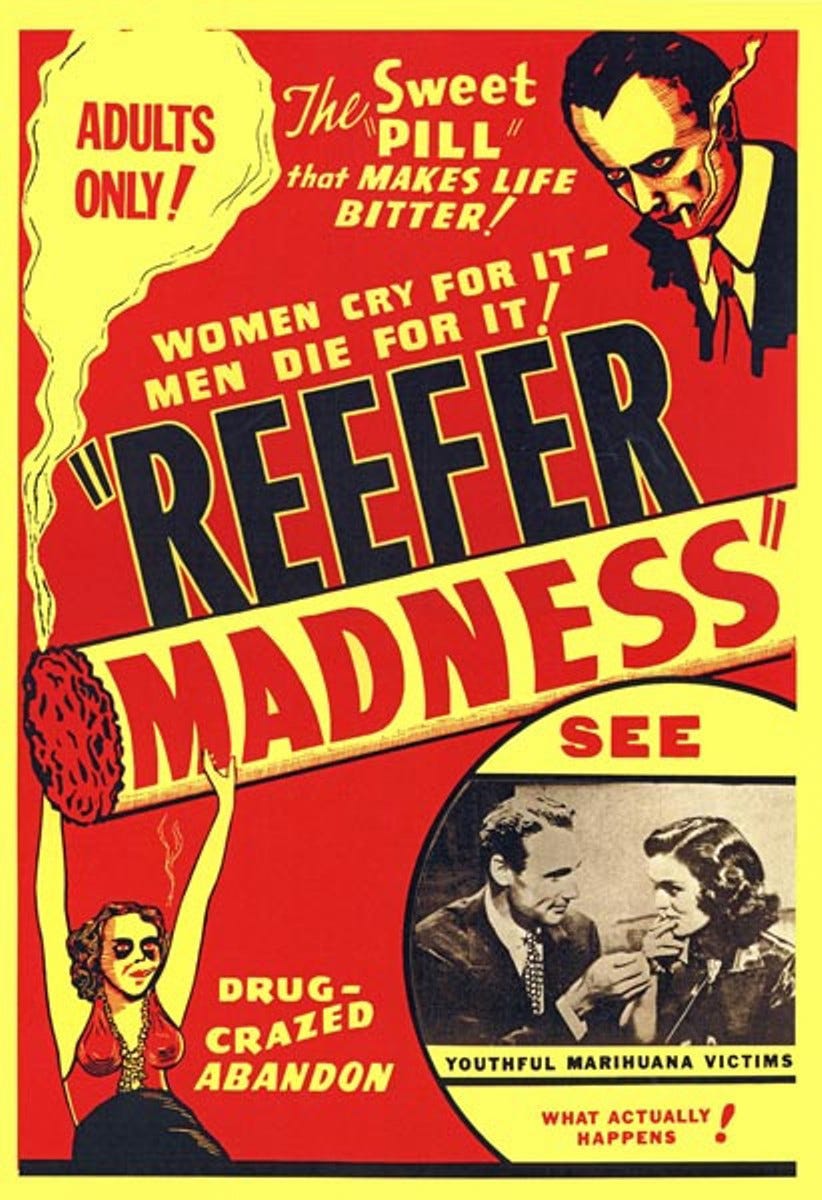
Ironically, with the reality of psychosis risk with today’s high potency cannabis, a dose of truth has been bestowed on 1937’s laughable propaganda film “Reefer Madness,” although it seems to me unlikely that there were a large number of cases of psychosis with the low potency cannabis of almost a hundred years ago when “Reefer Madness” was being made.
There is cannabis madness today in that there is far too little cannabis science and far too little regulation. As a result, we have a chaotic landscape of cannabis sales, quality, and use. This shouldn’t be the case. Alcohol has been an important point of comparison when the loosening of laws and regulations has been argued for cannabis. However, the marketing, sale, and quality of alcohol is very well-defined, and its use is not confused by dual systems of lightly regulated recreational and medicinal alcohol.
On the other hand, the cannabis sanity is in the wide recognition that the fun, stupefying, euphoric, or calming effects of cannabis aren’t a threat to our communities and that, as with the risks associated with alcohol, the risks of cannabis consumption can be reasonably weighed by adults for themselves. But, going forward, the science and regulation deficits have to be fixed.
Thank you for reading. In Part Four of “Ultraprocessed Cannabis: Potency, Policy, And Public Health In America,” we check on the continued black market in cannabis, look at how big money in cannabis has become a powerful influence, and propose seven policy and regulation recommendations to bring the public’s comfort with cannabis together with public health moving forward.
In Part One of this series, we have a look at the surprising history of cannabis in America. Did you know the Puritans brought it here, and by law they had to raise it because it was so valuable for hemp fiber to make rope and sails? We also discuss medical cannabis, cannabis use disorder, and the increased appearance in emergency rooms of people with uncontrollable vomiting and screaming stomach pain from too much cannabis, in Part Two.
You can find all that at EatingInAmerica.co.
What are your thoughts and experiences with cannabis, unregulated hemp-based THC products, and the way forward? Please share your comments! Your support for this post and podcast are appreciated. Peace.


