

Everyone on Earth has one food in common, milk. We all drank it as our first meal, even if it was just the milk contained in formula.
Breast milk is the most perfect food: the ultimate personalized nutrition. I envy all moms and dads who have experienced breast feeding and its joy and love. Of course, breastfeeding is great if it can happen, but, in the interest of inclusivity, I wasn’t breastfed and I turned out fine.
Milk has been in the news a lot lately with full fat milk being promoted in the new Dietary Guidelines and the Whole Milk for Healthy Kids Act signed this month, so I am going to share the answers, many of which I think you will find interesting or useful, to the questions I have had about milk.
First, guess the answer, which is better for hydration, water or milk?
Full fat milk is 87% water and skim is 90%. A 2016 study found that both full fat and skim milk were better than water for hydration of adults. In fact, milk was more effective than any tested fluid. Oral hydration solution, like Pedialyte or the equivalent homemade solution mixed with the correct balance of sugar and salt, was also effective, as was orange juice. Plain water was on a par with, surprisingly, Coca-Cola, tea, coffee, beer, and Powerade. That’s right, water is just as good as a sports drink for hydration…but not as good as milk.
In a small sample of participants, a 2014 study found that milk was better than Powerade for re-hydration after vigorous exercise. The dairy industry has made much out of some small studies that show milk outperforms water for rehydration after heavy sweating. This evidence is weak, but milk does have the electrolytes calcium, potassium, and sodium, which water has little of. More research is needed, but, since milk does deliver protein and good hydration, you might find it a good option after a workout, as I do.
Okay, let’s deal with what is in RFK Jr.’s head, and I mean his thoughts about milk, raw and whole.
RFK, Jr. says raw milk is good for you. He drinks it.
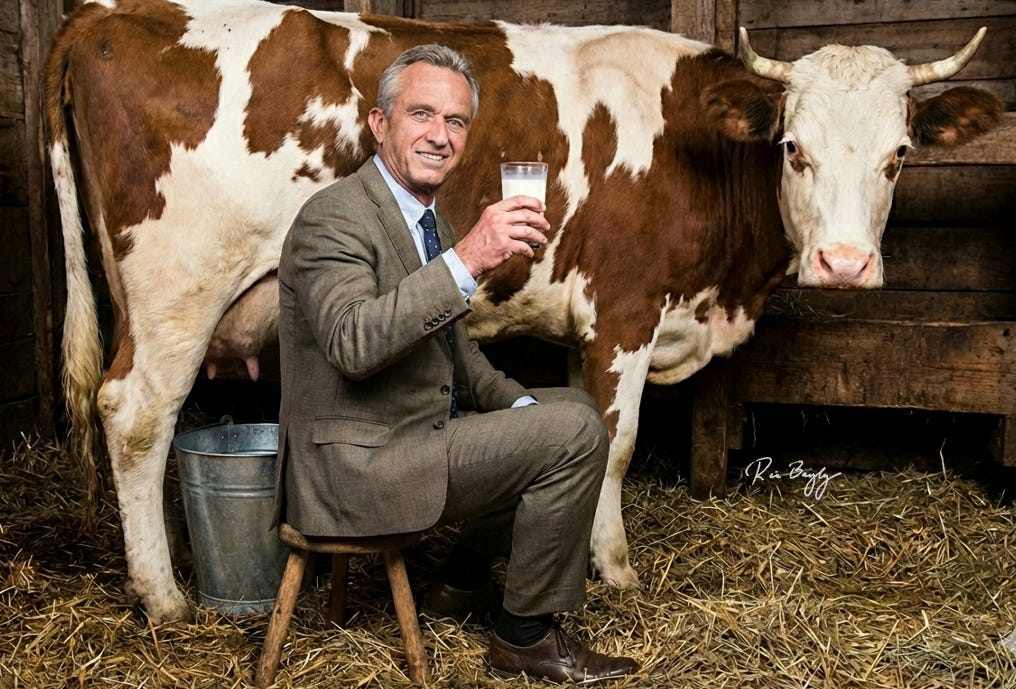
Raw milk can carry Salmonella, E. coli, and Listeria. The USDA, CDC, and FDA all strongly warn against drinking it.
Testing has refuted the argument that raw milk is better than pasteurized nutritionally. There is a minor reduction in some vitamins from pasteurization, but not nearly enough to risk a serious illness. The CDC found that from 1998 through 2018, 2,645 people became ill from raw milk, with 228 hospitalizations.
However, hard cheese made from raw milk is safer than fluid raw milk. One study found that raw milk hard cheese can meet European Union standards for bacterial safety, but that a rigorous production process is needed, so safety is not guaranteed. Softer cheeses are not as effective in reducing pathogen loads as hard cheese, so beware. Also, FDA research in 2024 and 2025 found that Avian Flu virus, H5N1, can survive the raw milk hard cheese aging process. However, the FDA has found that milk pasteurization does kill the H5N1 virus.

Should I buy ultra-pasteurized milk?
First Louis Pasteur discovered that the beer fermenting process was caused by yeast, and then he invented pasteurization to kill off the unwanted microbes that could cause beer to go bad. Having revolutioned the beer industry, Pasteur figured out how to pasteurize milk – 161 years ago in 1864.
I have a hard time heating milk on the stove for hot chocolate without making a skin on the surface. Have you ever wondered how milk is pasteurized without being ruined? The High Temperature/Short Time method is the common way. Milk is heated to 161°F for just 15 seconds. Milk pasteurized this way is coded for removal from grocery shelves 16 to 21 days after bottling or boxing.
Ultra-pasteurized milk, on the other hand, is flash-heated with injected steam to 280°F and then rapidly vacuum chilled. A box of ultra-processed milk can last for months, often without refrigeration. Very convenient, but there is a slightly sweeter, “cooked” taste, and some folks might prefer regular pasteurized milk for some uses. After it is opened the shelf life of ultra-processed milk is similar to that of regular pasteurized milk.
The Whole Milk for Healthy Kids Act and the case for whole milk
Trump signed the Whole Milk for Healthy Kids Act this month, allowing schools in the National School Lunch Program to serve full and 2% fat milk. This policy is heartily approved by Trump and RFK, Jr.’s MAHA followers.
But as Yasmin Tayag points out in the Atlantic, whole milk also connects Trump’s MAGA constituency back to a bucolic, pure, but imaginary American past that appeals to the right and far right. Social media posts by Trump and Kennedy of them with milk mustaches are reminiscent of the dairy industry’s “Got Milk” campaign of the 20th century.
And Trump’s post of himself as a milkman further reinforces this connection to a white American past. The milkman image goes way back to Trump’s childhood and reminds us that milkmen delivered milk bottles to doorsteps in the early through the mid-20th century. At one time almost a third of all the milk we drank in America was home delivered. Milkmen were the original Uber Eats, but without the app.
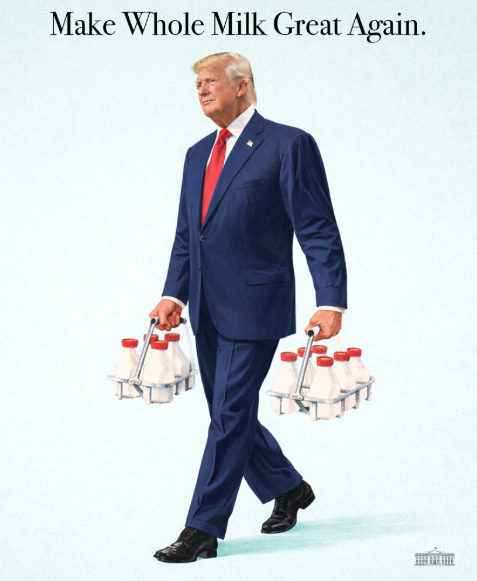
Framing Trump as a restorer of an old version of America is strong messaging built on a weak basis.
The effort to promote whole milk is meant to benefit farmers who hope to sell more, as milk sales continue a 50-year decline. Whole milk is more expensive than reduced fat milks (by which I mean 2%, 1%, and skim milk) because of its fat content, which can be used in other products like butter and cream. So if some people switch from lower fat to full fat milk, that’s good for the dairy industry.
What types of milk sell the most?
My analysis of USDA 2025 data through November shows that full fat milk is 47% of sales, skim is just 6%. In between are 2% fat, which has 34% of sales, and 1%, which has a modest 13% of sales.
In fact, there was a little shift in 2025 with all the buzz about whole milk. Regular full fat milk was up about one percent over 2024, but milk sales as a whole were down about two percent. So despite the promotion of whole milk, for the moment the industry continues to slip in volume.
Flavored milk is 11% of all non-organic milk sales. About 2/3 of flavored milk consumed is chocolate, both at school and at home. A survey of 51 flavored milks sold in schools found they all contained added sugar, ranging from 6 to 16 grams worth.
Organic milk, by the way, is 7% of all milk sales.
Is organic better?
How much healthier is organic milk for you than conventional? Pesticides are in conventional cow milk, mainly from cows eating contaminated feed and forage. Most conventionally farmed cows are treated with growth hormones and antibiotics that also show up in their milk.
Organic is a little better nutritionally because forage results in somewhat better milk than than the feed mixtures provided to intensively-raised indoor cows. While many conventionally producing cows are allowed to graze, factory farming counts for about 70% of milk production, and the number of small dairy farms dropped by almost half in the last ten years.
It would be an easy choice between organic and conventional milk if price weren’t a factor, but this week in the U.S. the average advertised cost of a gallon of organic, $8.16, is exactly three times that of a gallon of conventional milk.
Other motivators for organic dairy purchases are the public health benefits of not introducing pesticides and antibiotics into the environment, and the presumption that cows are happier being out grazing in a pasture at least three months a year, as required by the USDA for organic milk cows, as opposed to those many cows that spend their life inside where welfare issues are a concern.
Another hopefully interesting statistic: cow milk is almost 100% of American animal milk production, but, worldwide, cow milk is about 80%, followed by buffalos at 15%. Goats, sheep, camels, yaks, horses, reindeers, and donkeys together are responsible for 5% of milk production.
Will school kids actually drink more milk if full fat milk is available?
Blind taste test studies indicate kids will maybe, maybe not drink more full fat milk than lower fat milk on the basis of taste. One study found consumers can’t tell the difference between milk types by taste alone, while a recent one found a taste preference for full fat milk.
Saturated fat?
There is new debate among nutrition scientists about whether saturated fat in milk has the same risk-increasing effect on heart health that saturated fat in, say meat, does. More research is needed.
It seems very likely to me that if a kid is a milk drinker of whatever fat content, that alone is a win for health, as long as the milk is unflavored and not raw. Milk’s health benefit is further increased if the milk is consumed in place of less healthy juice or sugar-sweetened beverages.
Doesn’t removing fat from milk remove vitamins?
Calcium absorption in the intestines can’t effectively happen without vitamin D. The vitamins dissolved in the milk fat, A and D, are removed along with the fat in lower fat milk, but they are, by regulation, replaced with 2,000 IU of vitamin A in all lower fat milk.
Further, since about 1933, vitamin D has been added to milk. Vitamin D fortification is the primary reason that rickets, the crippling bone disease, is rare in America, 100 years after it was epidemic in northern industrial cities and the poor South. Almost eliminating rickets in America was a big public health and nutrition win.
However, rickets has begun to reappear, with a disease rate in the early 2000’s ten times what it was twenty years previously: still very low but unacceptable. Those affected have been primarily poor, dark-skinned children in the South who did not receive vitamin D supplements when breast feeding past six months.
Your skin is a vitamin D factory when you get sun exposure. If you are dark-skinned or above the 37th parallel, which runs roughly from San Francisco to Tulsa to southern Virginia, you are likely getting less vitamin D production from the sun than might be optimal.
What about the extra calories in full fat milk?
A large study, part of the Framingham Heart Study, found no relationship between drinking lower fat versus full fat milk on weight gain. So probably no worries there.
Calcium, the wondrous white metal we all need a lot of
Calcium quantities are the same in full and lower fat milk, so this is not part of the whole milk debate. Since calcium is a metal, when you think of it, our bones are made of metal, although a soft one! Calcium is critical to our bone health but also lets our blood clot, muscles contract, and heart beat. We lose calcium all the time through our nails, hair, urine, and feces. If it is not replaced in our food, our body takes calcium from our bones. There are a lot of factors that affect loss of bone mass and microstructure, but studies have shown dairy consumption is a protective factor: it decreases the risk of bone fractures.
Milk, yogurt, and cheese are not the only things that can benefit bone health. Physical stress delivered to your bones through exercise helps them strengthen and reduces the risk of osteoporosis. That goes for everyone. There might not be an upper age limit on the benefit of exercise to bone health.
For dairy-free consumers, in addition to exercise, to reduce the risk of osteoporosis calcium can be obtained by eating nuts and seeds, kale, broccoli, some lettuces, collard, Brussel sprouts, and cabbage.
Many people have good reason to avoid dairy. There is an interesting history to that.
It used to be that during childhood everyone in the world gradually lost the ability to digest milk - until about 8,000 years ago when dairy animals were domesticated in Turkey. My theory is that the body’s development of lactose intolerance was nature’s way of forcing the weaning of older children so that young ones could have their turn at the breast.
However, along came cow farming, and a genetic mutation that kept lactase production going in the human body through adulthood gradually spread. Then 3,000 years ago dairy herders in Northern Europe experienced selection for the lactase gene during famines – when dairy was the most reliable food source. Those who had the mutation were more likely to live through crop failures.
Everyone quotes a 2017 study that found 36% of Americans have lactose intolerance. The rate worldwide according to the study is 68%, but the study’s methods were off, and it was retracted last year. So perhaps we don’t have a reliable figure, but we know a lot of Americans have trouble with milk. Yogurt, by the way, tends to be less troublesome for lactose intolerant folks, since the fermentation process reduces the lactose content in yogurt.
The plant milk solution
While about 10% of the animal and plant milk market combined is lactase-treated milk for the lactose intolerant, about 15% is comprised of plant-based milks, mainly almond. In 2022 almond milk had about 60% of the market. Oat milk had 20% of sales, with coconut and soy milk each taking about 10%. Almond and oat milk lead sales because of their taste, which is preferred by many.
Plant-based milks have good nutrition, and although sugar is added to some, it can be less sugar than the lactose in milk. However, lactose in cow milk is a slow-digesting sugar compared to fast-digesting sucrose in plant-based milk, so expect less glycemic control with plant-based milks.
Oxalic acid is in a lot of foods. Be aware that the high oxalic acid content in almond milk significantly reduces the uptake of calcium from the milk. So when an almond milk claims it has more calcium than cow milk, the reason is that it needs to start with more calcium to try to match the ultimate calcium delivery of cow milk.
Milk allergy
Milk allergy is one of the most common allergies for children. Reactions vary from mild to severe. Happily, most kids outgrow it.
Trump’s disgust and dismissal of breastfeeding
First, in 2011 Trump called a lawyer in a deposition hearing who requested a break to pump milk “disgusting.”
Second, for decades the misleading marketing of infant formula in developing countries has caused untold infant deaths due to the use of contaminated water mixed with the powder. Formula use in these places is also associated with nutritional issues and economic stress for impoverished women who are misled into buying formula. America, the World Health Organization, and nutrition and public health experts everywhere had agreed for 40 years that breast feeding was the best source of nutrition to keep infants healthy.
However, in 2018, on the order of Trump, who was acting in the interest of formula manufacturers like Nestlé, the U.S. delegation to the World Health Assembly tried to block a resolution to promote breastfeeding and clamp down on inaccurate formula marketing. The U.S. forced Ecuador to withdraw the resolution by using trade threats and threats of withdrawing military assistance for the armed conflict on Ecuador’s border with Columbia. Many other intimidated nations refused to sponsor the resolution until Russia finally did, at which time it overwhelmingly passed.
That year, I was in Malawi to gather formula samples to test for contamination. I saw Nestlé formula marketing everywhere. I stood in line at a market behind a clearly low-income woman with a baby. She had one item: formula. She was not buying clean water…
I wonder how the U.S.’s own, already subpar, infant mortality rate will fare under Trump?
Got Milk?
In the face of 50 years of declining sales, the dairy industry has heavily marketed milk as an essential part of the diet to the American public. There are a lot of pluses to milk consumption, full fat or lower fat: great calcium and hydration, a substitute for unhealthy beverages, and it’s got low-cost protein. This may be a too-rare instance of a food industry interest roughly aligning with a public health interest. So, “Got milk?” Heck, yeah!
I appreciate your reading. Let me know if you didn’t find 8 interesting facts... Please share, like, or comment at will, and be sure to subscribe at EatingInAmerica.co.
You are helping Eating in America grow, and I thank you.
Oh, and a…
Conflict of interest disclosure. I had an early career in milk nutrition. In 3rd grade I was in charge of bringing the crate of little milk cartons to the classroom where we ate lunch. I was very proud. I think the milk cost 3 cents.


