
With today’s video podcast, you have your full choice: watch, listen, or, as most do, read Eating in America. Anyway you do it, we are glad to have you here.
This post and podcast are about what’s in our food and who’s in charge of making it healthy. While RFK, Jr. and his Department of Health and Human Services are getting a lot of attention when it comes to federal action or inaction on making our food healthy, in many ways it’s the USDA, the Department of Agriculture, that’s more in charge of the healthiness of our food.
For example, the USDA is responsible for the safety and inspection of our food. The Department is a full partner with Health and Human Services in writing the Dietary Guidelines that this year famously featured the upside-down food pyramid.
But, more importantly, the 2026 USDA budget is $458 billion – nearly half of a trillion dollars. Most of that money flows to agriculture through consumers who receive food assistance like SNAP in order to put food on their tables. Folks being able to afford to eat and not go hungry is certainly a big factor in health. But also, how SNAP and the other programs allow that money to be spent in the store influences the healthiness of the food that is produced. As Jerold Mande in our interview today points out, a lot of states are now beginning to put restrictions on SNAP dollars being used to buy unhealthy products like Coca-Cola.
However, a lot of money flows through the USDA to directly support agriculture in this country, and whether that money goes to the production of fruits and vegetables that are in short supply in American diets, which it mostly doesn’t, or whether that money goes to help produce corn for ethanol, feed for cattle and pigs, or ingredients for ultraprocessed food, which are the places most of the money goes, makes a tremendous amount of difference to what our American food environment looks like.
Perhaps no one knows more about these issues and how the USDA handles them then our guest on Eating in America today, Jerold Mande.
Interview - Introduction
Jerold R. Mande is a nationally recognized expert in public health, nutrition, policy. He’s an adjunct professor of nutrition at the Harvard Chan School of Public Health and CEO of Nourish Science, an NGO dedicated to greatly increasing nutrition research, putting bite and muscle (my words) into the FDA’s regulation of food ingredients and additives, including the regulation of ultra-processed food and modernizing SNAP food assistance.
This is all towards the overarching Nourish Science mission to change the federal nutrition goal to “ensuring every child reaches age 18 at a healthy weight and in good metabolic health.”
Mande has served three presidents in senior policymaking positions at USDA, FDA, and OSHA. He has shaped nutrition, food safety, and tobacco control programs. He led the Nutrition Fact Label Design Team at FDA for George H.W. Bush.
And first but not least, Mande started his career with Al Gore in Congress, helping Gore write America’s organ donation laws.
Transcript (lightly edited for clarity)
RB: “Jerry Mande, it is such a pleasure and honor to have you on Eating in America.”
JM: “Ric, thanks for having me.”
RB: “So I get sent frequent press releases from the USDA, as I’m sure you do. And I want to save a few minutes in this discussion to get your interpretation about what’s going on with all the program and policy initiatives and media events from the USDA these days.
“But first, one of the press releases that I passed over very quickly said the USDA is closing a couple of buildings in Washington DC and Alexandria, Virginia. But that closure had a lot of meaning for you. Will you explain please Jerry, what has happened with those buildings?”
JM: “So these closures are core facilities of USDA and represent a demolishing of the culture that makes USDA such a remarkable agency, fulfilling the goal of President Lincoln, who created the agency’s mission to make it “the people’s department.”
“First, the Braddock Building in Alexandria is the home of the Food and Nutrition Service. That’s the agency within the USDA that manages 80% of the USDA budget, feeds one in four Americans each year, and houses programs such as SNAP, the Food Stamp Program, the School Meals Program, and the Women Infants and Children, or WIC, program.
“The South Building in D.C. proper is attached to the USDA main headquarters building, the Witten Building. It’s the only federal department that is actually on the mall. It’s a short walk from the White House and right next to the Washington Monument. Actually the South Building should be the headquarters building because it’s many times larger. But the headquarters is the Witten Building. It’s a beautiful building.
“The South Building when it was built in 1936 was the largest office building in America. It held that distinction until the Pentagon was built. And still today, it’s the second largest.
“So the announcement you mentioned, it doesn’t scream out that there’s a problem in getting rid of those buildings. And what they’re doing in getting rid of those buildings is moving those programs somewhere else.”
RB: “Well, it occurs to me that USDA Deputy Secretary Vaden, when he announced the closures, said Trump’s idea is to control this sprawling federal bureaucracy. But to control it, they’re actually sending it away to many far, far away places. And that seems the opposite of actually controlling sprawl!”
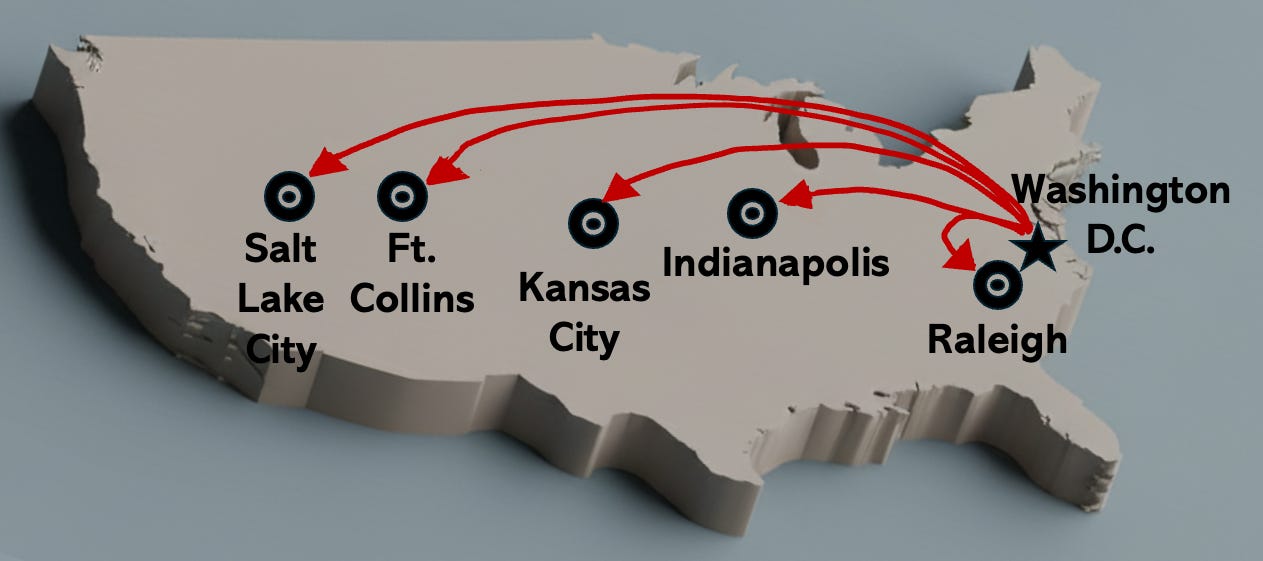
JM: “Just a little bit of background to help explain the impact of these closures. Earlier in my career, I worked at the Department of Health and Human Services, particularly the FDA. These were great agencies, I thought.
“And indeed, I thought that the Department of Agriculture was sort of the bad guys because of the industry influence on the issues I worked on, like food labeling, where we had to fight the USDA at every step to get the Nutrition Facts Label that we have in place today. But when I worked at HHS, something just didn’t stand out to me at all.
“The HHS, because it was cobbled together over many administrations and literally decades and decades, was scattered all across the country in different buildings and agencies. There is a big building a block off the mall. The secretary works there, but none of our agency heads work there because their agencies are scattered all across the country. I thought it was always a bit dysfunctional, and there were a lot of challenges. But I figured, this is just life in the federal government and that’s as good as it gets, I guess.
“But then in the Obama administration, I was invited to join the Department of Agriculture. And it was just this remarkable eye-opening experience that, wow, this agency operates so much better than anything I’ve ever experienced before. And it was because of the culture created by the proximity of all of the staff.”
“Secretary Vilsack, the secretary then, and all of his undersecretaries, which are the equivalent of these HHS agency heads, were literally on the same hallway in the Witten building, and all of their staff were right behind them in the big South building. As a result, we met all together, face-to-face, in-person every week. This, what I’ll call the subcabinet, and the physical proximity of all the agencies and the secretary, created just a much more effective culture.
“So the [Trump] administration is going to the HHS model: wanting to destroy the culture of the USDA and move its agencies all over.
“They began that in their first term. They ran an experiment. They took two of the smaller but important agencies at USDA, the Economic Research Service and the National Institute of Food and Agriculture, both research agencies, and decided they were going to move them to Kansas City. They did and it had the desired effect.
“People quit. People didn’t pick up and move to Kansas City. So the elite quality of those agencies was destroyed. The Biden administration tried to build them back, but they still haven’t been as strong and as effective as they had been in the past.
“The Trump administration took that lesson to heart. If you try to just get rid of an agency altogether, well, that’s up to Congress to do and people go to court and the administration loses. But they said, gee, it’s within our authority to just tell an agency they have to relocate somewhere else. If we can do it within our budget, it seems to be legal, and it’s going to have the net effect of destroying that agency, essentially.”
RB: “I think almost two thirds of the Economic Research Service just declined to move to Kansas City, as nice as Kansas City might be.”
JM: “No, they have their families, their careers, their lives in Washington. And so four years wiser and learning from their first time, the Trump administration came back and said, just move the agencies someplace different. They’ll explain it that the agencies need to be closer to the people, but you have to say “if it’s not broke, why do you?”
“So you have this extraordinary agency with a really remarkable culture that Abraham Lincoln literally put in place and that’s operated at an elite level for 150 plus years. But they came armed with a blueprint of how to demolish that, and that’s what they’ve embarked on. And that’s what these closures represent.”
RB: “Thank you for that insight and perspective. The contrast you have drawn between HHS and USDA couldn’t make things clearer.
“The other thing I wanted to look at a little bit is what’s going on with the programs. I’m a recent subscriber to the press releases from the USDA. I see a lot of program initiatives. Big ones, like $38 billion in conservation money, $12 billion in Farmer Bridge Assistance, $16 billion in Supplemental Disaster Assistance, and smaller ones, too. And then lots of media events.
“What’s going on? Am I incorrect in getting the sense that the USDA is making a push to shore up farm and ranch support in this somewhat chaotic environment for the country and agriculture and ranching?”
JM: “Well, they are trying to support our farmers, our ranchers, and should, right? We rely on only 2 % of the population to feed us all. So it’s a very important thing to do.
“But they’re actually good on the food and nutrition issues, particularly the diet quality issues that I’ve devoted my career to.
“Food and nutrition, I will divide broadly into three buckets, all equally important. Food justice has to do with making sure Americans who are poor have the support and food that they need, but also that the workers in the system are taken care of.
Then there’s diet quality, which is my issue, making sure that the food we eat helps us thrive and certainly doesn’t make us sick or cause a chronic disease. And then, climate and sustainability, agriculture plays a big role in that.
My whole career is devoted to the diet quality piece. All three buckets are large areas and equally important. I strongly support work in all of them. I just chose to work in diet and health. It’s the one that most inspires and animates me.
“This administration has been remarkable on the diet and health part of food and nutrition. They’re actually doing a great job on MAHA, Make America Healthy Again, particularly SNAP, which is something that I oversaw.
“When I was with the USDA for six years, we were trying to make changes, or at least test some changes in pilots about how SNAP could be used as a lever with big food to improve diet quality. We couldn’t get a single state pilot started. They now have 22, which is just remarkable. Twenty-two states no longer sell soda to SNAP recipients [using SNAP dollars], which I think is a great idea.
“But on the food justice side and on sustainability and climate, they’re really breaking those things. That’s not their priority, and they’re doing a poor job.
“For me, it’s challenging. There are some areas where they’re doing a really great job. The dietary guidelines they put out are a sort of a microcosm of both [the good and the bad]. They’ve said some things that just don’t follow the science. They seem to be heading down the path about eating more red meat. That really is fine. People can eat red meat, but we don’t need to eat more of it. In fact, people should eat less of it. But then at the same time, they’ve said people shouldn’t be eating ultraprocessed foods, which is great - and something a second Biden administration probably would not have said.
“So it’s a very unpredictable time and something we’re all trying to still figure out.”
RB: “Thank you so much Jerry Mande for your perspective on the direction of the USDA these days: both the favorable things that are happening and things that are still, perhaps, lacking in their direction.
“I wish we could talk forever because there’s a wealth of knowledge there and some great ideas. What’s the website for folks who want to learn more about your efforts?”
JM: “It’s NourishScience.org. And Ric, thank you for having me. I enjoyed this and if you invite me back, I promise to come.”
RB: “All right! I will do that! Thanks so much!”


