
Red meat consumption is down, and chicken consumption is up.
While the consumption of beef, the most popular red meat, continued to grow in the prosperous years after World War II, it peaked in the 1970s and has rapidly declined since. On the other hand, chicken consumption has been growing steadily since World War II. During the Great Recession of 2007 to 2009, chicken overtook beef as the most consumed animal protein.
Shunned by some and loved by others, pork is classified by the USDA as a red meat but was famously and successfully marketed from 1987 to 2011 as “the other white meat.” Observers remarked that the white meat ad campaign contradicting the USDA was paid for by a tax on pig sales organized by the USDA.
In fact, pork can be quite lean like poultry, but the fat content of both beef and pork depends on the cut and can vary greatly in both cases. As a nutritionist, I agree with the USDA, and even RFK, Jr., that pork is red meat.
Pork’s fortunes have taken small ups and downs, particularly in the Great Depression of the 1930s and during the beef boom of the mid-1970s, when it took a big dip, but consumption has generally grown slowly over time.
Altogether, Americans eat a lot of protein, before we even get to plant protein and dairy. According to USDA data there were about 200 pounds of trimmed, boneless meat of various types available for each American in 2021.
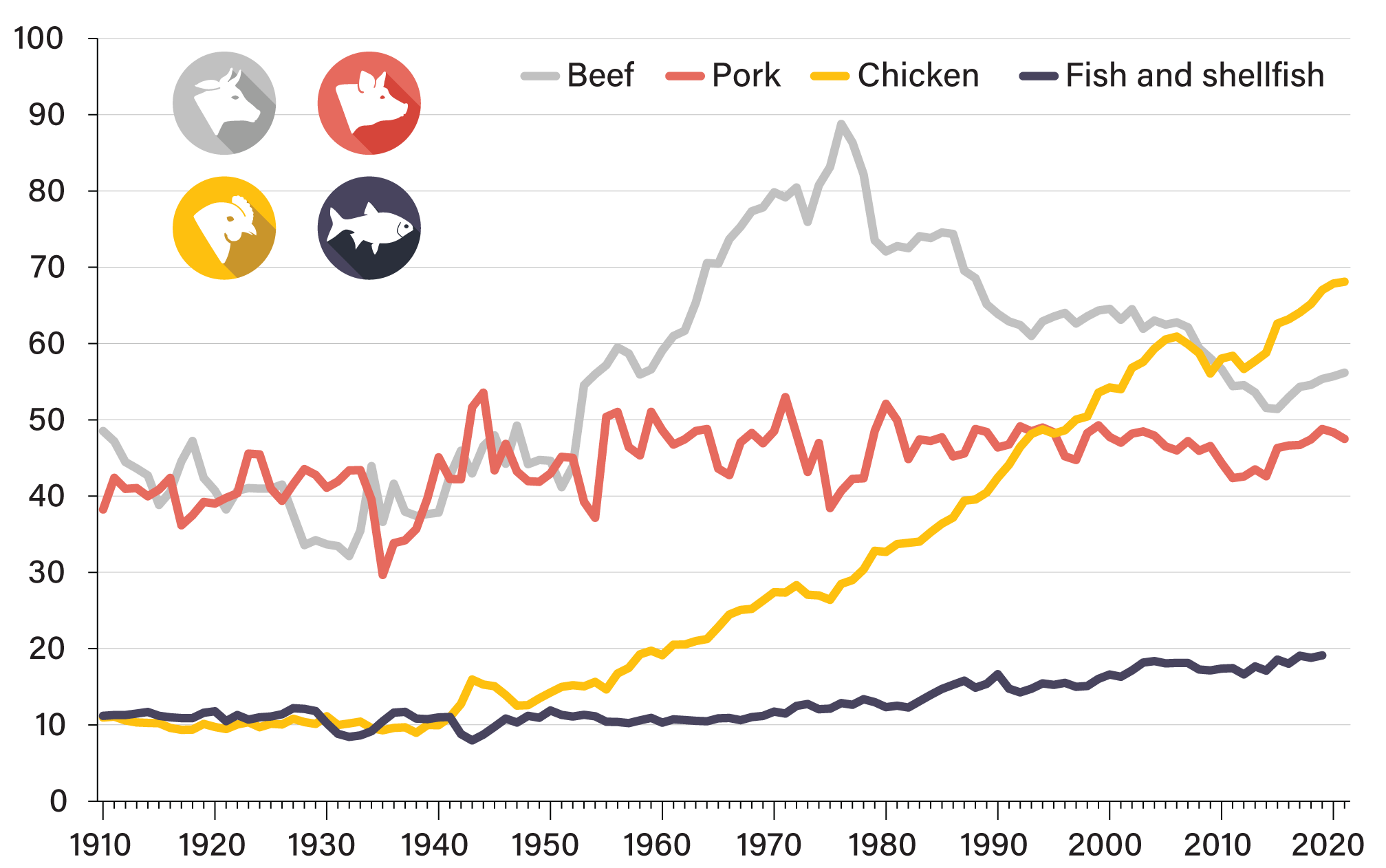
Those 200 pounds consist of chicken in the number one position at 68 pounds; beef at 56; pork, 48; turkey, 12; and about 20 pounds of fish. That’s over a half-pound of meat, poultry, and fish per American per day.
The reason that many Americans have been reducing their red meat consumption is that they’ve received the message about red meat being bad for your health. The true science is very clear on three points: red meat is linked to cancer, red meat in general has a lot of saturated fat which is linked to heart disease, and most Americans get more than the recommended level of protein.
Groups concerned with the environment have long publicized the heavy climate burden of cattle. Livestock, mostly cattle, are responsible for 15% of human-created greenhouse gas from their burps and production of manure. Additional sources of emissions are due to the loss of forest for pasture, the production of feed, and manure storage. However, survey data indicate that environmental concerns are not, for most people, a big motivator in their reduction of red meat consumption.
Apart from health, the other key factor in reduced red meat consumption, is cost.
Since the pandemic beef has led all food products in cost increases: roasts have gone up 74%, steaks 57%, and ground beef 53%. But while alarm bells have been ringing with the price of round roast hitting $9 a pound at the end of 2025, round was at $11 a pound – adjusted for inflation – in 1980, a few years after the peak of beef consumption in the mid-70s.
In short, beef got very popular and then very expensive and as the demand fell, prices fell, but now they’re back up despite only a very slow growth in demand over the last decade. It may be a difficult task for RFK, Jr. and the USDA to boost consumption much at this point.
And, despite the scientific consensus around the increased health risks associated with red meat, Kennedy wants us to eat more for our health. He believes we need more protein, while most nutritionists agree that generally we eat much more than we need.
Kennedy’s beliefs coincide with the mission of the USDA to support the cattle industry. Kennedy embrace of this symbiotic relationship was demonstrated in his February address to the National Cattlemen’s Beef Association, “begging” them to vastly expand the size of their herds to accommodate increased consumer demand and drive prices lower.
RFK, Jr.’s comment on herd expansion alarmed environmentalists. According to reporting in The Guardian, The World Resources Institute has calculated that to expand the American herd by 25 million head of beef cattle, 100 million acres of arable land would be required in the U.S. There are currently 86 million head of cattle in beef production, a 75 year low. The conversion of 100 million acres, about the size of California, would come at great cost in methane gas emissions and loss of land that would otherwise be a carbon sink or produce lower-burden plant protein.
Will Kennedy succeed?
Not only will RFK, Jr. and the USDA be fighting the widening understanding of the health risks linked to red meat and the price of beef at the supermarket, but they will also be fighting demographics. A 2023 study analyzed CDC National Survey data from 2015 to 2018 and found that 12% of American adults eat half of the beef we consumed.
That highest consuming population tends to be in the 50- to 65-year-old range. They were kids at the peak of beef consumption in the 1970s.
Foods we are exposed to at an early age make a biological imprint on us as part of the creation of our culinary compass. A large component of this early setting of food preferences is our family’s food culture. In short, children and teens fed a lot of meat, as many were in the 1970s, were tending to learn a lifelong meat habit. In coming years, as those heavy meat eaters age out of the population, the beef marketers are going to have to work even harder to bolster sales.
Plant protein and grain
When we hear the advice to eat more plant protein, we may think first about whether we could eat more beans like soy or many others. We may also tend to increase consumption of plant-based meat alternatives, like Impossible Burgers. We may not be conscious that on average 31% of the protein Americans eat already comes from plants, mostly from grains. Our diet is in contrast to the average diet in lower-income countries where 70% of protein comes from plants.
What about plant-based meat alternatives?
A 2025 study found plant-based, what I call “pretend,” meat had just 1.4% of the retail meat market share in the U.S.
It may be difficult to evaluate any health benefits of plant-based meat alternatives compared to actual meat or to plant protein sources in grains or beans, as plant-based meat alternatives are ultraprocessed foods with a wide variety of mixes of ingredients. These highly-promoted, lab-designed and manufactured products are convenient and likely more healthy than red meat products they replace, although pretend chicken or turkey replacements for organic poultry are a hard health sell for me.
If you believe in the greater certainty of the health benefits of real food, for additional concentrated plant protein, minimally processed ingredients like beans or moderately processed foods like tofu or tempeh might make sense.
Moving forward
So no, for pressures of cost, health, and the increasing difficulty of political and agricultural policy leaders in denying the climate crisis, I don’t think we are going back to the beef consumption America saw in yester year.
The cowboy and beef, and the heightened, comfortable machismo state they have evoked in our culture, are becoming saddle sore, encroached, and endangered in America.
In fact, let me be the first, or perhaps among the first, to propose a rational but radical idea. States and localities have authority to regulate and tax unhealthy substances, think tobacco, alcohol, marijuana (for those states where it is legal), and has been attempted in a few places, sugar-sweetened beverages. Tax revenues from these sources can be and sometimes have been used to pay for health expenses incurred by the state because of these substances. What brave state will be the first to tax red meat? Or ultraprocessed food, for that matter?
My dream is that nutrition will be an apex science some day: treated as one of the foremost disciplines in maximizing the health of humans. Then, having written the codex spelling out how our bodies metabolize food and how to eat healthy, nutrition can take a seat next to Newtonian physics: always fundamental, exerting its rule every moment of our lives, but just part of life. No need to think about it. In my dream gastronomy will become very simple like basic physics: apples fall from trees, and we eat them… and other real foods.
Thank you for reading. Please subscribe if you haven’t, share this post, give it a like, or share in the comments. You are key to keeping Eating in America growing, and I appreciate your help.


