
Farming districts, which tend to be heavily Republican and pro-Trump, have been buffeted in the quickly changing tariff, food stamp, Farm Bill, and farm subsidy winds of the Trump administration and Congress, as Eating in America pointed out recently. But agribusiness’s support for Trump has not been forgotten, as we are reminded in news about the way the Labor Department sets farm minimum wages to protect American farm workers.
In affirmation of a long-standing prediction by economists and reiterated in Eating in America last week, the Labor Department has warned that the new shortage of immigrant farm workers, due to Trump’s anti-immigrant policies, threatens a rise in food prices. This alarm, in the text of a Labor Department rule posting which revised the methodology for setting farm wages, was reported by the Washington Post.
Given the drop in migrant farm labor, the Labor Department foresees “imminent economic harm” with the potential for billions of dollars in lost farm operator revenue. The Labor Department, in the rule, states that American workers are unwilling to take the farm jobs migrants are leaving, citing the physical demands, long hours, and exposure to extreme weather.
Ironically, the Labor Department’s sudden switch to new methodology to calculate farm wage rates is required because the USDA in August killed the annual USDA Farm Labor Survey, the most reliable indicator of farm wage levels paid to Americans and, previously, the basis for setting required farm wages. The set rates varied by state but were, in general, considerably higher than state and federal minimum wages. Replacing the Farm Labor Survey with a less accurate method proposed by the Labor Department will have the effect of allowing farms and ranches to pay workers much less, increasing farm and livestock producer profits.
When the first Trump administration tried to kill the Farm Labor Survey in 2020, the move was knocked down by the courts, since the resulting mis-estimation of farm wage levels would indeed have lowered required wages. Farm workers, Americans and migrants both, would have seen $171 million taken from their pockets and put in the hands of farm operators. When Trump’s USDA killed the survey again last month, farm groups rejoiced. The expectation was that many farm operators and livestock producers will be able to lower wages, especially those paid to foreign workers.
This scenario, of course, depends on farms being able to hire foreign workers, who, in fear of ICE, have left farms in great numbers this year. Trump is trying to redress this shortage by making it easier, since the beginning of October, for farm operators to apply for H2-A temporary farm worker visas. 315,000 such visas were issued last year, but it is estimated that the farm worker population has diminished by 155,000 this year due to immigration enforcement.
The number of H2-A visas that may be issued is uncapped, and almost all farm operator applicants are granted visas for use by workers. The hope is that if the application process is easy enough, the number of visas used by migrant workers will be greatly increased.
Ironically, Trump pretends to be protecting American workers’ wages by getting rid of migrants. Instead, in the case of agricultural workers, he is choosing to allow wages for Americans to drop as exploitative wages are accepted by H2-A visa workers. Lower wages will make farm operators richer and, the hope is, by enabling sufficient farm staffing, still protect farm production levels and prevent food prices from zooming, which would cause wide dissatisfaction among American voters.
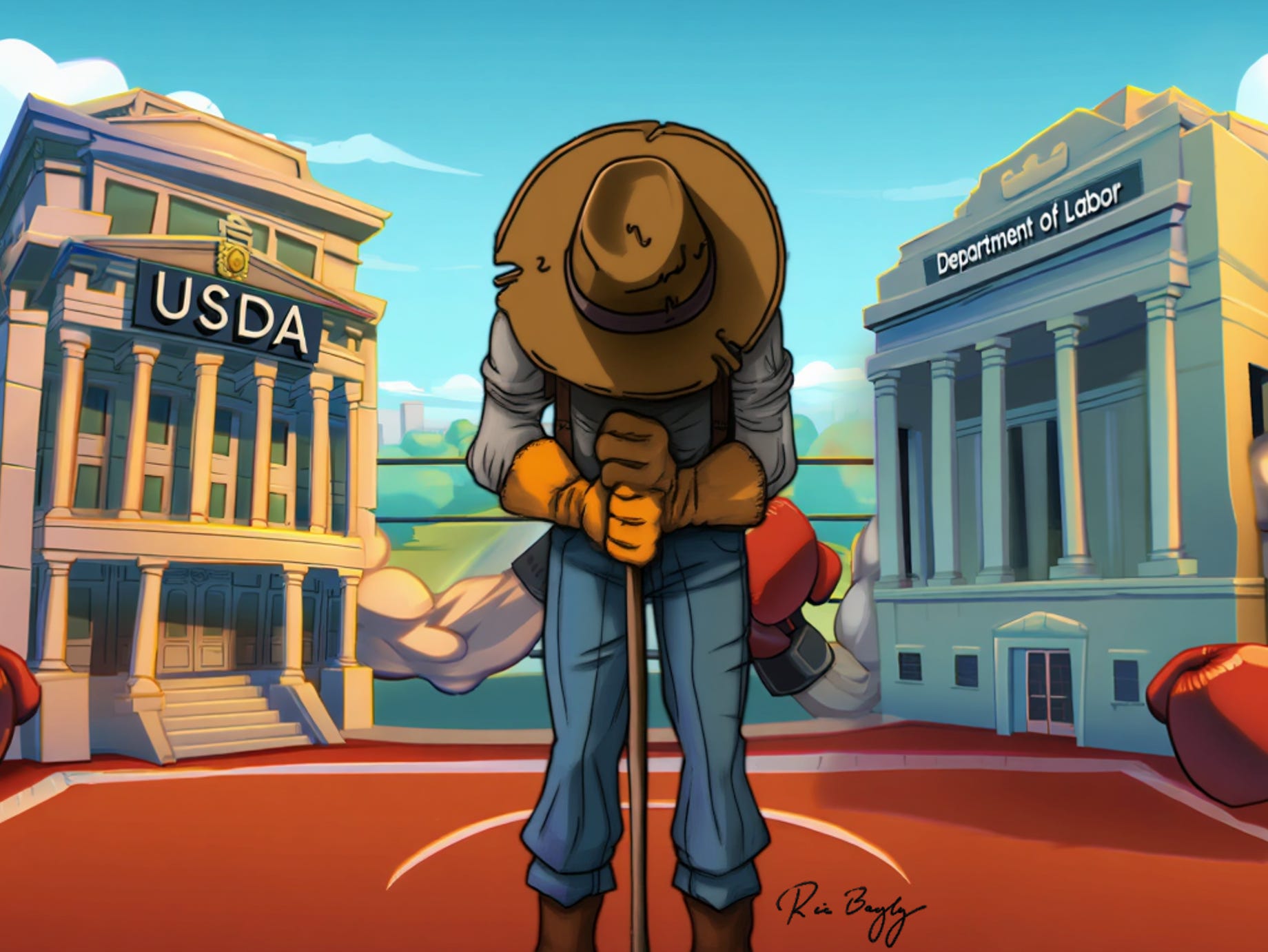
With the killing of the Farm Labor Survey, we again see American workers thrown under the bus by Trump and two federal departments moving in opposite directions, with the Department of Labor trying to comply with the law protecting American wages and the USDA complying with the wishes of farm and livestock operators and their lobbying groups by paving the way for lower wages.


