
The new 2025 Dietary Guidelines are due out this month, according to RFK Jr.
Significant changes may be coming!
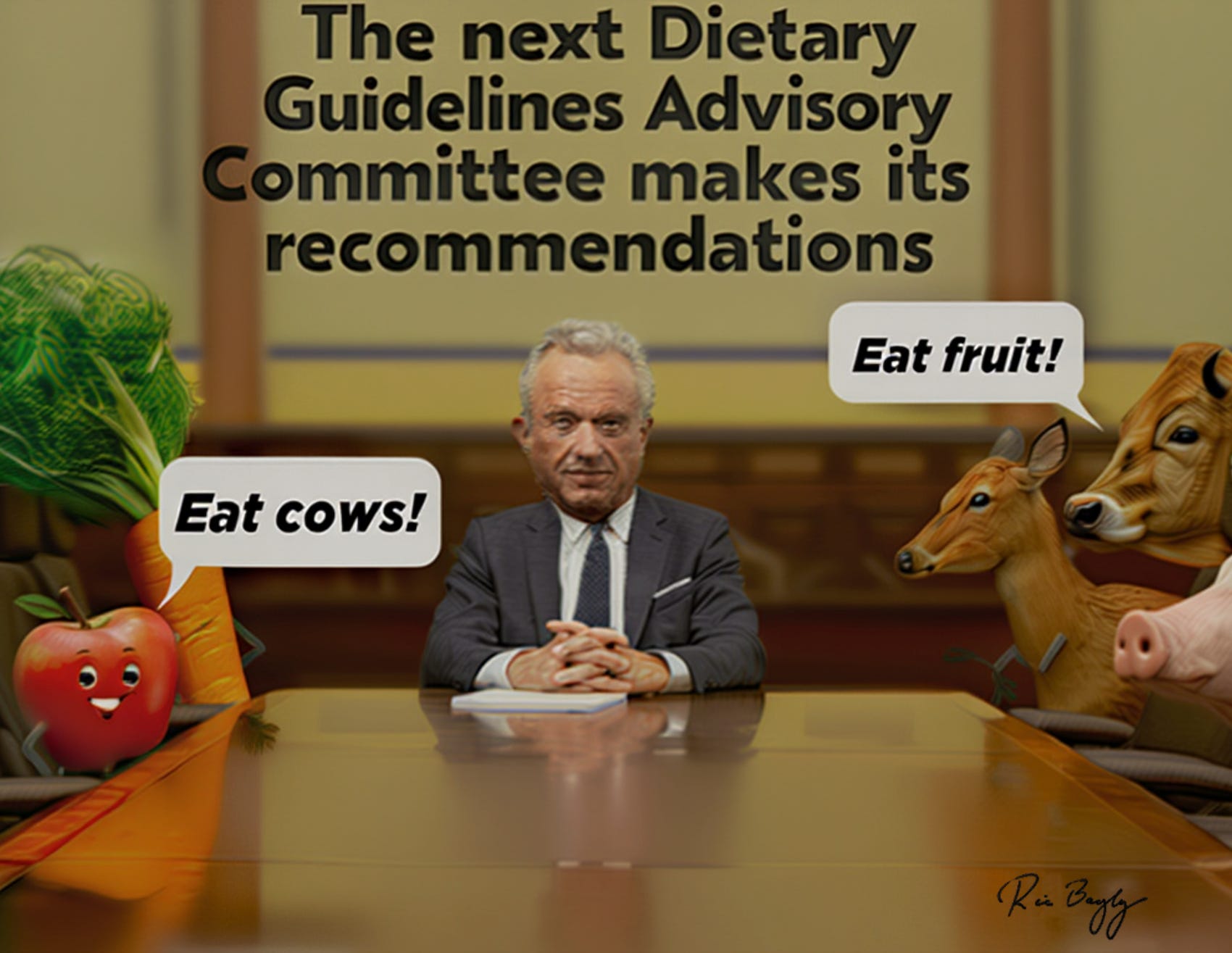
The Dietary Guidelines have, in the past, been largely guided by science. This year Secretary of Health and Human Services Kennedy would like them to reflect his own particular ideas about healthy food. Given the makeup of his Advisory Committee on Immunization Practices, we know Kennedy feels unrestrained by the evidence of science when it comes to public health. We’ll soon see if this is reflected in the new Dietary Guidelines.
But no matter if Kennedy is able to override science to assert his own beliefs in the new Guidelines, going forward, the 2030 Guidelines, and the Report of the 2030 Guidelines Scientific Advisory Committee, which is meant to inform the Guidelines, need to be updated to address the rapid downward slide of American nutritional health that has occurred over the last 75 years. The pace of change of the Guidelines must be accelerated to address the pace of change of our food environment.
The last Guidelines were 160 pages long to provide detailed guidance for a host of Federal and state nutritional programs, and for policymakers and health professionals. Kennedy has promised a 4-to-6-page document this time. A six-pager, with necessarily general guidance, if issued, would present a great challenge of interpretation to the nutrition programs that depend on the Guidelines. Brevity would provide a strong focus on any changes to the Guidance, but the most important possible beneficial change, the condemnation of unhealthy ultraprocessed food in our diets, has so far been squashed by the ultraprocessed food industry and their insiders in the administration.
The 2025 Guidelines’ Scientific Advisors were appointed, in the usual secretive process reflecting corporate influence, by Biden’s USDA and Department of Health and Human Services. However, all of the 2025 Advisors had true scientific bonafides.
The next Dietary Guidelines Scientific Advisory Committee is due to be appointed by the Trump USDA and Department of Health and Human Services, the politicized nature of which poses the potential that it will be a sham, in the same way that the current Advisory Committee on Immunization Practices appointed by Kennedy is an embarrassment for public health and a lethal danger to Americans.
With the current administration tilting toward heavy corporate influence in governance and dismissal of science as a key to American well-being, combined with a diet-based health crisis of obesity, now is the moment to strongly advocate for change in the formulation of the next Dietary Guidelines.
This month I attended a panel discussion with 2025 Dietary Guidelines Scientific Advisory Committee Chair Dr. Sara Booth. When asked about public compliance with the Guidelines, Dr. Booth noted that, sadly, there is not much compliance: we have a failing grade at healthy eating in our society. Most interestingly, Dr. Booth advocated that the next Scientific Committee revisit the question of eating behaviors to address lack of public compliance to the Guidelines. This year’s Scientific Report cited the need for research of eating environment changes that can support behavioral change, giving the home as an example.
That is a baby step.
Eating behaviors in today’s food environment are in large measure created by the marketing and sale of lab-designed, hyperpalatable, high-profit-margin, ultraprocessed food. These products prey on our biological and psychological responses to their combinations of salt, sugar, carbohydrates, and fat – and to the manufactured sensory appeal of the food apart from the taste. Like lab rats, we feel rewarded when we see, taste, and ingest these products, and we soon want more.
The 2025 Scientific Advisory Committee punted on the issue of ultraprocessed food. According to Dr. Booth, some Advisors argued that the Committee was already accounting for the effects of ultraprocessed food as they evaluated its components. This approach in isolation overlooks the fact that these foods are designed to work in combination. The successful formulation of ultraprocessed food depends on the whole being greater than the sum of the parts. That is the guiding principle of ultraprocessed food.
I am never excited about eating a minimally processed baked potato with salt and butter, but I can devour a bag of McDonald’s french fries with its list of 10 to 20 ingredients, working together to trigger the reward circuit in my brain. The ultraprocessed difference for me and other consumers ends up in the quantity and quality of nutrients and the number of calories consumed.
The 2030 Dietary Guidelines Scientific Advisory Report needs to account for the ultraprocessed food effects on diet that simple minimally processed food ingredients don’t elicit.
The Dietary Guidelines themselves are intended to make recommendations with the end goal of our healthy eating. As Dr. Booth pointed out, decade after decade, five-year iteration to five-year iteration, the Guidelines evolve a little each time but are always healthy. And the public always gets a failing grade at eating to the Guidelines standards. However, the failure is really that of our federal and state governments who have neglected to ensure the safety and healthiness of our food environment and to protect the public.
In the last half of the twentieth century our food environment underwent a technology-driven, historically unprecedented transformation, the scale of which has never been seen. Ultraprocessed food grew from a small portion of our diet to 55% of our calories, 62% when just youths ages one to 18 are considered. Now, on any given day, almost 10% of us get more than half of our calories from fast food. On any given day, one-third of us patronize a fast-food seller.
When the first formal dietary guidelines were produced in 1980, the explosion of fast and other ultraprocessed food and the obesity epidemic were both just getting started. Ultraprocessed food was not even named until 2009, and the fact the U.S. and the world were in a growing obesity epidemic was not identified until the 1990s.
In effectiveness, what penicillin was to infection, GLP-1s are to obesity. But unlike an antibiotic, Zepbound, Ozempic, and that class of drugs are a fix to the symptom, not to the problem. Even with a possible leveling off of the number of adults with obesity (about 40%), the obesity epidemic is not about to end – even though drugs may help hide it. And severe obesity (about 9% of adults) is continuing to increase.
As Dr. Chris van Tulleken said last month in introducing the public health action paper in the new Lancet trilogy of papers on ultraprocessed food, the obesity epidemic is commercially driven. And the money is huge. The ultraprocessed food lobby is the biggest lobby in Washington by a wide margin.
The Dietary Guidelines have slowly evolved while the U.S. has found itself in a food environment crisis in a new era in food history. In response to these changes, it is time for the Dietary Guidelines to reboot and grapple with ultraprocessed food. The Scientific Committee needs to investigate eating behavior, as Dr. Booth proposes, and so, of necessity, investigate the drivers of unhealthy eating behavior in our food environment.
The Scientific Committee is concerned with the nutrient effects of food components and so in this cycle deferred making recommendations about ultraprocessed food, saying it required a standardized definition of ultraprocessed food that could be researched with results that could be compared across studies. A federal ultraprocessed food standard definition, while promised by RFK, Jr. and the recent Make America Healthy Again Strategy Report, may or may not come within the current administration’s term. A body of research adhering to a standardized definition is years in the future at best.
A new approach for the next Scientific Committee is required, an approach focused on the biological effects of hyperpalatable foods, how those effects drive how we eat, and how the 2030 Dietary Guidelines should take those hyperpalatable foods into account. The crushing burden of chronic disease due to our unhealthy eating has been made abundantly clear, in the research and in the personal lives of Americans. Assertive action by the 2030 Dietary Guidelines Scientific Advisory Committee and by the USDA and HHS is required, with the goal of helping Americans live longer and healthier.
Thank you for reading. Please subscribe if you haven’t and share Eating in America with your friends.


