

The 2025 Dietary Guidelines are finally here. Revealing them took a lot longer than Bobby Kennedy expected.
It turns out that, working in secret, Brooke Rollins’ USDA and RFK Jr.’s Department of Health and Human Services went to the trouble of writing a whole new science report to replace the one that didn’t say what they, and their friends in the cattle, pork, and dairy industries, wanted it to say.
To create the report, Secretaries Rollins and Kennedy secretly appointed a whole new committee with blatant, strong ties to the industries whose products they were primarily writing about. Creating science takes time, even when it is preordained science, but the secret committee did write a tremendous amount in a very short period.
We’ll get back to the report in Part 2 of this podcast.
Part 1: Biggest takeaways
One of the most important recommendations in the new Guidelines is to consume no added sugar. This recommendation is for everyone but is also repeated explicitly for children under the age of eleven. The Guideline’s position is clear, direct, and could be – maybe not under Trump but down the road – the basis for policy and program changes that would eventually make a difference in American health and fitness. Excellent progress.
The other big recommendation is to reduce consumption of unhealthy categories of ultraprocessed food, called here “highly processed food.” Highly processed foods are condemned and warned against and that is a pleasant surprise and a political win for Kennedy, who had been shut down on ultraprocessed food in the Make America Healthy Again Strategy Report of September. Regardless of the politics this was excellent progress.
The promoting of red meat is the biggest negative in the new recommendations. The link between red meat and cancer is removed in this version. Big win here for the cattle and pork industries and a step back for healthy food.
The saturated-fat-friendly language relative to meat and dairy is a very bad message for the public, but, for the dieticians and program planners, the retention of the 10% limit on fat calories from previous Guidelines makes adding more red meat and whole fat dairy to the meals they plan a challenge. But, in essence, a big win here for cattle, pork, and dairy.
The alcohol language is watered down. Drink limit recommendations are left out, as is the warning about how any amount of alcohol consumption is linked to cancer. The alcohol lobby is popping their most expensive champaign to toast their win on this.
These Guidelines shift from the previous approach of focusing on a precise standard addressed to dieticians and policy and program designers. The old Guidelines needed subsequent interpretation for the public, while the new Guidelines directly address the public. They are readable, concise, and largely clear. They’ll have to be interpreted back in the other direction – for use by dieticians, policy makers, and program designers. However, the more the public understands what is required, the more they can advocate for the massive change in policies that will allow Americans to achieve healthy diets.
The bottom line: the newly issued Dietary Guidelines for Americans, 2025, will do real harm around red meat, alcohol, and saturated fat, but, given that the Guidelines push hard on two important points about sugar and ultraprocessed food that have needed hard pushes, these Guidelines might, on balance, do some real good in the long run. This will depend, however, on if and when valid, true science returns to being an imperative when federal nutrition messaging and health policy are made.
Regardless, with the new language in the Guidelines about sugar and highly processed foods, there is no going back. A barrier has been cleared that might allow going forward from a policy standpoint.
Part 2: Pseudo-science, propaganda, pyramids, and how it all breaks down
Pseudo-science and propaganda
We knew the new Guidelines would ultimately be controlled by ideology and big money influence and not by science. Unfortunately, Kennedy and Rollins went to the trouble of having a group of industry-entwined scientists do their bidding and find science to match Kennedy and Rollins’ personal ideas of truth - and provide talking points for their propaganda lies about the old and new Guidelines. If you look in their new Dietary Guidelines upside-down-science report (the conclusions were clearly dictated ahead of time and the science was filled in to support them) you can find a disclosure of Conflicts of Interest that makes Kennedy and Rollins’ complaining about previous industry influence in the Guidelines utter, outrageous hypocrisy. Seven out of nine of the Kennedy/Rollins scientists have strong ties to cattle, pork, dairy, supplement and meal substitute peddlers, Big Food, grain farmers, or GLP-1 business interests.
That wacky food pyramid – again?
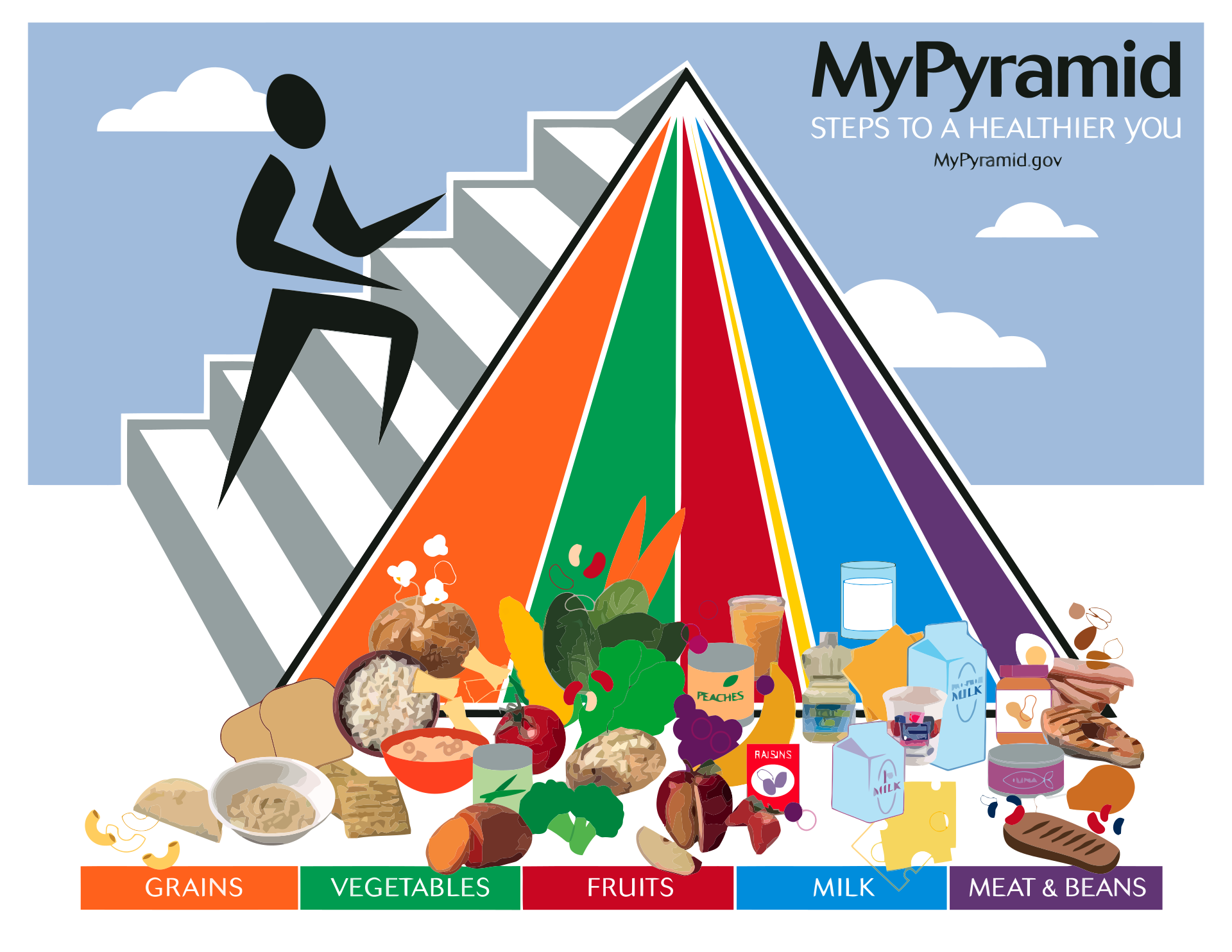
While the official use of the USDA food pyramid is 15 years in the past – it was replaced by the MyPlate graphic in 2011 – its simplicity in depicting the supposedly best way to eat has kept it present in nutrition discussions to the present day. Now RFK, Jr. and USDA Secretary Rollins have officially resurrected it.
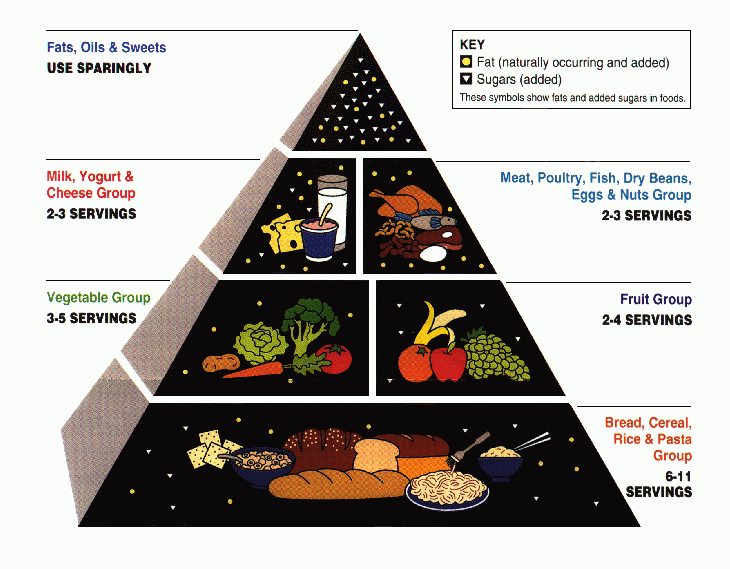
However, like the prior two food pyramids from 1990 and 2005, this reincarnation is awkward and unrealistic, and, since the pyramid is now standing on its tip, to me it is disconcertingly unbalanced. Grains are now at the bottom (the narrow upside-down tip), essentially making the pyramid represent a low carb diet, which very few Americans are going to agree to adopt any time soon.
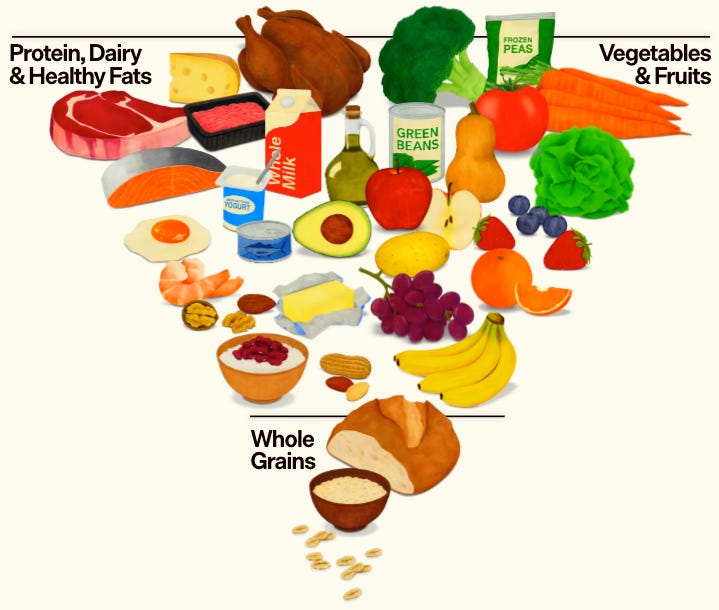
But wait, the food items are drawn such that the ones lower in the pyramid very slightly hide the items above. Seen this way, the pyramid is like a rack of billiard balls on a pool table, the balls at the tip slightly hiding the balls behind.
In this perspective it’s ambiguous as to what is the top and what is the bottom: all of the food items can be seen as on the same nutritional level and contributors to a healthy diet. I like that perspective, intended or not. And it is a clean, attractive graphic, especially compared to the weird 2005 version.
The images of frozen peas and canned green beans are quite legible in the new pyramid. I like their inclusion because it acknowledges that frozen and canned vegetables, which are more affordable, can be just as nutritious, and sometimes more so, than fresh ones. And for Americans to incorporate a lot more produce into their diets, it is going to have to be more affordable. And you can see a big slab of healthy salmon up near the top (below a fat-rippled slab of steak, of course!)
Oh, and I like the motto that comes with these Guidelines: “Eat Real Food.” This is adapted from Michael Pollan’s mantra: “Eat food. Not too much. Mostly plants.” Kennedy was sure to leave out the “mostly plants” part, but “Eat real food” is still an good motto to promote.
The new versus the old recommendations – what went right and what went wrong
Protein
The 2025 Guidelines push protein, saying eating twice as much as previously recommended. These Guidelines are friendly to red meat where the 2020 Guidelines encouraged fish and vegetable proteins and discouraged meat that was processed.
Americans generally get enough protein. Doubling intake is not necessary under normal conditions.
However, increasing protein is, by itself, fine – more protein is, in moderation, nutritionally harmless and, if done as a substitute for refined carbohydrates, provides calories that are metabolized much more slowly, a good thing. The caution would be in adding red meat as part of that increased protein because of red meat’s links to heart disease and cancer.
Also, some fish have such high levels of mercury that they should be avoided or eaten sparingly. RFK, Jr. himself had mercury poisoning from frequent eating of tuna. I can’t let it go unsaid that unfortunately, while Kennedy railed against mercury in the environment prior to becoming Secretary of Health, he has had tight lips as Trump has begun rolling back mercury-emission regulations.
Dairy
The 2025 Guidelines want us to include full fat dairy, but exclude dairy that has added sugar. The 2020 guidelines specified drinking no-fat or reduced-fat milk and omitted any mention of added sugar.
The 2020 Guidelines pointed out that 90% of Americans do not consume enough dairy.
In that light, the consumption of saturated fat in whole milk and other dairy products could be weighed by the individual against consumption of other sources of saturated fat, like red meat, the goal being to increase milk consumption with its nutrients like calcium and added Vitamin D.
Recommending exclusion of added sugar from milk is good. Other ways must be found to increase milk consumption in kids apart from adding sugar in flavored milk.
Gut health
Gut health appears in the new Guidelines for the first time.
They point out that highly processed foods are disruptive for the trillions of bacteria in our colons and that this microbiome of organisms plays a key role in our health. Vegetables, fruits, and fermented and high fiber foods are recommended for gut health.
Vegetables and fruit
The essential message in the new Guidelines remains the same: Eat lots of vegetables and fruits, and canned (without sugar) and frozen vegetables and fruits are just fine. The more detailed 2020 Guidelines took care to point out that 90% of Americans don’t eat enough vegetables and 80% not enough fruit.
The new Guidelines recommend 3 servings of vegetables and 2 of fruit. This is more or less the same as the 2020 recommendations, but those were expressed in cups. Cups are nice and precise for dieticians planning meals for schools or the military, but don’t communicate well with the public who would rather just know they can grab an apple or put a pile of carrots on their plate to begin to meet their health needs.
Any uptick in fruit and vegetable consumption on the part of the public would be a win but still leave consumers far from meeting the fruit and vegetable recommendations. And these Guidelines are all about the public. The dieticians and program planners are going to have to interpret them for their own specific purposes.
Healthy fats
The 2025 Guidelines claim, against the evidence, that saturated fats in meat and dairy are healthy and advocate for their use. However, the 2025 Guidelines still stick to the recommended 10% limit on saturated fat consumption from previous Guidelines and call for more research into healthy fats.
Seeds are still identified as good sources of healthy fats in 2025, but, per RFK, Jr.’s personal beliefs, healthy seed oils like canola, soybean, and corn, don’t get a mention.
Whole grains and refined carbohydrates
The new Guidelines say to prioritize whole grains and reduce highly refined grains in a way that is stronger than the previous Guidelines.
More than two-thirds of our bread, a major source of grain in the American diet, is white, and 23% is a mix of white and whole grain. I like the simple dictum of the 2025 Guidelines: switch from highly refined grains to whole grains. This is a stronger approach for the public than the previous Guidelines’ advice to limit refined grains to 50% of grain consumption, which is an almost impossible calculation to make or goal to achieve for the average American consumer whose highly refined grain consumption is way more than 50%.
There are a few additional considerations in the whole grains crusade that always go unmentioned. We often have the wrong idea how much whole grain versus refined flour is in our bread, pasta, frozen waffles, or breakfast cereal labeled as multigrain or as made with whole grains. These products can be mostly refined flour. Where is the acknowledgement of that?
And where is the acknowledgement that most of the time to make whole wheat flour, the wheat berry is milled to separate the endosperm (the source of the white flour), from the germ and bran, which are then all separately ground down fine and recombined to qualify for the term “whole wheat” on the label or in the name? This type of whole wheat bread has a palatable, smooth consistency. It just doesn’t have all the nutrients, phytochemicals, and structurally intact fiber that were in the original wheat berries and that are retained in whole wheat flour made by grinding down the wheat berries without separating their three parts. Phytochemicals have very important antioxidant, anti-inflammatory, and antimicrobial effects in our system.
Grain products with added fiber similarly are missing vitamins, nutrients, and phytochemicals.
Real food in the form of grain is not highly refined. Policy is needed at the federal level to reduce the use of nutrient- and fiber-deficient refined grains in favor of whole grains, and the Guidelines have yet to provide real impetus for that change.
Ultraprocessed food
The new Guidelines call for “a dramatic reduction in highly processed foods laden with refined carbohydrates, added sugars, excess sodium, unhealthy fats, and chemical additives…”
No argument from me.
Sugar
On average according to the USDA, Americans eat and drink 34 teaspoons of sugar a day. That’s 544 calories worth.
The 2025 Guidelines say, “While no amount of added sugars or non-nutritive sweeteners is recommended or considered part of a healthy or nutritious diet, one meal should contain no more than 10 grams of added sugars.” I won’t bore you with the math, but this is way less sugar than the old 10% of calories recommendation.
The sugar language is perhaps the most important improvement in the Guidelines. Basically, it says don’t eat added sugar, and if you have to, cut down a lot from the average. The sugar recommendation is even stronger for children. Previously the recommendation was that children under 2 should not have added sugar. The new Guidelines say no added sugar before age 11.
My hope is that this new sugar language can be a bit of a turning point and momentum can build from here toward political action and regulation aimed to eventually returning control of our sugar-contaminated food environment to the people.
Salt
The 2025 Guidelines are basically the same as before but specifically recommend avoiding highly processed foods high in sodium.
Alcohol
In a big reversal, the 2025 Guidelines say, weakly, “Consume less alcohol.” The 2020 Guidelines said limit alcohol to two drinks for men, one for women and that alcohol in any amount is associated with cancer.
The alcohol industry is the 4th largest lobby in America, after ultraprocessed food, tobacco, and gambling. Alcohol’s big money lobby, and the Trump administration’s level of susceptibility to big money influence, likely explain why alcohol had a huge win in diluting the alcohol recommendations in the new Guidelines.
The basis for the watered-down language was provided by a new National Academies of Sciences report on the health effects of alcohol. According to the National Academies’ report, if you are drinking moderately, as within the limits previously stipulated by the Dietary Guidelines, you’re not increasing your risk of death and may be decreasing it. However, there’s no evidence supporting doing away with a moderate drinking limit in the Guidelines and the evidence linking alcohol to the risk of cancer and heart and liver disease continues to strengthen.
I guess a reluctant tip of the glass to the alcohol lobby is in order.
A proposal for 2030
In 2030 when the next Guidelines are due, I would like to propose the name of the document be changed to “Dietary Guidelines for America,” not “Americans.” The guidelines are meant to inform policy formation, but their title implies it is the sole responsibility of Americans as individuals if they want to eat healthy food in line with the Guidelines. However, obesity and malnutrition are diseases, and malnutrition in America is caused not only by inability to get sufficient calories but also by being overfed but still badly nourished. Curing these diseases depends on our government taking responsibility for cleaning up the food environment to make it healthy.
Kennedy and Rollins’ introduction to the new Guidelines lays part of the blame for the ongoing devastation of diet-related chronic disease on past federal policies. This is more than true. The worst food environment in American history can only move toward healing and rehabilitation if policy changes are made and new policies formulated.
The USDA, Kennedy’s Health and Human Services Department, the larger administration, and Congress should all be working in favor of the people when the people’s interests collide with those of Big Food and Big Agriculture.
Thank you for reading. Your support is helping this community grow. Please like, comment, and share Eating in America with your friends.


