
This post is in the “totally bonus” category. This short, summarized description of a proposed highly- and ultra-processed food definition is for scientists and policy makers familiar with this important issue as well as anyone with an interest. So if you missed the first version of this piece a couple of days ago, maybe because it was a lot longer, here is a chance to hear the essence of it. And some of the ideas have been revised or clarified since then.
If you feel done with HUPF for the moment, a podcast on coffee production in the mountains of Panama is coming in the next few days. I recently had an interesting visit there and got to ask about the role of the indigenous people on the coffee plantations.
Back to HUPF:
A federal definition of Highly- and Ultra-Processed Food (HUPF) is coming. How HUPF is defined is important to two opposing interests: Big Food with its future profits at stake is certainly lobbying hard on the issue with the Trump administration, and the American people with their health in jeopardy have the voice of RFK, Jr., who has been badly losing on the HUPF fight to date.
Using the original definition by Carlos Monteiro from 2009, 55% of the calories Americans eat are HUPF and those HUPF calories have strong links to chronic disease. If a clear, strong definition is achieved, it could provide the basis for policy that grows in effectiveness over time and minimize the opportunities for Big Food to lobby and connive its way out of regulation.
A durable, strong definition will be clean and simple, which I suggest is best achieved by identifying the technology that is essential to the creation of HUPF and using the historical timeline a technical framework provides.
This timeline is easy to determine. All HUPF is a product of innovations in technology in the last two hundred years. It was the Second Industrial Revolution (mid-19th to mid-20th centuries) and Third Industrial Revolution (the post-World War II Digital Age) that enabled the creation of new food products and additives that humans had not previously encountered or consumed. The great bulk of these have been created in the Third Industrial Revolution since 1945. Of course, we are continuing to create new food substances and additives in the 21st century as we enter what some have termed a Fourth Industrial Revolution, but it may be too early to define the current era.
The proposed definition is:
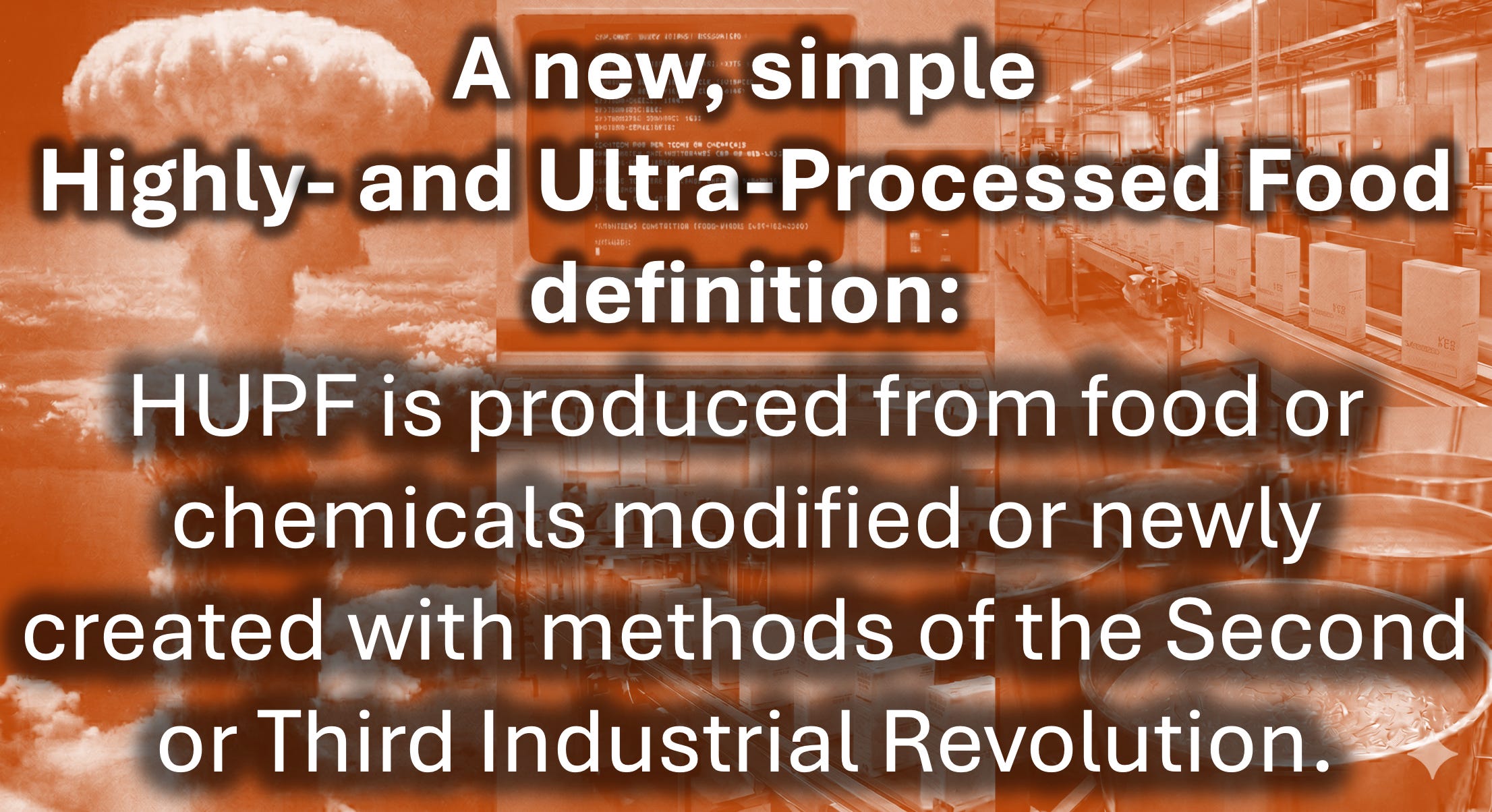
Highly- and ultra-processed food is produced from food or chemicals modified or newly created with methods of the Second or Third Industrial Revolution, or moderately processed food that has become a health risk because it is mass produced with new technology and can now be over-consumed.
That is a strong, simple, working HUPF definition in 46 words.
There are several tenets to this working definition:
1. HUPF is unnatural food.
2. Everything that is natural food predates the Second Industrial Revolution and has been consumed by humans for a long time. (This claim bears checking, but I can’t think of a natural food that was created after the Second Industrial Revolution began.)
Intuitively, hundreds of millions of humans have manipulated their available natural foods with any tools and chemical processes at their disposal over the course of human history. Invention of moderate food processing techniques to create new foods and additives – many fermented foods are ancient examples – will have played itself out by the time of the Second Industrial Revolution.
3. Because of our accumulated cultural experience, natural food tends to be healthy, how we tend to eat it.
4. HUPF is not, by this working definition, unhealthy, but for most of the thousands and thousands of HUPF substances, healthiness is not well certified.
This definition provides room for nutritionists to weigh as appropriate to each implementation the healthiness of individual substances and categories, some of which may be ambiguous, like bread with reconstituted whole wheat flour and the category of seed oils.
Everything that is HUPF is a new industrial invention, or it is a food that is a new risk because of mass production, which is made possible by a high level of processing. Newly over-consumed substances like refined sugar, highly refined flour, salt, and white rice are in this sub-category of HUPF.
5. While the beginning of the Second Industrial Revolution likely marks the point after which any newly created food or additive is HUPF, it seems reasonable to assert that any food substance or additive created after 1945, approximately the beginning of the Third Industrial Revolution, is HUPF. This includes most HUPF, thousands of which have not been identified, catalogued, or certified by our government.
We can say no new natural foods have entered human food environments since at least 1945 and any food or additive created after 1945 is HUPF. Some HUPF is older. Hydrogenated vegetable oil, for example, was invented in 1901. It’s possible the watershed date should shift 100 years earlier.
6. Any definition of HUPF, simple or complex, will require exceptions when implemented in law, policy, regulations, or programs. Exceptions will be added based on the circumstances of jurisdiction, institutional setting, nutritional needs, economic and financial dictates, or political influences. In order to have a defensible policy, the exceptions should be added to the language of the implementation and not be part of the main definition. In definitions offered and enacted so far, exceptions have been embedded in the definition – where they invite argument. I cannot think of any exceptions inherent to the simple working definition offered.
7. The proposed HUPF definition is in harmony with the original 2009 definition of Monteiro that has been the foundation of most research on the effects on health of HUPF. This compatibility provides an evidence-base for policy that could be implemented using the simple definition.
It was the youthful Hippies in the late 1960s who intuited that during their short lives our food environment had gone bad, with our diets co-opted by lab-created, unnatural products. The Sixties Counterculture’s insight into the dichotomy of natural/unnatural food is fundamental to understanding what HUPF is. Ironically, the Hippies valuable contribution, aimed at restoring the health of our food environment, has been co-opted by the commercial sector, with 557 Whole Foods stores worldwide stocked with aisles of HUPF.
The health risks are bad, but the economics favor HUPF. In every implementation of an HUPF definition, policy makers may consider that HUPF can provide convenient, cheap calories, whether it is the increased costs of reduced-HUPF school lunches in California or the cost of calories in vegetables versus the cost of soda calories when sugar-sweetened beverage taxes are formulated.
Thank you for reading. Your comments, likes, and shares are always valued.


