
A draft of the Make America Healthy Again (MAHA) Strategy report has been leaked, causing a big stir and considerable disappointment in the MAHA camp and among most others who advocate for better nutrition for Americans.
In place of strong action on ultraprocessed food and pesticides, the report has recommendations for more research. Ultraprocessed food is mentioned only once, with the report saying there is a need for a definition of ultraprocessed food.
I’ll discuss the MAHA strategy report more in future posts, and the finished report may come very soon. But the leak of the overdue MAHA Strategy Report reminds us that the 2025 U.S. Dietary Guidelines, mentioned in the leaked draft, are also overdue.
It largely escaped public attention in July when Secretary of Health Robert Kennedy pushed back the promised date for the publication of the new Dietary Guidelines from July to October. This key document for the American food system is still under review—and likely being negotiated with special interests—by Kennedy’s Health and Human Services Department and Secretary Brooke Rollins’ Agriculture Department, the two departments responsible for jointly writing the Guidelines.
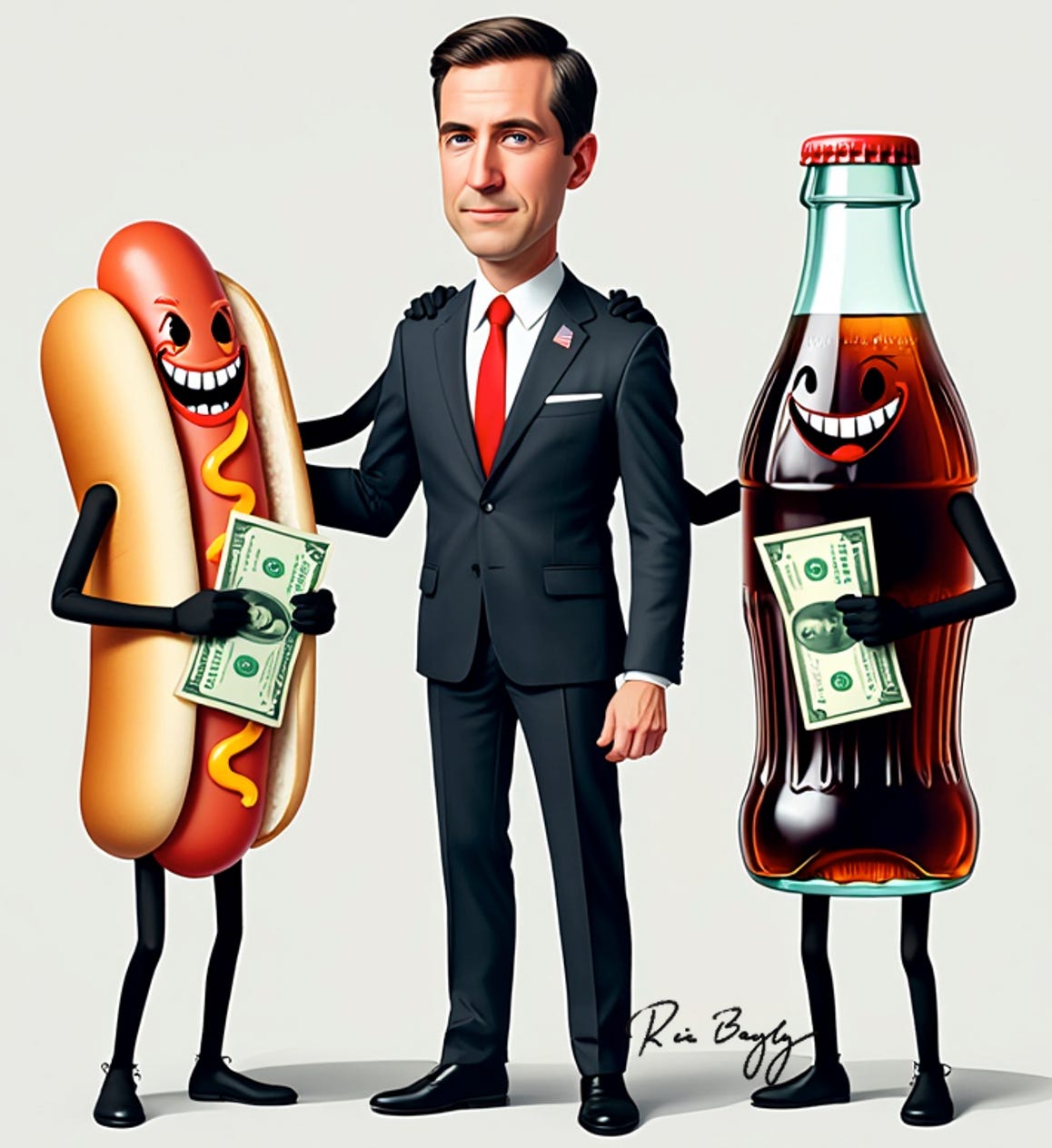
It is hard to overstate the magnitude of the lobbying power of the food industry, and much of this lobbying has historically been directed at influencing the Dietary Guidelines. From 1998 to 2020, ultraprocessed food (UPF) was the top lobbying industry in the U.S., according to a peer-reviewed report. The UPF sector spent $1.15 billion lobbying the federal government during this period. Next on the lobbying list was gambling, then tobacco at $755 million. Alcohol was fourth at $541 million.
Keep that $1.15 billion in mind when considering what the MAHA strategy report and the Dietary Guidelines are likely to say (or rather, not say) about ultraprocessed food.
When he originally announced the July date for the Guidelines, RFK, Jr. may have underestimated the strength of the Big Food machine defending Kennedy’s food system targets, particularly ultraprocessed food and pesticides. It might be taking the HHS and USDA, and their Secretaries, more time than anticipated to resolve the complaints and requests about the proposed Guidelines from outside interests.
And there are potentially inter-departmental discussions to be resolved. USDA Secretary Rollins is among those pushing back against any proposed restrictions on pesticides.
By law, the Dietary Guidelines are researched and rewritten every five years. They are the U.S. standard on how we should eat and for critical nutrition programs, like School Lunches, SNAP, and WIC for new moms and small children. They’re the basis for policies, education, and food labeling initiatives. They are the source of what doctors tell their patients. The Guidelines are highly influential to American health.
But with influence comes economic power, and the Guidelines have a bottom-line impact for corporations in the food, agriculture, weight control, and, increasingly, pharmaceutical industries. Think weight control drugs.
Players from these sectors are lobbying HHS and the USDA, for protection of their interests in the coming Dietary Guidelines. The influence of these industries likely helped shape the secretive selection of the 2025 Dietary Guidelines Scientific Advisory Committee (DGAC), early in this process.
Nine out of 20 DGAC members have been identified by the watchdog group U.S. Right to Know as having a medium or high risk of a conflict of interest due to funding or some other relationship with a food, agricultural, weight control, or pharmaceutical company or association.
So, given that some of the DGAC members might have come to the evaluation of the science with some biases favorable to interested industries – where do things stand with the 2025 Dietary Guidelines Advisory Committee Scientific Report that was issued in December?
The report has two big failures, both of which will have pleased many in the industry. First, the report describes what the DGAC believes is the way we can eat to maintain or achieve a healthy weight. Unfortunately, the DGAC doesn’t acknowledge the evidence that shows that few of us who have lost our most healthy weight (i.e., we have put on the pounds) can get our weight back down on a permanent basis by dieting. Our human biology is wired to pull us back up to our previous weight.
CDC data shows three-quarters of us are overweight or obese. Is this a failure of will power, the ability to do something our bodies tell us they don’t want us to do? Please, it is not the hundreds of millions of us overweight Americans that are the problem. It is our food system that is at fault and in need of fixing. It would be very helpful, both for consumers and for policy makers who want to take action to move the needle on obesity and other chronic disease, to redirect the responsibility and blame from us overweight eaters. The blame, and power, belongs to the corporations selling the food. The DGAC does not provide even a hint of this direction.
Second, the DGAC agreed the evidence from its systematic review of ultraprocessed food showed a relationship between eating ultraprocessed food and obesity. More UPF means more weight. Sixteen out of 16 studies included in the review said so.
This is an improvement from the 2020 Report which had only one glancing mention of “ultra-processed food”, in quotes, in 845 pages of report!
However, in its 2025 recommendations, the DGAC did not rise to protect Americans from health outcomes connected through obesity to ultraprocessed food. The DGAC did not recommend the Guidelines advise limiting the consumption of ultraprocessed food. The Committee excuses itself from this responsibility only by pointing out that the 16 studies used different definitions of ultraprocessed food. However, quoting the report:
Despite this inconsistency, most of the foods categorized as ultra-processed were higher in saturated fat, sodium, and added sugars, as well as other food additives and preservatives.
By not recommending a limit in consumption of ultraprocessed food, defined as best as the DGAC could, the Committee provided an escape clause for HHS and USDA. Sure enough, the leaked draft of the MAHA Strategy uses the “no-definition” excuse to say just one sentence about ultraprocessed food:
USDA, HHS, and FDA will continue efforts to develop a … definition for “Ultra-processed Food” (UPF) to support potential future research and policy activity.
When the Dietary Guidelines are released in October it will be surprising if they recommend any limit on consumption of ultraprocessed food, even though Health Secretary RFK, Jr. is an opponent of UPF.
On the positive side? The recommended guidelines demote meat, poultry, and eggs in our diet, and elevate beans, peas, and lentils, recategorizing these legumes as protein sources rather than vegetables. In other words, the DGAC scientists put a strong emphasis on encouraging plant-based protein. Check mark for science.
Whether the Dietary Guidelines will reflect a re-ordered priority of plants over meat when they are issued is another question. USDA Secretary Rollins’ mission includes supporting agriculture, and beef is the biggest sector in agriculture. Moreover, Secretary Kennedy goes against the science and favors meat-based saturated fat over plant oils and is not worried about red meat in our diet.
So who will win out, ultraprocessed food and the other commercial interests, the science, or the opinions of RFK, Jr.? None of them will entirely win, but none will entirely lose. And that’s the problem.
The Dietary Guidelines should be solely about protecting the health of the people. That commercial interests are having any say in shaping the Guidelines is sadly wrong. Let the policy negotiations, and the reality of implementing changes, come after the best science in the interest of the people is firmly established.
As for Kennedy and his opinions? His directorate includes two of the top scientific health organizations in the world, the NIH and the CDC. He should be a scientist, at least in spirit if not in training. There should be zero tolerance for his personal opinion replacing the scientific facts. Unfortunately, malformed ideas from Kennedy are a new ingredient in the recipe for Dietary Guidelines this year, and they are likely to leave a bad taste in the mouths of those who believe in actual facts.
I’d love to hear your thoughts…
Articles about the influence of Big Food on the Dietary Guidelines:
Access to Nutrition Initiative, 2022. ATNI Spotlight on Lobbying 2022. Access to Nutrition Initiative.
Aubrey, A., Godoy, M., 2016. New Dietary Guidelines Crack Down On Sugar. But Red Meat Gets A Pass, Morning Edition, The Salt. NPR. January 7, 2016.
Callahan, A., 2023. Food Industry Influence Could Cloud the U.S. Dietary Guidelines, a New Report Says, NY Times. October 4, 2023.
Chung, H., Cullerton, K., Lacy-Nichols, J., 2024. Mapping the Lobbying Footprint of Harmful Industries: 23 Years of Data From OpenSecrets. Milbank Q 102(1), 212–232.10.1111/1468-0009.12686
Gostin, L., 2016. The Influence of “Big Food” Promotes Healthy Profits but not Healthy Consumers. JAMA Forum Archive A5(1).10.1001/jamahealthforum.2016.0030
McKiegan, A., 2024. The Federal Government Have Breached Their Duty to the American Public by Promoting Dietary Recommendations Causing Killer Diseases. N.Y.U. American Public Policy Review.
Reinhardt, S., 2020. New Dietary Guidelines Cater to Alcohol and Soda Industries, The Equation. Union of Concerned Scientists.


