
As you may have read or heard in last week’s Trick-or-Treat Eating in America post or podcast, the PEZ dispenser packages I bought to give away at Halloween contained Red Dye No. 3 in the candy, so I took them back. Too bad. It was an otherwise great treat idea.
Red No. 3, banned in Europe and North America because it can give cancer to rats, must be all gone from U.S. food shelves in 2027 and from U.S. medicine in 2028.
I have searched hard for Red Dye No. 3 in many candies and ultraprocessed food products, like cake mix and frosting, Jell-O, salty snacks, soft drinks, sports drinks, powdered drink mixes, pre-cooked meat products, and breakfast cereals for children. I even checked maraschino cherries, long famous for red dye. PEZ was the only place I found Red No. 3.
Most products I checked did have other artificial dyes: plenty of Red No. 40 as well as Yellow Dyes 5 and 6 and Blue Dyes 1 and 2.
RFK, Jr. pronounced in April that he has an understanding with Big Food that synthetic dyes will go voluntarily. As has been pointed out by the Center for Science in the Public Interest, Kellogg, whose synthetic dye containing products include Froot Loops; Mars, maker of M&Ms and Skittles; and Walmart, maker of many private brand products, have previously promised to end the use of synthetic dyes.
In fact, Big Food is taking two approaches to the synthetic dye problem. On the one hand, some ultraprocessed food manufacturers have acknowledged that the time has come to cut out synthetic dyes and have begun to eliminate them in their products. Perhaps the primary driver here is that upwards of 20 states have started initiatives to ban the dyes, and it is difficult to sell food with different safety standards in different states. In lieu of a national standard, these manufacturers are taking a broad approach to cutting synthetic dyes.
On the other hand, some manufacturers and organizations, like the Consumer Brands Association, representing a who’s who of manufacturers, including Nestlé, Mondelēz, Coca-Cola, PepsiCo, General Mills, and Kellogg, have defended dyes.
Walmart however, this month has again pledged to do away with synthetic dyes, along with 30 other food additives including the food whitener titanium dioxide, in its private brand products. While Walmart’s press release bragged that 90% of its private brand products are already free from synthetic dyes, I was a little shocked: you’re saying 10% of Walmart products currently contain synthetic dyes!?
Three other die-hard dye surprises
The first surprise, in two ways, was that, in my very limited survey, PEZ was the only product I found containing Red Dye No. 3. That’s a good surprise overall, but a bad surprise that a product meant solely for children would be a Red Dye No. 3 holdout.
The second surprise was that titanium dioxide is an additive to Walgreens’ Nice brand candy covered peanuts. Yes, the same titanium dioxide that can be found elsewhere in Walgreens as a sunblock agent.
The litany of issues with titanium dioxide is long. Titanium dioxide is a potential carcinogen and is banned in food in Europe. It is linked to genetic damage; cell death; neurological, heart, and lung disease; elevated blood glucose; and disruption of gut hormones and the body’s own GLP-1, the hormone Glucagon-Like Peptide 1, which is key to the weight and diabetes control drugs Zepbound, Wegovy, and Ozempic.
The third surprise is the amount of caramel coloring in colas. Caramel color is not a synthetic dye in the sense that it is made from petroleum, but given the chemical process used to make it, I regard it as clearly artificial. Caramel coloring made from sugar and ammonium compounds is the most widely used food dye, by weight, by a large margin. I found caramel coloring was the second ingredient in sugar-free Coke and Pepsi, coming after water, and the third ingredient, coming after high fructose corn syrup, in the sugared versions. It was also in the ginger ales I checked, as a lesser ingredient. While most caramel dye is consumed in colas, it is also found in baked goods, beers, and sauces. In the manufacturing of ammoniated caramel coloring 2-methylimidazole and 4-methylimidazole, which cause cancer in mice, are produced. The Center for Science in the Public Interest reports that in 2007 the U.S. made a finding that these compounds have links to cancer, and the World Health Organization later labeled the compounds as possibly carcinogenic in humans.
California played the hero in 2012, requiring food containing ammoniated caramel coloring at levels above 29 micrograms per serving, like colas, to have a cancer warning label. Coca-Cola and Pepsi consequently reduced their caramel coloring levels from as high as 150 micrograms to 4 micrograms per serving, first in California and then nationally.
The Center for Science in the Public Interest recommends avoiding colas altogether, given that the FDA has a limit for food additives that contain carcinogens that is 10x as strict as California’s – meaning the amount of 4-methylimidazole in these colas may well exceed the FDA limits.
The FDA, meanwhile, incredibly, still allows ammoniated caramel coloring to be exempt from regulation as a food dye and to have Generally Recognized As Safe, or GRAS, status, meaning the FDA is still taking the manufacturers’ word for the safety of the additive. Please read or listen to the Eating in America post or podcast about GRAS for more details about how the FDA is failing to protect Americans with the GRAS system.
As of 2020 the FDA was in a review of 4-methylimidazole, but an FDA food additive review can be a black hole with a due date of infinity and beyond, so I have no expectations of FDA action on that account. I do hope RFK, Jr. will try to add caramel coloring to his hit list of other artificial dyes and provide cover for some action within his department. I also hope Kennedy makes good on his pledge to get rid of the GRAS system.
Let’s be clear about caramel dye risks. It’s the sugar in colas that is the biggest health risk by far, but given the dye is there solely for looks, wouldn’t the best approach be “when it doubt, throw it out”? When there’s a risk, based on evidence, that something might be bad for humans, and we know caramel coloring does nothing positive for humans (only for the food manufacturers and marketers), wouldn’t it make sense if the FDA said “nah,” Coca-Cola, people can live without it? But that is a discussion for another day.
Back to PEZ…
The PEZ story is a perfect example of the way food manufacturers with vision saw, in the 50s and 60s, how to create commercial success by combining post-war food manufacturing and additives with modern mid-century marketing and growing affluence and consumerism. In the mid-1950s PEZ was a tiny but vivid harbinger of the meteoric rise in highly- and ultra-processed food that was to follow.
If you caught the Trick-or-Treat episode last week, forgive me for quickly reheating the history of PEZ and serving it again. This time it has a surprise ending.
Eduard Haas III invented PEZ as a mint in Vienna in 1927 and marketed it as an aid for quitting smoking. The dispenser was designed in 1949 by a product engineer who had, fittingly, designed cigarette lighters. And that lighter flicking motion is mimicked in the PEZ dispenser. Haas imagined he was going to help his customers occupy both their cigarette-less mouth and their fingers.
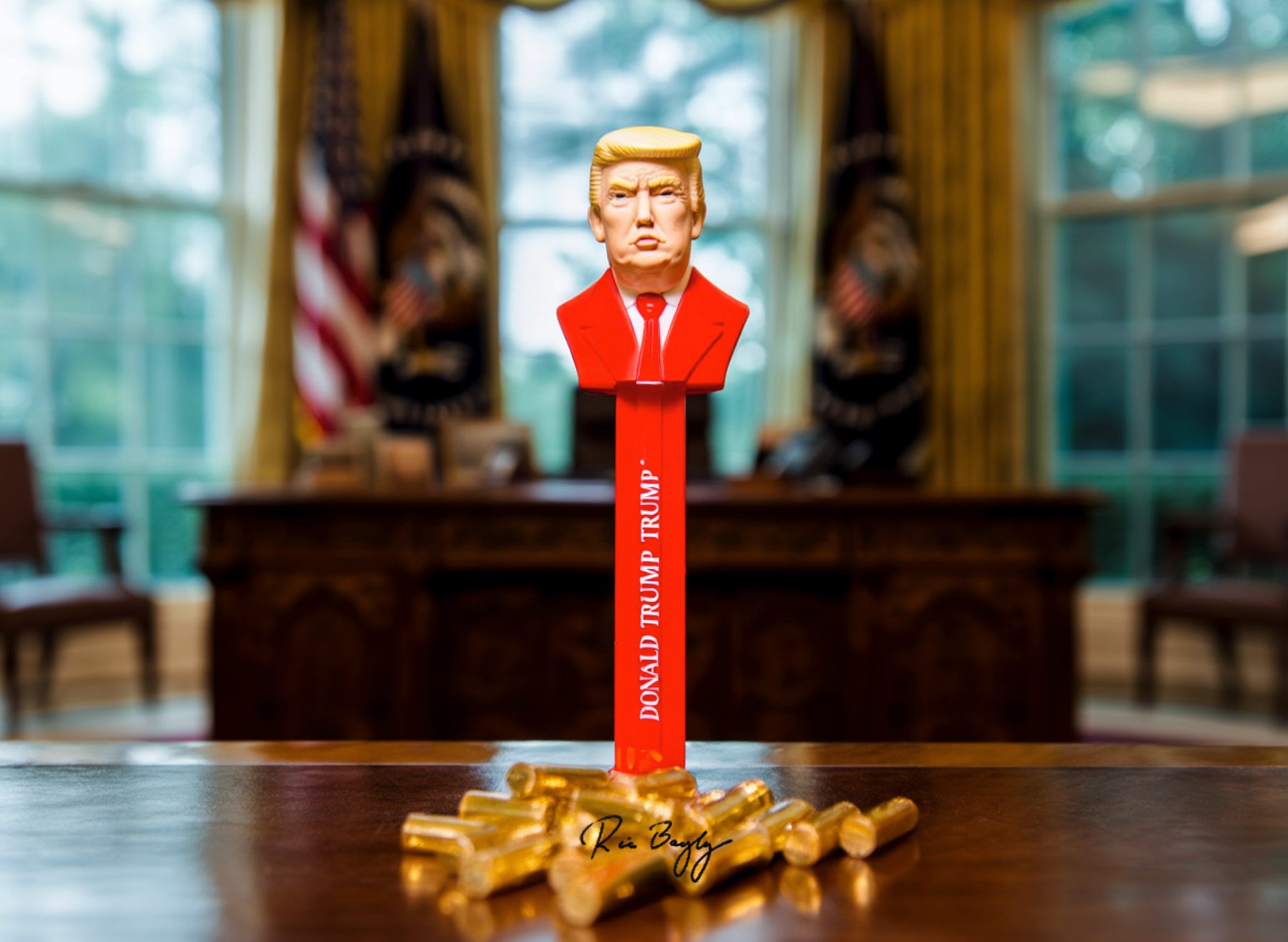
Unfortunately, when Haas left post-war Austria to come to America in 1952, he discovered Americans didn’t want to quit smoking. In an absolute brilliant pivot, Haas changed the mint candies to fruit flavors and colors and added little figures to the dispensers, like Disney characters, witches for Halloween, and Santa Claus for Christmas. PEZ has also made dispensers for 38 of the 46 U.S. Presidents. Barack Obama is the last President to be so honored. I expect that when Donald Trump finds this out, he will turn his attention from campaigning for the Nobel Peace Prize to making sure he has a PEZ dispenser issued with his likeness. The candies, of course, will need to be golden.
Thank you for reading!
Your subscription of any type supports the growth of Eating in America. Thank you. Your paid subscription supports the research and keeps me supplied with PEZ dispensers.


