
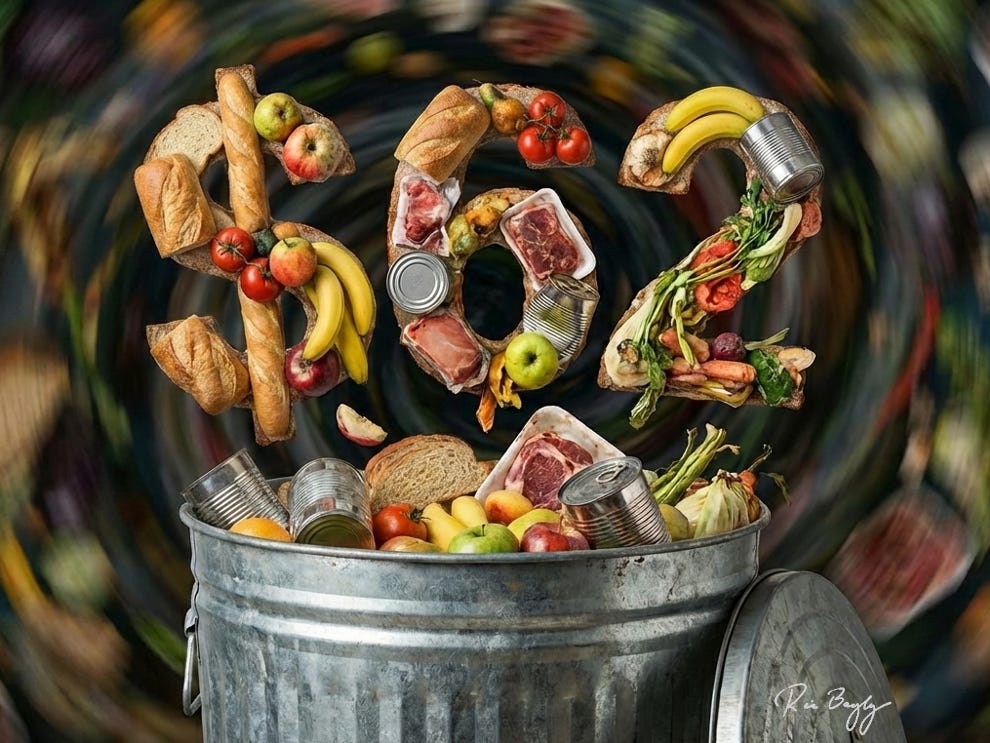
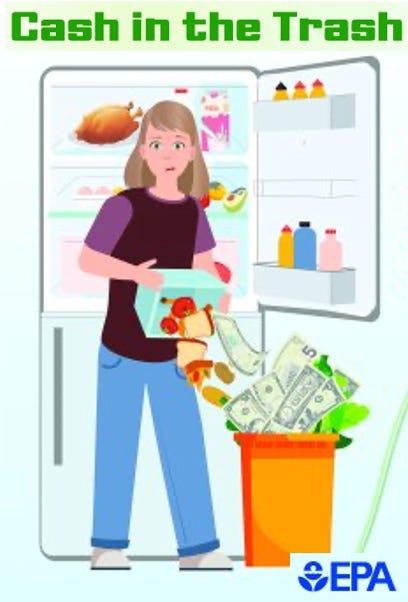
We toss over 10% of our national food supply out of our homes each year, based on new statistics and methods from the 2025 Food Waste Report by ReFED, a leading non-profit using hard evidence to push for a reduction in food waste. That thrown-away food not only has a significant environmental impact but costs us consumers $262 billion. That is a lot of grocery money: $62 a week on average for a family of four. “Cash in the trash”, the EPA says.
The product’s date label is often the only thing we check in deciding whether to chuck food we suspect is too old.
In my household we have a range of approaches to dates on a food container. Some of us will not touch a product with a date that has passed, no matter if the label says “Best by,” “Sell by,” or “Use by.” Those products are mostly thrown away around here. Some of us will open a product with a date that has passed, take a look, give it a smell, have a little taste, and, if no alarms are raised, eat it.
The confusion and widely differing ideas about date labels stem from the fact that there are fifty states, Puerto Rico, D.C., and other entities and no standard for food date labeling across them. By one estimate there are fifty different terms like “Freshest before,” “Expires on,” and “Sell by” used on products in the U.S.
I wondered if Americans all over the country grapple, like me, with the question of what the heck the date on a food product actually means? Are the terms we see on products about safety or quality? And who decides what date to use?
Because I have been told the people in Odessa Texas are very nice, and I know the people in food banks and pantries are really nice, I decided to call Libby Stephens, the CEO of the West Texas Food Bank, serving the urban areas of Midland and Odessa Texas plus 19 very rural counties which together are the size of the state of Maine.
I asked Stephens if she understood food date labels.
“Well, I mean, I think so, just because I’ve been in the food banking world for 15 years. So, there are expiration or “best by” dates, but also from the USDA we do get some different dates that let us know when we can or cannot continue to pass out donated food or salvage and reclamation food that we pick up from grocery stores.”
Ok. So the USDA provides some safety guidance – the federal government has no rules or requirements for food dates – and a food bank or pantry can use that guidance in determining when it is still okay to offer food to customers. Stephens again:
“We have charts hanging up in all of our processing rooms at the Midland and the Odessa campuses that tell us whether milk is after expiration or not after expiration. Bottled water is up to a year. We really don’t like to take sodas, but those are 9 months. If you get to juices, it’s 6 months past the date. So it just depends on what the commodity is.”
Sounds complicated to have to depend on dates, even for the professionals, who in the case of the West Texas Food Bank are taking a date on the product and adding on a recommended margin, which might be quite large but is still regarded as safe. The Food Bank of course wants to be very sure its customers are safe but also wants to make sure they aren’t hungry. Any food bank or pantry is going to want to maximize the amount of safe food it can pass through from donors to those in need.
Lots of folks, 43% of us according to a 2025 survey, toss out food close to or past the date on the container.
And states are confused as well as consumers. About 20 states ban sales or donations of past-date products. That is good, healthy food that cannot go to a food bank.
Economists, nutritionists, environmental scientists, and politicians have been worried for years about the costs to consumers, the environment, and those in need that occur when good food is thrown away because of confusion around food date labels.
California again gets honors for stepping up, as California so often does, with an answer. It’s a law that is quite tidy and very easy to understand. As of July 2026 all food products sold in California that have a date must also have the words “Best if used by” or “Use by” in front of the date. Only those terms. No other terms are allowed. If a retailer or distributor wants to have a “sell by” date so they know when to pull a product off the shelves, that date will have to be coded so a consumer can’t read it. And, as in the past, the use of food date labels is not required by the California law.
For the consumer this means that if there is a “use by” date, it can be understood to be the last day on which the food packer guarantees the product will not have spoiled. If there is a “Best if used by” date, that marks the end of the estimated period of peak freshness. And remember, freshness is something that deteriorates tiny bit by tiny bit from the minute the product is packed, canned, or bottled to days, weeks, months, and often years past the date on the food container. I trust my senses, including my common sense, along with some basic food safety rules when it comes to things like meat and seafood, to tell me what to do as a product passes its printed date.
The USDA backs me up in this:
“If the food date label passes during home storage, the food product (except for infant formula) should still be safe and wholesome if handled properly until the time spoilage is evident. Spoiled foods will develop an off-odor, flavor, or texture due to naturally occurring spoilage bacteria. If a food has developed such spoilage characteristics, it should not be eaten.”
Neither terminology allowed in the California law, “Best if used by” nor “Use by”, provides a date a product needs to be thrown out. The USDA is clear:
“Food date labels are not indicators of food safety.”
By the way, it is the manufacturers and packers who decide the dates, often running shelf-life tests to help choose a date for the label. The dates you find on labels might or might not be a sort of science-y choice.
The food dating issue is very big for us a society when you add in the various costs involved in the production and transportation of the food to the consumer: the land, fuel, crop treatments, and a lot of water used for irrigation. And the story doesn’t end with the consumer’s cash in the trash. When the food waste leaves the home, 96% goes to landfills, incinerators, or into the sewer system. The landfill waste decomposes, releasing methane gas, which contributes to the buildup of heat trapped in our atmosphere. All these are reasons why bipartisan legislation, along the lines of what has been enacted in California, has been introduced in Congress to bring federal standards to food date labeling.
Meanwhile, when you go to the supermarket, ignore “Sell by”: that is just for the retailer. And remember “Best if used by” is an indicator of freshness and “Use by” is just an indicator of a spoilage timeframe.
Thank you for reading. Please support Eating in America and help it grow with your subscription, comments, and likes, and share this with others, please! I’m curious to know what you have been thinking about food label dates. The comments are open to all readers.
I wish you lots of love, kindness, good eating, and good health for 2026.


