
We are a nation with some big superpowers – like military might, for example. One of our greatest superpowers is agriculture. America is the world’s leading single nation food exporter. (The European Union in aggregate is a larger exporter.) We produce enough food to feed the U.S. population and a third more.
Why can’t America put healthy food on every plate?
Why, as an agricultural superpower, do we not as a nation simply do what it takes to make healthy food affordable to all Americans and central to American eating habits? Secretary of Health RFK, Jr. is right that we can’t be as strong as we should be, individually and as a nation, unless our food is healthy.
Subsidies are not helping put healthy food on our plates
Our agricultural policies are often directed away from healthy solutions. The vast majority of our agricultural subsidies go to commodity farmers, producers of corn, wheat, cotton, rice, and soy. Only 1% goes to growers of fruits, and 1% goes to growers of vegetables. Corn production, America’s most heavily subsidized commodity, is for animal feed (46%), ethanol for gas (43%), and ultraprocessed food (10%.)
And who gets the subsidies?
Ten percent of commercial farmers get three-fourths of the subsidies. Many of these farm operators have annual incomes over $1 million.
What would a good king do?
As U.S. agricultural policy expert Parke Wilde has said, people tend to think about American agriculture by taking the “benevolent monarch” approach to fixing problems: what would I do if I were Queen or King? But our agricultural policy has been shaped by the influence of multiple constituencies, all with their own priorities, making it difficult, in normal times, to change anything.
Who are the players?
The most important and by far the most powerful constituency is agribusiness, from the wealthy and industrial plantation end of farming and its large suppliers to the small, struggling farmers. Agricultural policy reporter Helena Bottemiller Evich recently pointed out that due to the modern-day efficiency of farming methods, actual farmers are only about 1% of voters. They may not be a big voting block, but farm operators punch far above their weight in political power. Farming, including ranching, is the at-home job of 5% of Congressional Representatives and 8% of Senators.
Other stakeholders, as described by Wilde, include farm workers; food manufacturers; input suppliers like seed, fertilizer, and equipment manufacturers; anti-hunger advocates and nutrition advocates, two distinctly different constituencies; environmentalists and climate activists; and agricultural product trading partners internationally.
I would add American food shoppers to Wilde’s list. Consumers, while not well represented by lobbyists, get angry and loud when food prices rise, and prices have been outpacing inflation in recent years.
Don’t touch the Rubik’s Cube
With all these players jostling for a place at the table, creating change in agricultural policy has been a Rubik’s Cube of twisting pieces into place to find a solution. Once a solution has been found, most agricultural stakeholders are not eager to start the puzzle over.
Nutrition in the realm of chaos
As the traditional balance in U.S. government power dynamics has collapsed into chaos, two things happened this summer that signaled a shift of power in the world of agriculture.
Nutrition funding moves to the Big Beautiful Bill
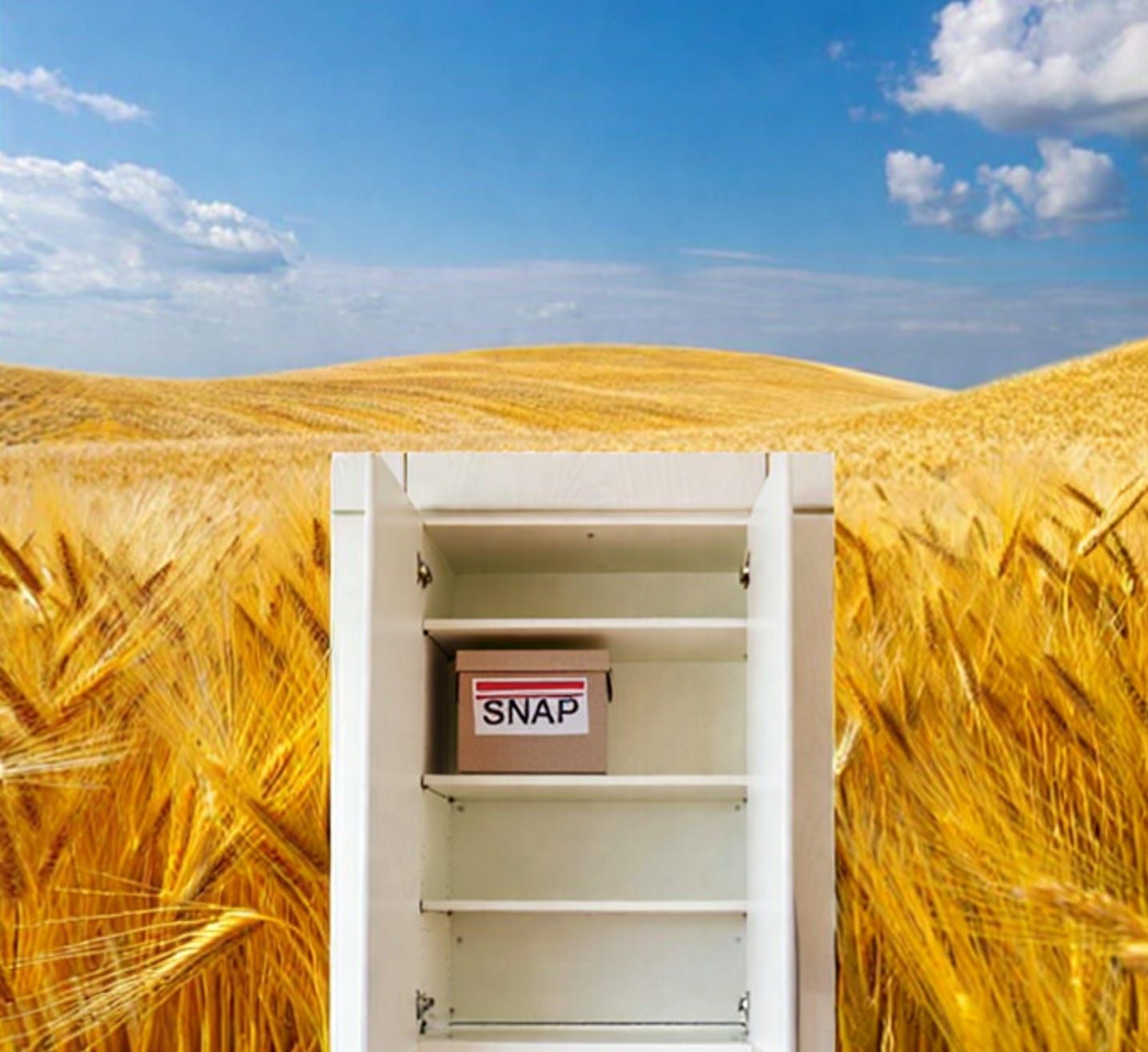
First, the nutrition piece of the Farm Bill was tucked away into Trump’s Big Beautiful Bill which was signed into law in July. In doing so, the Republicans in Congress made heavy cuts into the biggest piece, by far, of the nutrition money: SNAP, or Food Stamp, benefits. SNAP was cut by 20%: $186 billion over the next ten years. SNAP is relied on to put food on the tables of 12.5% of our population, 41 million Americans. Between 2 to 5.3 million Americans will lose some or all of their SNAP benefits under the new cuts, and all benefits will be reduced.
Bipartisanship: a long-standing tradition in the fight against hunger
Since 1969 when Republican President Richard Nixon got the anti-hunger ball rolling with the first White House Conference on Food, Nutrition, and Health [note: the Wikipedia page linked here was authored by me and Katrina Sarson with subsequent anonymous contributors], fighting hunger has been a fully bipartisan issue.
Nevertheless, in 2025, hunger has still not been solved. Twenty percent of children are living with the stress and fear of food insecurity, 50% in some rural counties. Yet even before the Big Beautiful Bill SNAP cuts were passed, Trump cut $1 billion in food for school lunches and food pantries, both critical sources of food for children and families in need.
Let’s hope the decimation of SNAP in the Big Beautiful Bill does not signal the end of the bipartisan agreement that hunger has no place in America.
But what about the Farm Bill?
Traditionally, the Farm Bill is massive and complex, with a confusing array of subsidies and protections for farmers. The Farm Bill has always stood on its own as a piece of legislation. Changes have been made incrementally on a five-year cycle, avoiding the great difficulty of constructing a new Farm Bill from the ground up.
However, with nutrition pulled out, nutrition and food security having been 81% of Farm Bill spending, the rest of the Farm Bill, mainly the subsidies, is in limbo, and the outcome a question mark. The Democrats required to help the Republicans meet the 60% threshold for Farm Bill passage in the Senate have little appetite to engage.
The cutting of SNAP, school lunch, and food pantry assistance signals a power shift
Clearly, the voices of anti-hunger advocates and nutrition advocates on both sides of the aisle have been quieted or ignored by the unprecedented power grabbing of Trump. But these nutrition and anti-hunger cuts also represent significant reductions in American agricultural purchases.
In the past, food and nutrition programs have had a symbiotic, quid pro quo relationship with agriculture. The reason food and nutrition and agriculture are losing out together is because of Trump’s overriding desire to help fund trillions in tax cuts for the wealthy and hundreds of billions for ICE to deport immigrants. He needs the anti-hunger funds for these priorities even if it hurts his strongly pro-Trump farm constituents.
How agribusiness and Big Food fared in the MAHA Strategy Report
The second marker of a power shift favors agriculture. RFK, Jr.’s Make America Healthy Again initiative took aim at pesticides, an agricultural issue, and ultraprocessed food, a food issue. While the MAHA Assessment report released in May contained a hearty indictment of pesticides, agribusiness successfully lobbied pesticide restrictions out of the MAHA Strategy report issued in September.
The success of agribusiness stands in contrast to Big Food’s considerably less than complete victory with the MAHA Strategy report. The September report pledged an ultraprocessed food definition instead of action, a major let off. On the other hand, the report presented the link between highly processed food and chronic disease prominently; promoted front-of-package labels for saturated fat, salt, and sugar; proposed marketing guidelines for children-targeted food; and pledged to at least partially close the Generally Recognized As Safe food loophole through which many toxic substances are added to our food supply without our knowledge.
JFK, Jr., the X factor
Big Food, although the largest lobby in America, was outperformed in Washington this year by the agribusiness lobby. The X factor was RFK, Jr., who, although his success in nutrition policy has been very limited so far, has brought significant issues to the forefront for discussion.
Is getting ICE off the farms a win for agricultural power?
Perhaps a third marker of agricultural power in this environment of chaos is how quiet ICE has been on the farms recently. Over 40% of farm workers are migrants without authorization to work. In June Trump proposed backing off the targeting of farm workers, and, judging by the news since then, ICE may be largely doing that.
Does the fleeing of farm workers spell trouble for Trump?
Despite Trump’s musings about calling ICE off the farms, farm employment dropped 7% between March and July, with many workers worried about being detained by ICE. The increasing farm labor shortage this year could portend an impending crisis for Trump. Without enough farm workers to tend and harvest crops and animals, food prices will continue to increase, to the great dissatisfaction of American voters. Trump knows to worry about this. He quite possibly would not have won the 2024 presidential election without voter dissatisfaction over rising food prices.
Where’s the nutrition superhero?
If Trump completes his quest for autocracy, he is not going to amend the agricultural system and be a nutrition hero, nor will JFK, Jr. While at least Kennedy might be headed toward getting a small piece of MAHA’s nutritional agenda enacted (not all of which is actually healthy), he has a long way to go on any of these proposals. And it is easy to envision that in a normal political environment that was not susceptible to fantasy science, the limited nutritional reforms on the table could just as easily be enacted without an RFK, Jr. Meanwhile, solving America’s Rubik Cube of a food system to provide healthy food for all, will require political will beyond what MAHA can bring.


