

Elon Musk and Joe Rogan, eat your hearts out.
In today’s game, three doctors walk into a Fox TV studio for a taping of Survivor, Surgeon General. Two of them work for Fox. Two of them got their medical degrees at schools in the Caribbean. One of them lies about her qualifications. Two of them are selling supplements. One of them isn’t really a doctor and is a recent stockholder in tobacco. Two of them are not completely pro vaccine. Which of these three are qualified to be the U.S. Surgeon General? Who will be voted out? You decide, because you are a whole lot more qualified than the President who nominated them.
Candidate #1
To recap our game so far, Donald Trump named Dr. Janette Nesheiwat as his nominee for Surgeon General two weeks after being elected to his second term. In his statement, the President-Elect repeated Nesheiwat’s lies about being double-board certified and a graduate of the University of Arkansas School of Medicine. In fact, her medical degree is from a Caribbean university, which as a group are best known for accepting those who fail to get accepted into a U.S. medical school. For many though, the Fox commentator’s real fault was that she was pro vaccine and science. People who wanted someone who could be trusted to speak the truth about everything, not just vaccines and science, objected to the nomination, and everyone else wanted someone who would not speak the truth about science, so they objected, too.
“YOU’RE FIRED!”
Warming our hearts with his famous Apprentice reality TV show catchphrase, in May 2025 the President told Nesheiwat, “You’re fired!” as the Surgeon General nominee.
Candidate #2
Next up, vaccine skeptic, supplement seller, tobacco investor, and not-an-actual-doctor Casey Means was the second nominee for the nation’s top doctor. Means is a darling of the MAHA movement, and they love everything about her -- except MAHA folks didn’t mention her holdings in tobacco giants Altria Group and Philip Morris.
With everything else to complain about with Means, the tobacco investments did not get much attention, but to me it was a serious red flag. Surgeons General through the years have played a huge role in turning public attitudes about smoking toward the negative, but there is still a long way to go with tobacco. Smoking remains the leading preventable cause of death in America with a half-million deaths annually. We can’t have a Surgeon General nominee who profits from tobacco.
“YOU’RE FIRED!”
But it was the not-a-real-doctor thing and her vaccine skepticism that tanked Means’ nomination in her confirmation hearing. Trump said, “You’re fired!”
Candidate #2
Trump’s third nominee hoping to be named “Survivor, Surgeon General,” is Dr. Nicole Saphier. Like Nesheiwat, Saphier both graduated from a Caribbean medical school, yup, and was a commentator on Fox News. Like Means, Saphier sells supplements and has expressed ambiguity about vaccines.
Let me be clear, ambiguity about FDA- and, more importantly these days, W.H.O.-approved vaccines is completely inappropriate in a Surgeon General. But since Eating In America is about what we consume in our bodies, I will object to Saphier on the basis that she is yet another snake oil selling nominee, who claims science where there is none, makes health promises where there is no or insufficient evidence or expert scientific consensus, and takes money for products where there is no proven efficacy but there are serious concerns about safety.
Outrage #1: Saphier proposed as Snake Oil General
Saphier, in addition to her job as a radiologist and work on Fox, is a maker and vendor of a line of wellness supplements. Her company, Drop Rx, sells four elixirs, she calls them tinctures, for about $10 an ounce. They are named “Focus,” “Calm,” “Soothe,” and “FemmeX.” Saphier makes unsupported health claims for these formulations of unquantified herbs and ultraprocessed ingredients and one of them contains an ingredient, kava, that is banned in the U.S. military.
I will come back to this outrage, and the even bigger outrage of the way the U.S. handles supplements, in a moment.
Don’t mess with the Chinese sea snake
We all may have become familiar with the term “snake oil salesman” by watching American Westerns where men in bowler hats sold cure-all elixirs out of the back of a covered wagon. There is a surprising origin story to these early wellness hucksters.
180,000 Chinese laborers brought the oil of the Chinese sea snake, the extremely venomous black-banded sea krait, when they came to build railroad lines in the American West in the mid-1800s. This traditional medicine is very rich in eicosapentaenoic acid, or EPA, an anti-inflammatory omega-3 oil. The snake oil might have provided some relief for aches from pounding stakes into railroad ties all day and the other difficult and dangerous work these men were doing. There is some evidence that EPA can help with joint pain. But I can’t help speculating if the crates of snake oil didn’t also contain some bottles of snake venom wine, also a traditional Chinese medicine and a more powerful treatment for pain than snake oil.
The Rattlesnake King
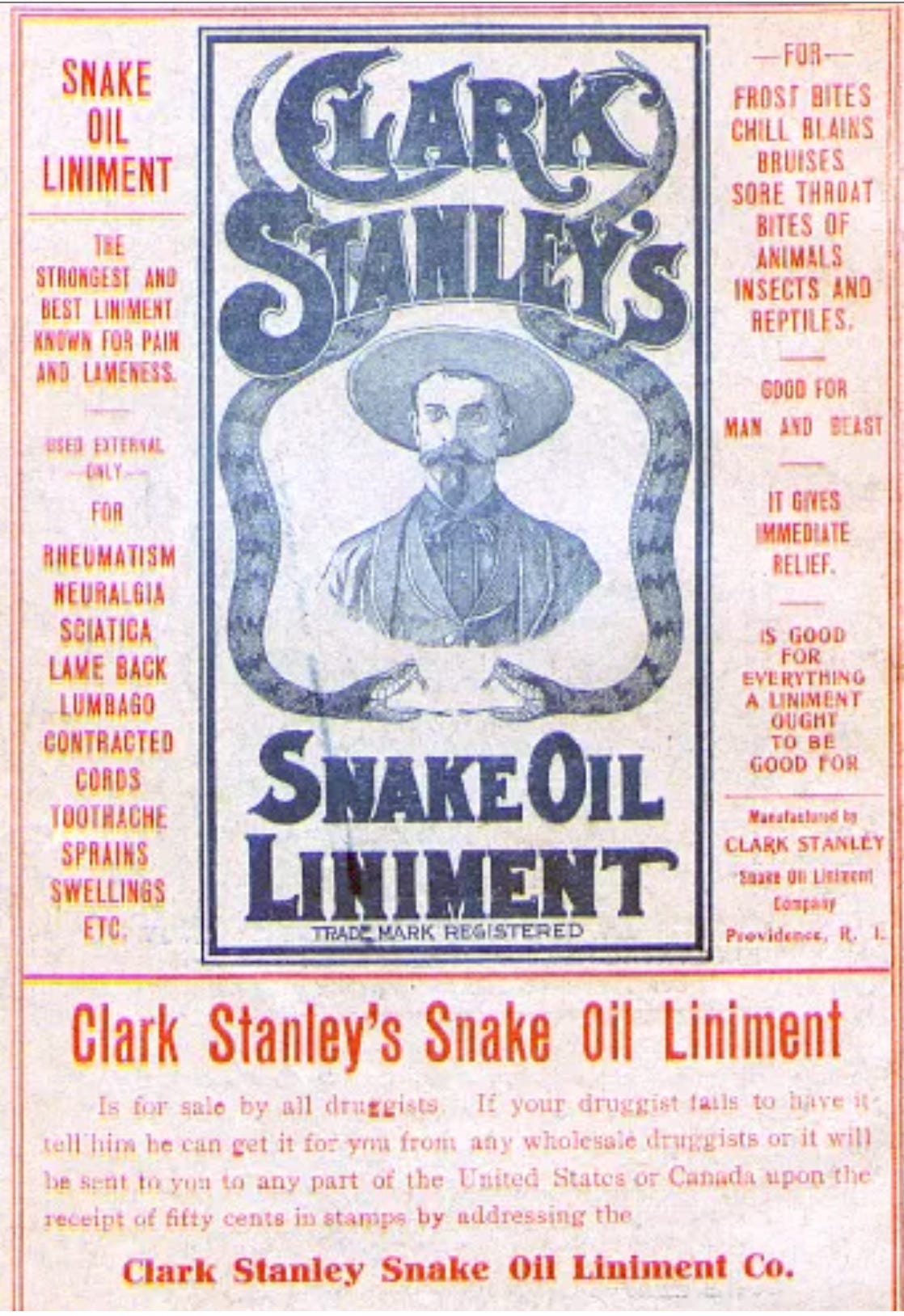
In any case, inspired by the widespread Chinese use of sea snake oil, a man named Clark Stanley showed up in Chicago in 1893 dressed as a cowboy and carrying live rattlesnakes and bottles of supposed snake oil that actually contained only mineral oil, beef fat, red pepper, turpentine, and Stanley’s false claims of healing powers. But Stanley was a good hawker, and the snake oil business took off.
Snake oil elixir, a new law, and a $20 fine
A surge in snake oil and other elixir sales was part of the reason for the passage of the Pure Food and Drug Act of 1906. That law was the basis in 1917 for fining Stanley $20 for his false health claims. The fine didn’t hurt Stanley, but the bad publicity resulted in him having to shut down his factories and, in fact, his whole operation.
Defining a supplement: food, drug, or a little of neither?
Skipping ahead to 1994, the new Dietary Supplement Health and Education Act categorized supplements as food, not drugs. As a subcategory of food, supplement makers don’t have to prove their products work or are even safe before putting them on the market. Further, while food items aren’t allowed to make unapproved health claims, food supplements are given a lot more leeway. They are not supposed to make health claims, but, well, they do.
The American snake oil supplement system
The system we have is deficient. Americans spend $60 billion a year on supplements that are not reviewed for their health claims or safety.
Some of these supplements are meant to be nutritional, like vitamins, minerals, omega-3 fatty acids, or whey powder protein, for example. These should be regulated like food and held to the same strict FDA standard for food health claims.
Other supplements are, in essence, over-the-counter drugs. These include products containing psychoactive ingredients. Some supplements in this group are meant to calm us, like bacopa monniera, or make us alert, like ginseng. The other supplements in this group are advertised as being associated with a range of health benefits such as stress relief, inflammation reduction, or soothing digestive issues. Like any drug with a health claim, these should be treated by the FDA as over-the-counter medications and verified for safety and the validity of their claims.
Surgeon General hopeful Saphier’s supplement
Let’s check one of Surgeon General nominee Saphier’s Drop Rx products, “Calm.” “Physician formulated. A clean product you can trust. Experience the power of nature, backed by science.”

So, a doctor designed it, Drop Rx says we can trust its safety, and science says it works. Well yes, there is some science that supports the psychoactive calming effect of ingredients, including kava, in Calm. But there hasn’t been the rigorous testing that should accompany any psychoactive product that is, in essence, a drug.
Kava, unfit for service
But, worse, the science also points to kava’s risk of liver damage, which is the reason the U.S. military, UK, France and Switzerland have banned kava, and the FDA published advisories about its potential toxicity in 2002 and 2020.
There is some confusion about the kava in Calm. In two places the Drop Rx website shows the presence of kava in Calm and in two other places on the website the kava is missing in favor of another psychoactive ingredient. But regardless of the quality, safety, and efficacy of Saphier’s elixirs, the fact that she is selling supplements is the basic issue.
What we need in a Surgeon General
We need a Surgeon General who is deeply committed to solidly scientific approaches to saving lives and improving our health, with a desire to communicate about the effectiveness and safety of vaccines, the need to control tobacco and addictive substances including ultraprocessed food, along with addictive media and digital and instantaneous gambling, the need to treat unhealthy weight in Americans, and the urgent need for diligence in the face of new global health threats due to both climate change and the ease of pandemics to spread.
As long as Trump puts forward candidates as inappropriate and unqualified as Saphier, we can only hope the game of Survivor, Surgeon General will go on. But, for better or worse, it seems that the lack of an actual Surgeon General is not going to stop the Surgeon General’s office from issuing Surgeon General advisories. This past week RFK, Jr. went ahead and signed and released a Surgeon General’s report warning about excessive screen time for kids.
Thank you for reading. Please support Eating in America by subscribing for free or as a paid subscriber to help me keep up the level of research required to make this publication one that can be counted on not just for facts, but for new perspectives and analyses.


