
Please note that a small portion of the text of this podcast is taken from an Eating in America Note, published on EatingInAmerica.co this week.
I propose a new, simple definition for highly- and ultra-processed food, the definition of which shouldn’t be, but nonetheless has become, perhaps the most important nutrition issue of 2026. It has been made an issue as a tactic of delay by the Big Food lobby, which will exploit any opening to postpone the possibility of regulation of highly- and ultra-processed food.
You haven’t heard from me as much as usual lately because I have been working on this definition intensely over the last few weeks. My hope is to provide a fresh perspective that provides a framework for the clearest, simplest, most durable way forward.
Highly-processed food = ultra-processed food
Highly-processed food and ultra-processed food are two terms for the same thing. This is supported by the new Dietary Guidelines, which uses the term highly-processed instead of ultra-processed. I will use the abbreviation HUPF, standing for highly- and ultra-processed food.
HUPF and disease
HUPF has been linked to many chronic diseases, including obesity, heart disease, cancer, diabetes, and dementia.
The Tobacco Playbook: the chapter about delay.
Big Food knows HUPF as a category is bad for our health and that it will be increasingly regulated at various levels of government. But Big Food has had close ties to the tobacco industry, so, like Big Tobacco, they have learned all the tricks and moves to fight regulation, including those in the chapter about delay in the mythical but often cited Tobacco Playbook. This is the set of schemes and strategies that has been used not only by Big Food, but the alcohol industry and opioid manufacturers, and is being employed now by the gambling industry.
To interfere with the growing momentum toward regulation, the question of a viable definition of ultra-processed food has been pushed by the HUPF food lobby, America’s biggest. RFK, Jr.’s Health and Human Services department and the USDA have been struggling to settle on a definition of ultraprocessed food that can be used for writing policy and regulations. Kennedy says the definition is finished and is awaiting the approval of Trump now. This holding pattern means Big Food is not done lobbying on the issue.
A simple definition of HUPF is needed
I predict the Trump administration will come out with a not-simple, maybe even tricky, definition that is as favorable as possible to Big Food while maintaining the appearance of addressing the concern with HUPF that is a core issue of Trump’s important constituency, the Make America Healthy Again movement.
The Big Food lobby and HUPF
However, what Americans actually need is a clear and simple definition of HUPF that can’t be corrupted by Big Food.
I can ‘t know for sure that the federal HUPF definition will be compromised by Big Food’s influence but, given the record of this administration and the record of success and power of the Big Food lobby, it is a safe bet that industry profit will be considered at least equally with public health in the forthcoming Health and Human Services and USDA definition.
For examples of the power of Big Food, their lobby got the word “ultra-processed” taken out of this year’s Dietary Guidelines, even though RFK, Jr. is an avowed enemy of HUPF. And the Make America Healthy Again Strategy Report, of September 2025, mentioned ultraprocessed only once, in the context of the need for a definition.
Before RFK, Jr. and the USDA issue their Big Food-compromised definition, I have a proposal.
First, some background.
Carlos Monteiro, the scientist who invented and popularized the term “ultraprocessed food,” did the world a huge service in identifying how the food we are eating is industrial, formulated to be addictive, heavily marketed, all about profitability, and not healthy. Monteiro defined ultraprocessed as generally bad and not ultraprocessed as where the good lies, which is all true. But his definition of ultra-processed was too inclusive and not simple and clean enough to be used for policymaking.
Clarity from an unlikely source
I respectfully offer a simpler way to view what has happened to our food environment and how it happened, a clear dichotomy that was popularized in the late 1960s by none other than the Hippies.
Without the benefit of science or research, the love-beaded, bell-bottomed folks of the Counterculture Revolution intuited that the direction the food environment had gone was all wrong. They understood American diets were being co-opted by the marketing and lab-created, unnatural products of Big Food. They said, “What was the matter with the way we were eating before?”
The natural food movement blossoms
And so the natural food movement was born in earnest. In the words of Crosby, Stills, Nash, and Young from 1969’s Woodstock, “…we’ve got to get ourselves back to the garden.”

Suddenly un-sugared granola and un-sugared plain yogurt were to be found in small urban food co-ops along with raw milk, whole grains, nuts, honey, molasses, organic vegetables, lentils, brown rice, tofu, and sprouted beans. Highly- and ultra-processed food were rejected. To the youth of the Counterculture, this was an entirely new way of eating, but to the grandparents of those Hippies and their grandparents and their grandparents, this was just the way food was supposed to be. Except for the tofu, of course, which was “far out, man.”
The end of World War II and the beginning of the HUPF Era
These twenty-somethings had been born in the years surrounding the dropping of the first nuclear bombs in 1945, ending World War II and beginning the Atomic Age, and the Anthropocene Epoch proclaiming the most pronounced human impact on our planet, and, not coincidentally, the HUPF era.
It is no coincidence that the HUPF era directly follows World War II. The needs of the Allied war machine had driven both the development of new HUPF food products for our soldiers and chemical design and manufacturing that fueled the rapid rise of commercial HUPF after the war.
HUPF harms? We happily swallowed the problem.
Why did it take until the early 21st century, 60 years after the start of the HUPF era, for concern about the radical change in our food environment to come to the forefront in American society? Money, marketing, and our indulgence and belief in the delightful wonders of HUPF, perhaps. You could say we swallowed the problem. Fortunately, the now almost extinct human subspecies called Hippies – I say that with love and peace – seems to have been created on earth to detect the unnatural change in our food that had occurred and to call out the alarm.
The Hippies’ natural foods is now a commercial sector
We are five plus decades beyond the start of the “back to natural foods” movement. That movement is now a fully commercialized sector of our food system with 557 Whole Foods stores globally. And despite the array of HUPF products in Whole Foods stores, the Hippies did start us on a healthy way forward.
The stark division identified by the Counterculture between new food and natural food is the true way to think about ultra- and non-ultra-processed food and the best starting point for a definition of HUPF.
A new proposed definition
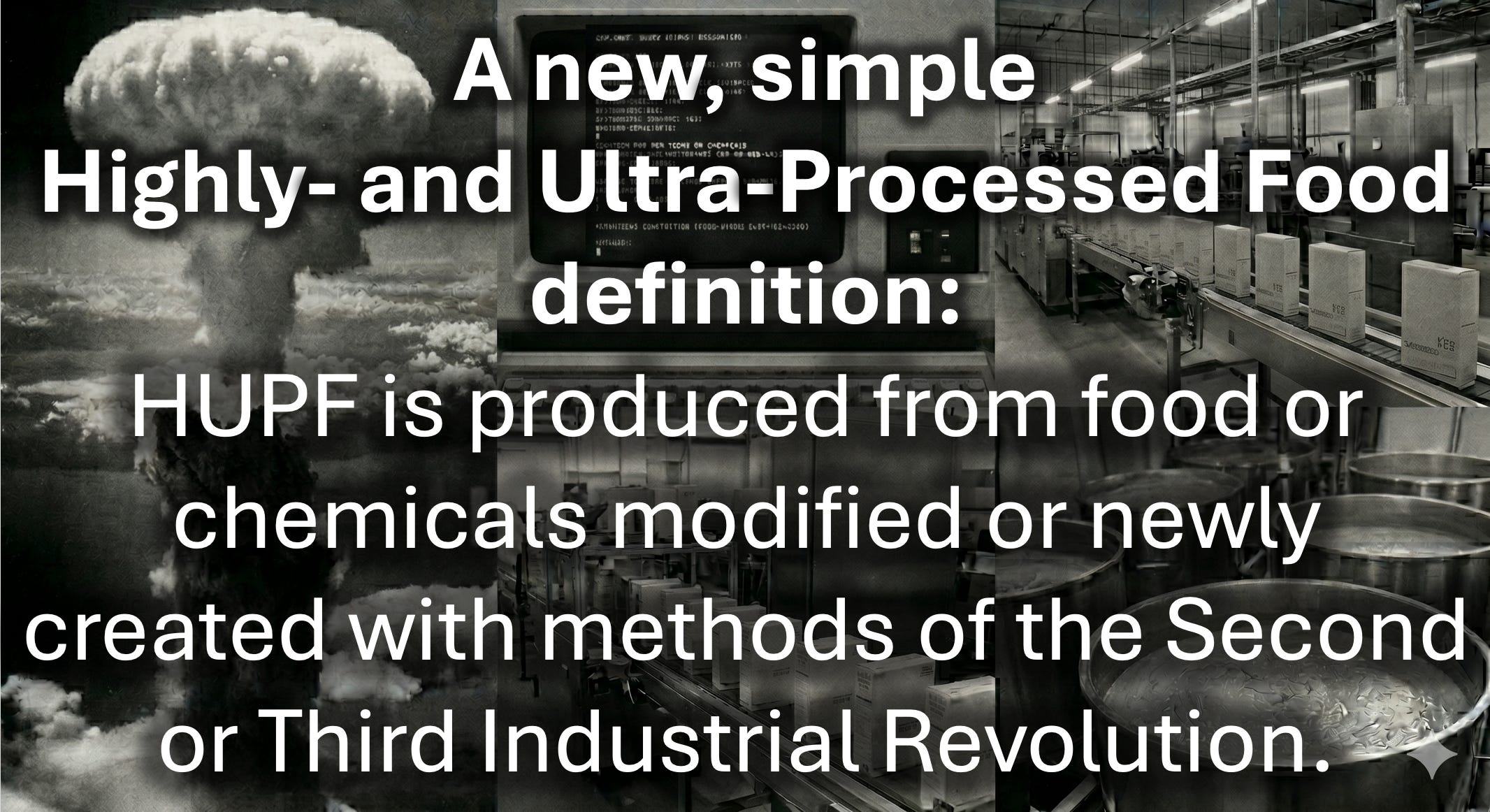
Highly- and ultra-processed food is produced from food or chemicals modified or newly created with methods of the Second or Third Industrial Revolution. That is my definition of HUPF in 23 words.
There are several tenets to the definition
1. HUPF is unnatural food. Natural food, if processed or modified, is done so with methods that predate the Second Industrial Revolution* (see the footnote for an explanation of the dates and the nature of the first three Industrial Revolutions), and in the case of techniques like fermentation, by thousands of years.
EXAMPLE
Yogurt is a food that can be very healthy in its natural form but is now sold mainly in a modified form with post-industrial ingredients, making it HUPF in those cases. Yogurt is the example almost always cited (to the delight of the HUPF lobby) when the Big Food-inflated problem of defining HUPF is discussed. The question always posed is “What about yogurt with its additives? It’s healthy food!” The answer is “Okay, although healthier in its natural form, but if you want to make a law banning HUPF while making an exception for yogurt: fine, help yourself.”
2. Everything that is natural food has been consumed by humans for a long time. Humans have learned what to eat and what not to eat over millennia. We have adapted some food to our biological needs, or, in some cases, our biology has adapted to the available food. What we eat, works for our health.
EXAMPLES
First, we have developed genetic adaptations in some cases. Lactose intolerance develops in children as a way to force their weaning from mother’s milk in order that their new baby siblings can get adequate nutrition. In northern cultures where animal milk is common, lactose intolerance has evolved out of the genetic pools, allowing more resilience to famine. Second, a traditional Inuit diet, which is all protein and fat and lacks vegetables and fruit, adapts the available food by including raw organ meat like seal liver and caribou brain which is rich in vitamins. Furthermore, evolution within the Inuit genes allows the metabolization of fat from their hunted food in a way that reduces bad cholesterol and heart disease.
3. Everything that is HUPF is a new or relatively new industrial invention, or it is a food that is a new risk because of mass production allowed by a high level of processing.
a. All of the many thousands of food products and additives created after 1945 are HUPF. Keep in mind, please, that 1945 is not a hard and fast date, pending further investigation and discussion of how far back it could be pushed. For now it is a safe and convenient date to mark the watershed after which no new natural food could have been created. We can say no new natural foods have entered human food environments since at least 1945 and any food or additive created after 1945 is HUPF.
b. Some HUPF is older.
EXAMPLE
Hydrogenated vegetable oil, or transfat, as in margarine or Crisco shortening, was invented in 1901. It was marketed as a healthy alternative to butter, but in reality, is very toxic to heart health.
c. Second Industrial Revolution processes made some moderately processed food into HUPF. These foods had been tolerated without great harm in small amounts in our diets, but they became significant health risks when they became widely and cheaply available by virtue of mass production, made possible by a high degree of processing. The nutritional and structural character of these foods was the same as it was in the pre-industrial age, but industrial processing and mass production lowered cost and allowed over-consumption.
EXAMPLES
Refined sugar, highly refined flour, salt, and white rice are in this sub-category of HUPF.
4. Where natural food is available in sufficient quantity and quality, it is sufficient nutritionally. In such an environment, HUPF brings few nutritional advantages to the table.
The health risks are bad but the economics favor HUPF.
HUPF is an overwhelmingly negative nutritional contributor to diet but has economic value on the basis of convenience and cost per calorie. Policies addressing the pervasiveness of HUPF in our food environment have to deal with these economic factors, whether it is in the potential increased cost of school lunches -- as in California’s HUPF school food ban -- or when creating sugared beverage taxes, which have the greatest effect on lower-income households.
Policy makers are aware that when the choice is between sufficient HUPF calories or insufficient healthier calories, having sufficient calories must win every time. Hungry children, and there are many in America, are not okay. The cost of healthy food is the greatest and broadest nutrition policy challenge in America.
We have to acknowledge that HUPF is not by definition harmful.
Some HUPF substances are toxic. Some might be fine in low doses found in normal consumption but toxic in high doses. But for most HUPF we don’t have safety data, and it would be very difficult to get. Some HUPF likely have benefits outweighing any risks. For example, seed oils are good replacements for animal fats. Some preservatives like nitrites and nitrates reduce levels of dangerous bacteria but present their own carcinogenic risks. I would suggest the sensible default, where we can afford it, is to pass over HUPF unless there is strong evidence it is safe.
HUPF may never be removed from our food supply, but it will hopefully be reduced in many helpful steps and stages.
California leads the way, as usual
Impatient with delays addressing the health harms of HUPF, some states have proceeded with their own definitions and laws. California leads the way, as usual, using Monteiro’s 2009 definition as a basis.
Monteiro’s definition has been widely used in research for approaching 20 years, but it is overly descriptive and inclusive. Nutritionists and policy makers, joined by a happy chorus from the Big Food lobby, have been in consensus that the Monteiro definition is not well-suited for regulatory, law-making, or program-design use.
Complexity and exceptions weaken definitions proposed to date
Other nutrition scientists have offered their definitions, hoping to provide a more independent, scientific perspective than any that will come from Health and Human Services and USDA. Typically, these HUPF definitions are not simple and have exceptions built in. Any complexity and any exceptions will be examined by Big Food for an opportunity either to argue that certain HUPF products are not covered or to re-design their products to avoid coverage by regulation. A simple, solid definition presents less openings for argument and so can be more impervious to corruption by Big Food.
Also, any definition of HUPF, simple or complex, will require exceptions when implemented in law, policy, regulations, or programs. Exceptions will always be added based on the circumstances of jurisdiction, institutional setting, nutritional needs, economic and financial dictates, or political influences. In order to have a defensible policy, the exceptions should be added to the language of the implementation and not be part of the main definition.
EXAMPLE
The usefulness of simplicity is seen in the FDA smoking control regulations where the target was defined simply as nicotine in combustible tobacco products. The streamlined approach to defining the problem helped create an extremely effective regulatory framework for tobacco control.
Conclusion
HUPF consists of thousands and thousands of substances created mostly in the decades since the end of World War II and the beginning of the Third Industrial Revolution.
Most of these modified foods and additives have no substantial certification of their safety on record. They are not sold to us for our health. They are produced to profit the corporate coffers of Big Food. The quick creation of an effective regulatory framework for HUPF, beginning with a strong and durable definition, would reduce health harms and deaths from diseases that are linked to HUPF and point to a possible return to a healthy food environment.
Thank you for reading. Your comments, likes, and shares are appreciated as is your support through subscribing!
Footnote
*The First Industrial Revolution, from the late-18th to mid-19th centuries, was about the transition from the agrarian economy to industrial employment, mainly in textile factories in England. Industrial innovation for the production of HUPF occurred mainly with the Second and Third Industrial Revolutions. The Second Revolution was from the mid-19th to mid-20th centuries and saw massive leaps in technology and communications with the dawn of electricity, steel, telephone, internal combustion engines, and expanded railways. The Third Industrial Revolution was, in essence, the Digital Revolution, which began after World War II.


