

Height equals genetics plus nutrition plus health. George Washington was about 6’-2” tall. Trump claims to be 6’-3”, but his draft card and driver’s license said he was 6’-2”.
Average Americans were a little shorter in Washington’s time than they are now, making Washington’s height more impressive. However, average American men were a whopping 5’8”, three inches taller than the average European! Colonial Americans were largely farmers, growing and eating their own food. Apparently, they got more food and better food on the New World farm, and they got taller.
Remembering Wendell Berry
Let me pause here to remember the great American agrarian writer Wendell Berry, who died this week. He wrote a lot about society that is divorced from the farm, that is, most of us today: “The industrial eater is, in fact, one who does not know that eating is an agricultural act, who no longer knows or imagines the connections between eating and the land, and who is therefore necessarily passive and uncritical—in short, a victim.” That’s from the book Bringing it to the Table. Thank you, Wendell Berry.
The equation for good teeth
Back to teeth. Good teeth equals genetics plus nutrition plus health plus good dental care.
The dental situation is where Washington came up short
There was no or little added sugar in Washington’s growing up years, but also no added fluoride, no toothbrushes, and nothing similar to the professional dental care we have today.
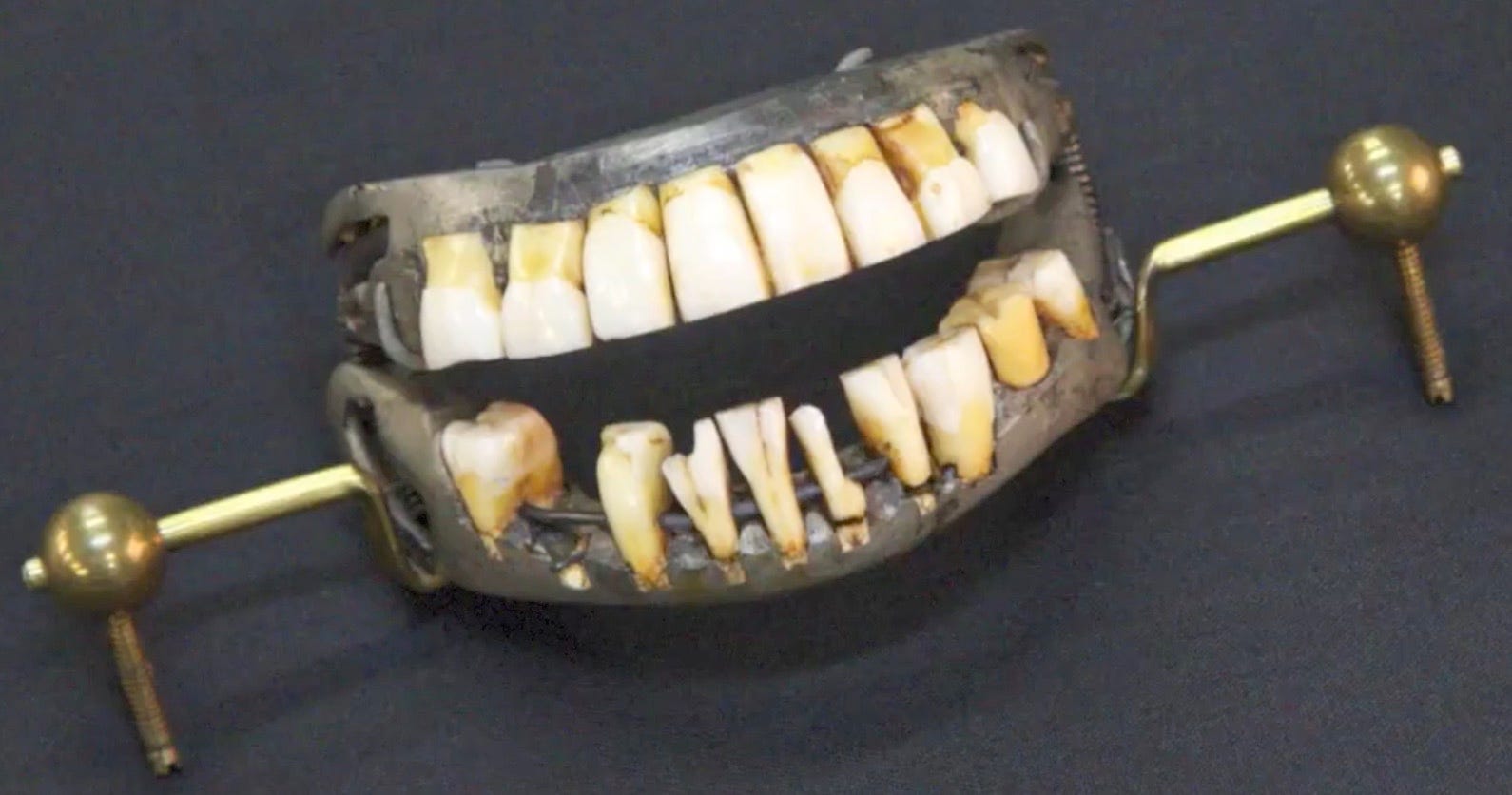
Washington lost his last tooth while he was President. None of his various dentures ever fit well, causing him problems like being reluctant to speak in public.
I wrote recently about how Washington’s mandatory smallpox inoculation measures were possibly critical in the eventual success of the Continental Army. An incident involving the General’s teeth helped deceive the British about Washington’s ultimately successful attack on Yorktown, Virginia.
A stolen letter and a lost battle
Washington had written to his dentist in Philadelphia asking him to send tooth cleaning tools, saying that he, Washington, wouldn’t be in Philadelphia soon. The letter was intercepted by the British and unintentionally helped convince them that Washington’s plan was to stay north and attack New York City. Because of this Cornwallis received no reinforcements at Yorktown and lost the battle to Washington, leading to the end of the Revolutionary War.
The very unpleasant, unethical makeup of Washington’s dentures
Those dentures the General was trying to take care of? Not wood, but the ivory bases were so brown-stained that an observer might think so. The teeth in various of Washington’s dentures consisted of a few of his own teeth that had been removed, along with “purchased” teeth extracted from people enslaved by Washington at Mount Vernon. Cow, donkey, and horse teeth were also used, along with ivory from a hippopotamus, a walrus, and maybe an elephant. The mandibles were spring loaded to open, and the teeth were embedded in lead, tin, copper, and silver alloys.
American oral health has improved a lot since Washington’s day
The huge increase in dental health began in the 1940s as the era of the ultra-processed was getting started with the technical innovations devised for military food. Two changes in dental care happened just in time to save our teeth, somewhat, from the flood of carbonated, sugared sodas and ultra-processed foods with refined starches and added sugars which was just about to come.
Give me 100 pushups and brush for two minutes
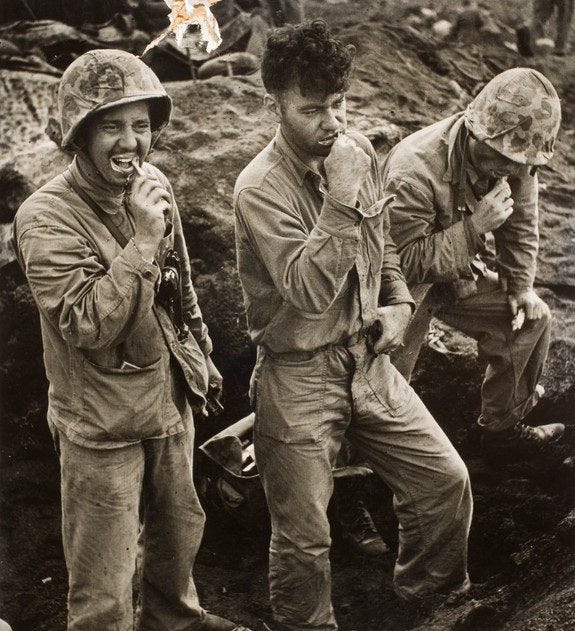
It was the military that changed American dental habits. Badly hampered in readiness by dental issues like Trench Mouth in World War One, the military made it a firm policy that troops in World War Two would brush daily. They were provided with toothbrushes and powder or paste, supplies that many, perhaps most, could not afford before joining up. Brushing was a habit brought back home in the 1940s by many millions of troops.
The other big change was fluoridated water. Fluoridation of the water supply was first tested in Grand Rapids, Michigan in 1945. In ten years, tooth decay in the city’s 30,000 school children had dropped 60%. Today over 209 million Americans receive caries protection from 17,400 fluoridated community water systems. Community water supplied populations which receive fluoridation range from an extreme low of 8.5% in Hawaii, mostly on military bases, to a low of 16% in New Jersey, to around 90% to 100% in many southern and rural states. Globally, 25 countries have fluoridated systems.
Tooth decay remains a public health issue
Despite these changes and big improvements, tooth decay, or caries, remains a public health issue because of all the pain, infections, time lost from work and school, loss of teeth, and costs. It’s the most common chronic disease in children, with half of nine-year olds having already developed caries. And for people over 65, one-quarter have severe tooth loss, meaning they have only eight or less teeth remaining. All the teeth are gone in fifteen percent of older Americans. Socioeconomic disparities and inequities continue to exist in oral health, particularly impacting poor children, but those disparities have tended to lessen as dental health has gotten better in America.
Tooth decay down 26% with fluoride in the water
Fluoridated water can reduce caries 26% in permanent teeth. This varies depending on factors like the use of fluoride toothpaste in a population or whether the water supply contains natural fluoride. Fluoride is the 13th most common element in nature and some community water systems and many private wells contain higher levels of natural fluoride than the low level added to fluoridated systems.
Fluorosis
Too much fluoride can cause fluorosis. In its mildest form, fluorosis can cause almost invisible white flecks on the teeth. Acute fluorosis comes with gastrointestinal problems. In a combination of data from 40 other studies, researchers found fluorosis to the degree of showing as spots or streaks on teeth, an esthetic concern, in 12% of people. Another study found that fluorosis is mainly diagnosed in children age five and under who might have swallowed too much fluoridated toothpaste.
Fluoride applied directly to the teeth through toothpaste or treatment at a dentist’s visit is by far the most effective method of delivering protection.
$120 billion on tooth care per year
In 2015, Americans spent $120 billion on their teeth and gums. That spending reduced productivity losses, which were still $46 billion. But fluoridation is the hero for dental return on investment. Every dollar spent on fluoridation decreased dental costs and productivity losses by $20.
From a public health standpoint, fluoridation is especially beneficial to those who can’t or don’t access regular dental preventive health services or don’t use fluoride toothpaste.
Despite the unquestionable and highly important benefits of fluoridation, community fluoridation is still an issue for many. The concern is not just fluorosis but also the potential risk to IQ.
IQ and fluoride
A recent analysis combining the results of other studies found a relationship between loss of IQ and increased level of fluoride from all sources. A big caveat of this analysis is that it did not include any direct data of the effect on IQ at the low level of fluoride added to community water systems. More research is needed around the possible effects of low levels of fluoride before the public health benefits of fluoridation are sacrificed.
In addition to fluoride in drinking water, toothpaste, or dental treatments to prevent cavities, dental sealants should be applied to the back teeth of children and young adults. Sealants can prevent 80% of cavities, and 9 out of 10 cavities are in the back teeth.
You are putting what in my mouth?
Throughout history the dental profession has promoted the use of various substances in our mouths which have been great for dental results but can be cringey when other health concerns are considered. Just drawing from the past 100 years, I am thinking of mercury amalgam fillings; BPA or Bisphenol A and a host of other toxic chemicals used in composite fillings, retainers, and sealant; Teflon for brace wires; arsenic to kill tooth roots; formaldehyde to remove the pulp in an infected baby tooth; and chloroform to dissolve the roots of teeth in a root canal operation. About the mercury and BPA-containing fillings: better than the molten lead fillings French dentists would pour as hot liquid into their patients mouths in the 1700s, right?!
And then there are the liberal x-rays, the radiation dose of which has been cut dramatically in the digital age.
Today, these toxic substances have been eliminated or greatly reduced in dental treatments. Of course, there are other materials and chemicals used in dental care outside the office. Almost all toothbrushes have nylon bristles that can shed microplastics. Dental floss is made of nylon or, much worse, Teflon, as in Glide floss. Even natural products maker Tom’s of Maine uses nylon in its floss.
Mouthwash and the possible negative effect on heart health
And then there’s mouthwash. The concern most worth considering is that anti-bacterial mouthwash wipes out beneficial bacteria in the oral microbiome. A 2023 set of papers reviewed the evidence and could not conclude if the effect of anti-bacterial mouthwashes, which can improve dental health, are harmful to overall health, mainly through killing bacteria in the saliva which help convert good nitrates from vegetables into nitric oxide in your blood. Nitric oxide is a vasodilator that relaxes your blood vessels, lowers your blood pressure, and is protective against heart disease. More research on mouthwashes is required.
Doctors and dentists: is having such separation good?
By the way, did your primary care doctor ever ask if you were seeing a dentist regularly or take a peek at your dental records? None of my doctors ever did. For dentists and dental insurers, it’s the opinion of the American Dental Association about the benefits of a treatment that most matters. The dental results come first, and the overall health perspective is not represented in our dental health choice making. The separation of dental care from other medical care in our society is probably not to our benefit. The division seems sort of strange.
The tunnel vision and the benefits of dental innovations
I don’t mean to be too harsh on the dental profession. Humans tend to look to new technologies for solutions without fully understanding the long term consequences. That tunnel vision has happened repeatedly in dentistry. Our FDA has long accepted this approach to the industrialization of our food supply, allowing all sorts of chemicals to corrupt our food without much scrutiny.
However, in contrast to what has happened with the gratuitous de-naturalization of the food environment, these dental technologies have given us much better teeth and gums, with less pain and cost and more comfort, beauty, and durability. But, yes, I asked about the amount of BPA exposure before I allowed the dentist to put sealant on my kids teeth.
Can I get a dental chair for my living room?
One dental technology cannot be quibbled with: the modern dental chair, which first appeared in 1958. For me, a dental procedure, even a cleaning, can be exhausting because of the potential for pain. Nonetheless, this year, in the middle of a long and very complicated root canal procedure, I fell asleep in the chair…while being worked on.
The “caines”
Thank goodness for the “caines.” Cocaine was a good local anesthetic for dentistry before the 20th century. I know how good it can be to numb pain locally. I once had an operation on my nose septum where the doctor used only cocaine, but plenty of it. I looked out from under the eye covering to see him pounding on my nose with a steel chisel and hammer. He asked how I was doing.


